Tuesday, 5 March 2013

2013: Animal Farm by George Orwell

Animal Farm by George Orwell, adapted for the stage by shake&stir theatre company (Brisbane), directed by Michael Futcher.  At The Q, Queanbeyan Performing Arts Centre, March 5-7, 2013.

Reviewed by Frank McKone
March 5

shake&stir is essentially a theatre-in-education youth theatre group – and young people came along in considerable numbers.  The applause from them and from those of us who are somewhat beyond youth was for a very satisfying piece of theatre, which made the message of Orwell’s famous cautionary tale absolutely clear.

All of us benefitted from a reminder to watch out for the con men and women of politics, especially when they spout slogans which morph mysteriously from All animals are equal to All animals are equal, but some are more equal than others!  There could be no more salutary lesson for us in this election year.

The success of this 90 minute adaptation relied on high energy precision in movement and voice by the cast of five, playing over 30 animal characters plus brief narration roles; and on equally high energy and precision in the sound track and visuals.  It was a joy for me to see multi-media and stage action thoroughly integrated, yet never becoming robotic (as I have seen in some children’s shows, for example, like Dora the Explorer performed to a pre-recorded tape).

Here, Ross Balbuziente, Nick Skubij, Tim Dashwood, Bryan Probets, and Nelle Lee (especially in her role of Molly, the horse who could not resist sugar, ribbons and a properly brushed mane) were all spot on in their timing and mood creation.  This Animal Farm was a revolution in action from go to whoa, never a comfortable fable of talking quadrupeds.  Or rather: Two legs Bad, Four legs (or two legs with wings) Good – or the chooks would never have stayed.

The set was quite extraordinarily complex, especially for a touring group to cart around the country.  It must be constructed as a huge jigsaw of pieces of myriad shapes and sizes, including speakers, lights and projector.  I can only admire the designer, Josh McIntosh, for his ingenuity – and the lighting designer, Jason Glenwright, and composer/sound designer Guy Webster – in making a set where actors, lights and sounds, and visuals on screens could all come and go in the right places at dizzying speed.

No roadie’s name is recorded in the program, so I presume everyone must be congratulated for amazing teamwork just to bump in and bump out.  Maybe Michael Futcher whips them all into place every night, unless they have all become as compliant as 457 Visa holders in the mining industry.  Whatever – it’s a great show for old and young to learn or re-learn Orwell’s warning.

© Frank McKone, Canberra


Wednesday, 27 February 2013

2013: Mrs Warren’s Profession by George Bernard Shaw


Mrs Warren’s Profession by George Bernard Shaw.  Sydney Theatre Company directed by Sarah Giles, Wharf 1 February 19 – April 6 and July 4-20, 2013.

Reviewed by Frank McKone
February 27 (matinee)


Mr Praed (pronounced 'prayed') - gentleman caller
 All photos by Brett Boardman
Frank Gardner - the son next door
Rev Samuel Gardner - the father next door


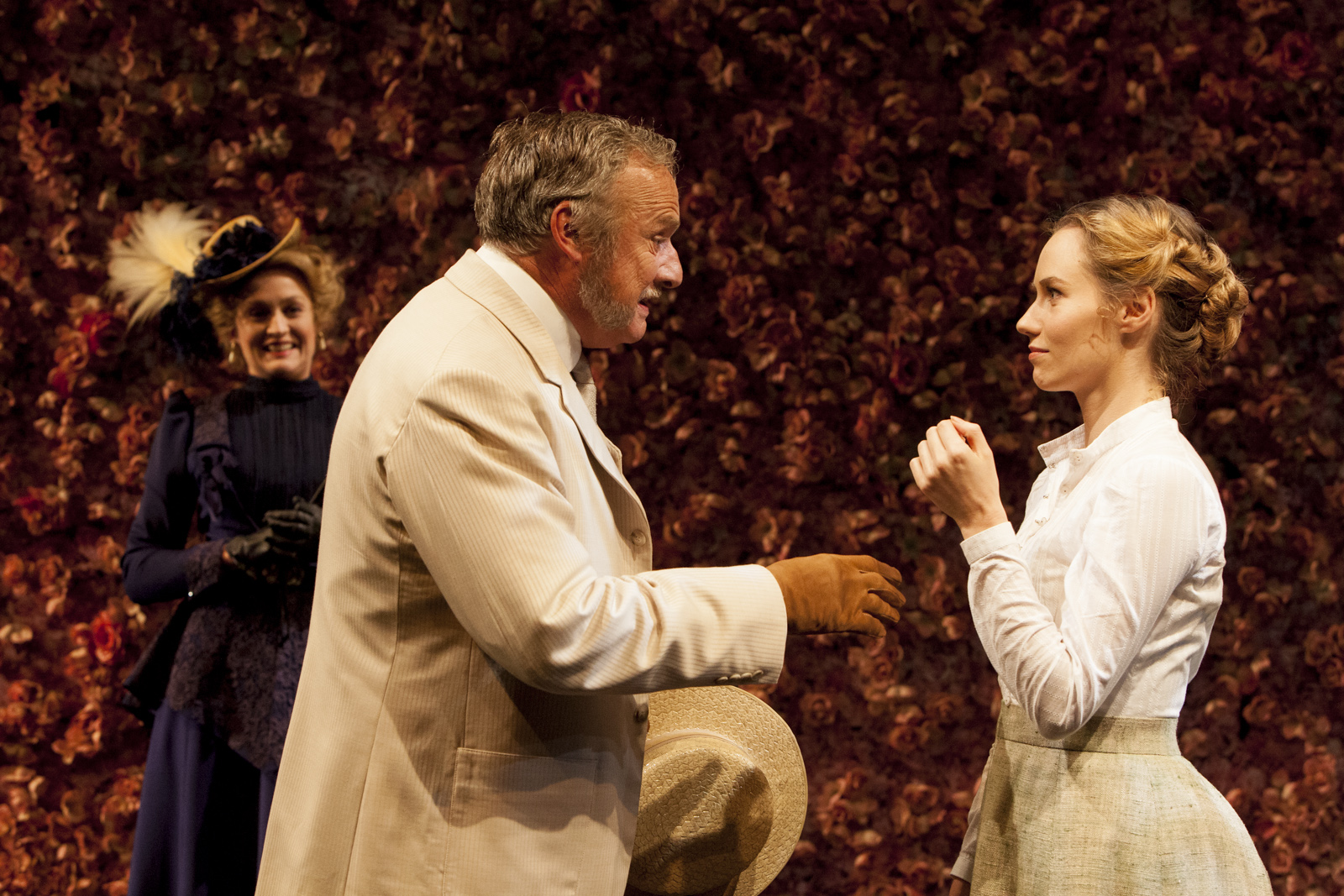
An innocent introduction: Mrs Warren, Crofts, Vivie Warren


Sir George Crofts (who ought to be kicked),  Vivie


Decision


Reconciliation?
Truth


Reality


This is a brilliant production which makes me acutely aware of the skills of the author, the cast and designers.  It is especially a triumph for Sarah Giles in her first mainstage production for Sydney Theatre Company.

The actors played exquisitely. While it is understandable, especially because of her final-scene speech and exit, that Helen Thomson receives star recognition as Mrs Warren, which she absolutely deserves, every other actor – Lizzie Schebesta (Vivie Warren), Simon Burke (Praed), Eamon Farren (Frank Gardner), Drew Forsythe (Rev Samuel Gardner) and Martin Jacobs (Sir George Crofts) – matched her precision of expression and language.  This is a perfect team for a play which still rings true after 120 years.

The basic designs for set and costumes seem to be based on the photos of the 1902 production by the Theatre of the New Lyric Club, when the official censor finally agreed – to a private club production, as Shaw wrote, “at last, after a delay of only eight years”.  (These photos appear in the 1912 Constable publication.)

But how clever and effective it was to make the garden backdrop into a curtain representing a full-height manicured hedge, and to change scenes using a slow-revolving stage which gave us not just a sense of time passing, but time to absorb the effects of the scene just ended.  So we were treated to the preservation of the period to which the play belongs, in a frame of modern staging technique.

Despite my long association with the work of Bernard Shaw I had never seen Mrs Warren’s Profession on stage and had wondered how it would work to construct the set as Shaw described it in considerable realistic detail.  The creative team of Renée Mulder (designer), with lighting designer Nigel Levings and composer/sound designer Max Lyandvert took the key elements from Shaw, playing with them in the open space of the Wharf 1 theatre and, in doing so, illuminated the relationships between characters more clearly, I believe, than Shaw’s original description would have allowed.

Finally I must explain my enthusiasm for the quality of expression and language in this production.  As Alex Lalak states, in one of the excellent essays in the program, “For George Bernard Shaw, the most important things in life were words.”  For many directors and actors over the past century, Shaw’s words have seemed a bête noir.  There are just so many of them!  So much philosophy!  How do we act these words?

The answer is to understand that Shaw was using words to both express ideas (of the characters) and expose the relationships between the characters, within a frame of social criticism.  Each laugh makes us think; each word tells us how the speaker is thinking and how the receiver of the words is thinking – and feeling – in response.

This is complex work for each actor.  This is not ordinary “naturalism”, where a Stanislavsky-style technique of recalled feelings can work.  This is writing by an author who is in charge of the effects on us in the audience – on both our thoughts and our feelings.  Shaw wrote, in “The Author’s Apology” for Mrs Warren’s Profession, “Give me the critic who has just rushed from my play to declare furiously that Sir George Crofts ought to be kicked.”

And, indeed, this was exactly the effect that these actors and this director achieved for this critic, at least.  Further than this, I felt proud that we have in the Sydney Theatre Company practitioners who do such good service to one of the greatest dramatic writers in English since William Shakespeare. 

And if you would like to know the source of the director’s note that Shaw stole the play from the famous actress with whom he had worked on Ibsen’s plays, check out A Companion to Modern British and Irish Drama: 1880 – 2005 edited by Mary Luckhurst: “A New Woman Drama” and Mrs Daintree’s Daughter by Janet Achurch – who was a remarkable woman indeed.


© Frank McKone, Canberra

Tuesday, 26 February 2013

2013: Henry 4 adapted by John Bell

David Whitney as Henry IV

Arky Michael, Felix Joseps, Yalin Ozucelik, Matthew Moore, John Bell, Terry Bader, Wendy Strehlow

Jason Klarwein as Hotspur, Matthew Moor as Prince Hal

John Bell as Fir John Falstaff

Matthew Moore as Prince Hal

Yalin Ozucelik, Matthew Moore, John Bell, Felix Joseps, Wendy Strehlow, Terry Bader, Arky Michael
All photos by Lisa Tomasetti

Henry 4 adapted by John Bell from Henry IV Parts 1 and 2 by William Shakespeare.  Bell Shakespeare Company, co-directed by John Bell and Damien Ryan, at Canberra Playhouse, February 26 – March 9, 2013.

Reviewed by Frank McKone
February 26

If this version of the Henry IV plays were a game of soccer (I’ve read that the Romans brought football to Britain, and it has flourished there ever since), I think the score would be Sir John Falstaff 7, Prince Hal 2.  Or maybe, sympathy for The People 5, appreciation of The Royals 0.

John Bell has selected material, directed the action and played the role himself so that the play seems to owe too much to Falstaff’s grandiose sense of his own importance.

This is not to say that Bell’s interpretation of Falstaff is at fault: in fact, I would say it is probably the best I can recall.  We see the full flowering of Falstaff, the con man, who uses all and sundry for his own benefit – and finally faces his justified come-uppance as the new king rejects his fawning attempt to gain high office. 

But the focus on the ordinary people weakened the importance – and the audience’s understanding – of the internecine warfare among the nobility, which in the end was Shakespeare’s real concern. 

It is the speech by Rumour, “painted full of tongues” – which opens The Second Part of King Henry the Fourth – which links the two parts.  The whole society is torn apart by Rumour which “is a pipe / Blown by surmises, jealousies, conjectures, / And of so easy and so plain a stop / That the blunt monster with uncounted heads, / The still-discordant wavering multitude, / Can play upon it.”

I can see Bell’s intention and some reasoning behind the setting of the play in a kind of modern England torn by the social strife of the recent riots, but Shakespeare set his play at a specific point in history, some 200 years before his own time, as a warning, I suggest, to those taking revenge on the basis of the rumour mill.  It’s probably more appropriate to see the parallel with our current parliament and the upcoming election, than to see much connection with the street-level destructive behaviour of the modern riots, just because Shakespeare used low-life scenes as comic contrast.

The most significant failure, to me, of this production was that the playing of Prince Hal lost the charisma, intelligence and strategic thinking which is central to his character.  Either Matthew Moore was not up to the part – and indeed much of his dialogue was not even to be clearly heard – or it was not considered necessary in the play’s direction to make sure that his words came through to us not as mere banter or drug-induced mish-mash. 

For example, when his father is ill, Hal says to Poins “By this hand, though thinkest me as far in the devil’s book as thou and Falstaff for obduracy and persistency: let the end try the man.  But I tell thee my heart bleeds inwardly that my father is so sick; and keeping such vile company as thou art hath in reason taken from me all ostentation of sorrow.”  He goes on to make clear that he has to think strategically about how “every man would think me an hypocrite indeed”. 

I can only fairly report that none of this text was delivered powerfully, so that we would understand how it could be that this apparently dissolute young man could turn around when necessary to defeat the Percy opposition, could face up to the responsibility his father’s illness and subsequent demise would place upon him, and show the kind of strength of character that would be seen by his brother John of Lancaster, now the Lord Chief Justice, when he says, as the play concludes, “I like this fair proceeding of the king’s. / He hath intent his wonted followers / Shall all be very well provided for; / But all are banish’d till their conversations / Appear more wise and modest to the world.”

Where was this strength of character and Hal’s ability to see through the “devil’s book” of Poins and Falstaff, while also understanding their humanity, which takes him on to become the Henry the Fifth of Agincourt?  I’m afraid it just wasn’t there. 

So, despite the success of the playing of Falstaff, the failure of Prince Hal to score left me disappointed with Henry 4.


© Frank McKone, Canberra

Wednesday, 20 February 2013

2013: Our Lady by the Beach over the Sea by Joe Woodward

Our Lady by the Beach over the Sea written and directed by Joe Woodward.  Shadow House Pits at the Courtyard Studio, Canberra Theatre Centre, February 20 – March 2, 2013.

Reviewed by Frank McKone
20 February

This is a new play of the many shadows of regret.  Through a number of his productions, Woodward has created his own genre of imagist theatre, where characters’ psychological shadows – in the Jungian sense – become physically represented.  What interests him is the interplay between the ordinary “external reality” and the fantasy “internal reality” as people live at once in the present and the past.

The central character, Jay, an old man apparently in a nursing home, is confronted – perhaps in either or both realities – with the woman who, at the age of 16, was for Jay the goddess of youth, Hebe.  Her real name is Em, perhaps Emma, and it appears in the final scene that she has sent her daughter, Nim, to find Jay – and to tell him that she, Em, will kill him.

I interpret this to mean that because Jay failed to turn his youthful infatuation into a permanent ideal love relationship, his memory – now obsessive fantasy – of what should have been, will be, in ordinary language, “the death of him”.

In disciplined and skilled performances, Em and Jay are played as externally realistic characters by Trish Kelly and Oliver Baudert, while Kat Bramston plays the fantasy “Young Em” as well as the externally real Nim.  Then there are a male shadow and a female shadow, Lycius and Lamia, from the poem Lamia by John Keats, who are also named Lucas and Mia, played by Andrew Eddy and Lucy Matthews.

The mood of this piece, rather more than in previous Woodward works, is melancholy – perfectly appropriate for Jay’s fixation on Keats’ poetry, since Keats’ source for the story of Lycius and Lamia was Robert Burton’s Anatomy of Melancholy.

For me there is an odd, though interesting, disjunction between the intention of imagist theatre – to build an identification in the audience’s feelings with those of the characters – with the reality that the images become mysteries that demand intellectual interpretation by the audience: thus preventing the viewer from responding emotionally while they try to work out what’s going on and what it all means.

I couldn’t understand much of the beginning scene or two, and only towards the very end found myself working out the probable story of Jay’s mental life – too late to identify with him, despite my being of his age (and even going through my own version of infatuation with a goddess in the nineteen sixties as he did – even on the occasional beach, indeed!)

Part of the problem is, I think – based on my own experiments in the past – that the imagist technique is rather cartoon-like in effect.  It’s often better for creating humorous effects, as in fact happened on a few occasions in this show, but too easily becomes tedious or confusing.

The only escape I can suggest is to write heightened poetic language for all the characters throughout the play, to provide an emotional “spine” to hang the living body on.  In Our Lady by the Beach over the Sea this was only done when Keats’ or Yeats’ poetry was being quoted, although the device of the video of the surf on the beach, reflected in the mirrors behind the action, worked in a limited way.  If the surf had changed at significant times from calm to storm, the image would have had more effect.

The music, by Damien Foley, was also quite effective in this way at times, but needed a lot more variety to push the drama along – like a good movie soundtrack, rather than an accompaniment.

So my conclusion is that Woodward has made an original and serious work in Our Lady by the Beach over the Sea, interesting for its ideas and imagist concept, but not entirely successful as a unified theatrical experience for the audience.

© Frank McKone, Canberra

Thursday, 14 February 2013

2013: The Secret River adapted by Andrew Bovell

 The Secret River adapted by Andrew Bovell from the novel by Kate Grenville.  Sydney Theatre Company directed by Neil Armfield at Canberra Playhouse, February 14-17, 2013.

Reviewed by Frank McKone
February 14

It’s difficult to write about a play when the depth of sadness in it leaves me in silence.

This – me: my place.  These are the final words of the tragedy that was, and still is, the dispossession and mass murder of Aboriginal people throughout Australia.  The sadness of The Secret River is that the invaders were themselves the dispossessed of London, saved from the gallows only by being transported for life.  Their only hope of survival was a ticket-of-leave and a plot of land – Aboriginal land.

My feelings turn even darker when I think that only yesterday – 200 years from the arrival the fictional William Thornhill and the real Solomon Wiseman on the Hawkesbury River – has our Parliament passed an Act of Recognition saying that in law the Aboriginal people were the First People of this land.  I noticed when the camera scanned the House of Representatives while the Prime Minister spoke, and the Leader of the Opposition spoke, giving bi-partisan support, the Opposition benches were almost empty.  How sad that those Members could not turn up and show real respect on such an occasion.

The tragedy, I’m afraid, is not over yet.

I was hoping from the pen of Andrew Bovell and the directing of Neil Armfield that Kate Grenville’s novel would be more focussed on stage; while perhaps its more epic nature as a novel tended towards diffusion.  Though at interval I felt unsettled because I could not feel sure of how things were progressing dramatically, the second half put everything together.

What Bovell has done is to concentrate on the essence of the novel.  The stage play doesn’t allow us to escape from the immediacy of the situation; while when reading we can stop and distance ourselves a little from our feelings.

The casting is excellent throughout, but I have to say that Ursula Yovich was quite extraordinary in her role of narrator, and her singing at the very end drove the tragic feeling into our very souls.  The whole audience remained silent in the stillness which is the mark of great theatre, and then responded especially, I thought, to the hope for the future that the curtain call represented, as the cast – themselves in reality from both sides of the divide in the play – were united in the success of the performance.


Set model for The Secret River
© Frank McKone, Canberra

Tuesday, 12 February 2013

2013: It’s Culture, Stupid! by Leigh Tabrett / National Arts Summit 2013. Comment article.


It’s Culture, Stupid!  Reflections of an arts bureaucrat by Leigh Tabrett is Currency House’s quarterly essay in the Platform Papers series for February 2013, serendipitously contemporaneously launched the day after the National Arts Summit 2013, which was held at Llewellyn Hall, ANU School of Music, Canberra on 12 February, ably MC’d by ABC ClassicFM stalwart, Christopher Lawrence.

Commentator: Frank McKone

“It’s my job, and it matters!”

With an efficiency dividend in mind, in this election year, I thought it best to consider both of these together since so much of Tabrett’s analysis has bearing on what was said by the Federal Minister for the Arts, Peter Garrett and the other speakers –

Robyn Archer (Creative Director of the Centenary of Canberra);
David Throsby (Professor of Economics at Macquarie University);
Lisa Colley (heading up business advisory services through the Enterprise Connect Creative     Industries Innovation Centre);
Hugh Mackay (well-known social commentator, former Deputy Chair of the Australia Council and inaugural Chair of the Australian Capital Territory Community Inclusion Board);
Don Aitkin (historian and political scientist, Foundation Chair of the Australian Research Council, former Vice-Chancellor of University of Canberra, and currently Chair of the ACT Cultural Facilities Corporation and the National Capital Authority);
Monica Penders (Director of ScreenACT);
Richard Gill (cuurently Artistic Director of the Education Program for the Sydney Symphony Orchestra, and Founding Music Director and Conductor Emeritus of Victorian Opera among many posts in a long and distinguished career);
Claudia Visca (Professor of Voice, University of Music and Performing Arts, Vienna, Austria);
Deborah Stone (Editor of artsHub Australia);
Julie Dyson (National Director of AusDance).

There was even a poem about a magnificent fart by Les Murray, Australia’s larger than life most ascerbic poet of the small indignities of human existence.

We needed the laugh, when, for example, the people near me were aghast as a music teacher in a Canberra Government high school explained that her budget to run a music department including two bands, with all the purchases and maintenance of instruments (including one instrument needing $300 for repairs) for 35 students was $1000.  I remember my budget for some 120 drama students, including managing a studio space and a 250 seat theatre was $4 per student per year – and then only after I put on a typical drama queen tantrum in the school’s finance committee.

It seemed to me, at this Arts Summit, that nearly 20 years since my retirement from that fray, little has changed.  Robyn Archer, as only she can do, made a rousing speech about courage in the face of the natural fear of performing, the inspiration “in a miraculous way” of the arts, and how they drive us to the great moral, ethical questions.

But I thought, in the whole morning’s talk, it was Deborah Stone’s report of the artsHub’s National Arts Survey that brought us to the greatest question, encapsulated in the quote from the practising artists, of whom, according to Don Aitkin, 99.9% “do something else for a living”.  They say:

“It’s my job, and it matters!”

The question is “What can we do about the community attitude in this country which accords the artist such a low status – despite the fact that everyone benefits from what artists do, from the design of the clothes you wear to the heights of the Opera House; despite the fact that participating in creative arts literally makes sad people happier (and even alleviates pain in hospital patients); despite the fact that the arts industry is economically huge.”

This was the issue that was clear from all the speakers.  But I thought another key concern was not articulated at the Summit.

Minister Garrett touched briefly on how the arts can be a medium for cross-cultural understanding, but did not develop the point that for a multicultural society to be successful, the arts – that is, all people having the opportunity and support for actively creating and appreciating arts – are essential.  Our multicultural success, which we love to pat ourselves on the back about, is under pressure from right-wing forces.  If multiculturalism gets no further than the Multicultural Festival we have just had over the last weekend in Canberra – largely still just a folkloric affair – then watch out for the next Cronulla Riot, and the continuing horrifying rate of deaths of Aboriginal people in jail.

Though one has to be cynical about political leadership, we can only hope that the Minister’s insistence that the combination of the Gonski reforms in education – to give every child fair resources across the country – and the full implementation of the new National Curriculum, in which every child will have continuing arts education (with a little help from our friend, the National Broadband Network), will make the difference for the next generation.  So long as the State Governments, who are constitutionally responsible for schools, he pointed out, come to the party.

Which, of course, raises the question of the other party who might win the next election in September.

And even then will we ever reach the stage, described by Richard Gill, of Finland?  There, he says, only those in tertiary music schools who are not good enough to be selected  as teachers, are then diverted into training as performers.  Imagine what that does to the status of arts teachers.  And down the track what it would do to the status of artists in the community.

Which brings me to the practical conclusions reached by Leigh Tabrett in It’s Culture, Stupid!  Reflections of an arts bureaucrat.

This is about the development of the National Cultural Policy.  She writes: “Unfortunately, our political system tends to put a very limited life on any policy developed by a single government.  I will try to suggest some mechanisms which might be more enduring than such a policy, and which might provide a basis from which national, state and local policy can be developed, and collaboration across levels of government can take place.”

To move towards a culture which is not so stupid, Tabrett suggests what we can do.  Check out www.currencyhouse.org.au for the full story.  I hope all political parties will have the sense to take up these suggestions:

A nationally agreed statement on the importance of culture and the purpose of public investment in culture.

And then, agreed statements on

Support for both makers and consumers;
A framework on the scope of arts and culture;
An accord between the Australia Council and the States [and Territories];
A change of focus in support for organisations;
New ways of using funds, and new sources of funds;
If we really want ‘whole of government’ involvement;
 And finally – A language of cultural value.

However ‘bureaucratic’ these sound, Tabrett, former Deputy Director-General of Arts Queensland from 2005 to 2012 explains what was not discussed or very much thought about at the National Arts Summit: that bureaucrats must work from policy documents which political institutions (in other words, politicians in parliaments) agree on.

We can only hope that the commonsense of a bureaucrat combined with the perspectives – and factual information – of the National Arts Summit speakers can be put together by a Federal Arts Minister who has himself (he told us so) had the experience of starting in his church choir, moving on to the folk scene and then becoming a successful (though probably still not very rich) pop-rock singer who presented himself as a person of conscience and concern for our relations with Aboriginal and Torres Strait Islander peoples and the environment.

And before September, if possible.

© Frank McKone, Canberra

Saturday, 2 February 2013

2013: Out of the Cabinet Shortis & Simpson


Out of the Cabinet  Shortis & Simpson at Speakers Corner, National Archives of Australia, February 2 and 3, 2013, 11am and 2pm.

Reviewed by Frank McKone
February 2

I trust this review of John Shortis’s work will not have the same dire consequences as the execrable review in Sydney of The Boiling Frog, for which John wrote the music at the original Nimrod Theatre in 1984.  He now claims that he was the cause not only of the failure of that anti-nuclear show, but also of director John Bell’s moving on, ultimately to form Bell Shakespeare, and of Nimrod moving from Nimrod Street, and its demise, to ultimately become Belvoir Theatre.

On the other hand, despite everything, in that same year, the destitute John had to be driven to work by Moya, his new employer, and love blossomed in her car, ultimately to form Shortis & Simpson, our very own and obviously much-loved at the National Archives, Canberran satirical duo.

So I suppose, objectively speaking, that John’s loss in 1984 was everyone else’s gain.  Artistically even for him, I’m sure – though he pointed out that in that year a musician’s income on average was $5000.  And it’s still the same today – for two of us, said Moya.

Over the several years that Shortis & Simpson have sung the history of the years past as the Cabinet documents are made public, one performance has grown to four.  The enthusiasm, nods of recognition, and a vote of at least 10 on the worm, evident in the applause today, showed why.

Of course the real purpose of our coming together at the National Archives of Australia was to hear Dr Jim Stokes tell the story of Government in 1984-85.  On the nuclear issue, with New Zealand denying access to US ships, since the US would not “confirm or deny” that they might be carrying nuclear weapons, and the French blowing up atolls in the Pacific, the Boiling Frog story is nothing compared with Malcolm Fraser, before the 1983 election, having secretly agreed to let the US test MX missiles – to hit the ocean about 220 kilometres east of Tasmania – while Bob Hawke managed to get the message through to Ronald Reagan that, however important the ANZUS Treaty was, public opinion might be difficult to manage if the MX test went ahead.

The test was shelved – and I found myself wondering what would have happened if an MX had fallen a little bit short and hit New Zealand.  Indeed, was the planned test meant to threaten David Lange, the NZ PM?

No wonder we needed Shortis & Simpson!

They lightened our day with clever humour, lyrics and music, but with the right degree of ‘edge’ – or more often the left – for this politically savvy audience.  They gave us the social life of those days through the popular music and songs, with I think the most amazing performance by Moya, from Leonard Cohen’s gutter-level gravelly voice to the high point of Madonna (that was after she had been rejected by Richard Attenborough when she auditioned for A Chorus Line).  And, especially for me whose hearing has never easily picked up pop song lyrics, I heard every word.  Now I know the rest of the lines of “Girls just wanna have fun!” – wonderful!


© Frank McKone, Canberra

Thursday, 17 January 2013

2013: Rian co-produced by Fabulous Beast Dance Theatre (Ireland) and Sadler’s Wells, London

                                                              Photo: Ros Kavanagh
Rian co-produced by Fabulous Beast Dance Theatre (Ireland) and Sadler’s Wells, London.  Director and choreographer, Michael-Keegan-Dolan; Music Director, Liam Ó Maonlaí.  Sydney Festival at Theatre Royal, January 17-23, 2013.

Reviewed by Frank McKone
January 17

I rather wish that highly expert directors/choreographers, like Michael Keegan-Dolan, and equally highly expert musicians/composers, like Liam Ó Maonlaí, would refrain from writing deep and meaningful romantic guff in program notes.

Rian stands, or rather dances, sings and plays, on its own two feet, without the need for justifications like “We dance to be reunited with the creative core from which we came” or “Myth describes the marriage of heaven and Earth again and again.  And so it is.  The sun and the Earth give us life....”

And the audience on opening night stood, not just to applaud the artistic quality of this Irish based World Music and Dance creation, not even in simple response to the emotional ebb and flow, culminating in energy pouring off the stage, but even more in thanks to a company who drew us all into an understanding of community.  The externalised world of our “modern” society was gently, and often amusingly, put to one side to allow our imaginations the freedom to see the world differently.

Here am I, a critic, ironically of course, writing: Just do it; don’t write program notes to tell us beforehand what we are supposed to experience.

What isn’t explained in the program is the title ‘Rian’, meaning trace or mark, in Irish.  My Irish ancestors probably escaped their west coast poverty for the bright lights and industrial poverty of London about 250 years ago.  Watching Rian makes me regret the move and imagine what I might have become.  I don’t have the language, or even the pronunciation, but I do still have ‘Rian’ – the trace that made me enjoy playing Australian folk tunes on my mouth organ after the latest move of our family to this country, where the lilt and rhythm of Irish song and dance has been a major part of the culture since the days of the convicts, many of whom were political prisoners.

What Liam Ó Maonlaí has done is to explore the world beyond Ireland, with, in this show, a particular focus on Mali, seeking the musical connections with ancient traditions, while Michael Keegan-Dolan has found a choreographic style of movement using traditional elements of Irish dance as a basis for expression of the joy, the fun, the sadness, and the exuberance of the music. 

This is nothing like the commercialised simplicity of ‘Riverdance’.  This is art reflecting real life back to us, with a cast representing many different cultural backgrounds.  The traces are in their names: Saku Koistinen, Saju Hari, Keir Patrick, Hannes Langolf, Anna Kaszuba, Louise Mochia, Ino Riga and Louise Tanoto.

Rian is an exemplar of the best presentations for this international Festival, currently directed by Belgian-born Lieven Bertels.  Bryce Hallett has written that he is “bold, eclectic and surprising” and is “driven to connect with audiences in meaningful ways, with an unconventional approach that promises to add even more colour to Sydney Festival’s much-loved palette.”  Rian definitely fits the bill.

See http://www.smh.com.au/entertainment/strength-in-diversity-20121025-286ja.html?skin=text-only for more from Bryce Hallett.

© Frank McKone, Canberra

Wednesday, 16 January 2013

2013: Urban by CIRCOLOMBIA

Urban by CIRCOLOMBIA.  Presented by Sydney Festival in association with Arts Projects Australia.  Artistic Director, Felicity Simpson; directed by Mark Storer; original theatre director, Jean-Yves Penafiel; Company Captain, José Henry Caycedo Cassierra.  Riverside Theatre, Parramatta, January 15-27, 2013.

Reviewed by Frank McKone
January 16

If you think of Circus Oz as quintessentially Australian (see my review of From the Ground Up in Canberra Critics’ Circle, October 5, 2012), then you can see Circolombia as playing a similar role for Colombia.  The origin of the company lies in the Foundation Circo Para Todos, founded by Felicity Simpson in Cali, Colombia in 1995; the establishment of a professional circus school specifically dedicated to underprivileged children; and its development into Circolombia producing shows and providing jobs for the graduates of Circo Para Todos – and spreading Columbian culture around the globe.

I contrasted From the Ground Up against the Cirque du Soleil as “no-bullshit Australian culture, which grabs our audience by the throat and makes us cheer the daredevils on, laugh, and be made aware of social justice all at once.  This is the art of Circus Oz”.  The same can be said of Circolombia in Urban.  Just change the culture.

Cali is a city very unlike Melbourne, and Colombia quite unlike Australia.  Before Urban gets the exciting daredevil circus action under way, while we wait for rather too many latecomers to be settled in their seats, a continuous video is shown taken through the back window of a bus on its route around Cali.  At a stop, a young boy – maybe 8 or 9 – jumps up on the rear bumper and hangs onto a rope, obviously permanently attached for people to travel on the outside.  Looking in, he notices the camera on the inside looking out, giving us the steady gaze of the already worldly-wise, rather than the cheeky grin of a child that we might expect.

The action begins with a white figure lying dormant in a dim spotlight, brought to life in stages by puffs of breath from a dark mysterious figure who disappears in the gloom.  The silvery white figure rises to find herself alone, leaving the stage apparently in search of something.  There is a pause, in blackout, then a great explosion of a dozen men, of racial backgrounds from almost effete whites in street-wise hip-hop gear, as you might see in New York, through to tall startlingly muscular Afro-Americans.  And they dance – do they ever dance! – to the ever-present reggae rhythm of South American hip-hop, in Spanish rhyme, with all the athleticism of that urban counter-culture.  Circus Oz looks rather sedate in comparison!

The men’s circus work was focussed on floor and tightrope tumbling and somersaulting, often up to heights where I was afraid they would hit the lighting rig, while the two women concentrated on aerial work.  I can’t tell from the program which of Diana Valentina Ramirez Londono and Julia Alejandra Sanchez Aja did which solo, but one was original, beautiful and scary on a high suspended ring and the other equally so on a slack rope trapeze which swung over the audience.  At least she was attached to a safety harness, but there was nothing to save the ring performer if she had come off  many metres above the stage.

As in Circus Oz, where Ghenoa Gela, a Torres Strait Islander from Rockhampton, told some of his story as an Indigenous person in Australia, we were told the story of poverty in Columbia by one of the men, whose Spanish name passed me by too quickly, but whose story was displayed in English on the screen, which was also used throughout the show as a backdrop.  Mind you, I didn’t often notice what was on the screen when people were flying through space, always with the threat of an injurious landing.

In the end, for me, Urban works because the danger and risk inherent in the circus represented the danger and risks that these performers grew up with in Cali, Colombia.  Here is where Urban diverged from Circus Oz.  From the Ground Up was an artistic metaphor with a highly positive view of multicultural Australian life.  I’m sure there must be aspects of Colombian culture which could be viewed in this light.  But Urban is about the underbelly of city life – which could also be shown about Melbourne, of course – and the endemic poverty out of which has grown the success, at least for these performers, of creating a show, as Felicity Simpson describes it, “at the forefront of a revolutionary new style of circus”.

And, to conclude, watch for the man (again whose name I can’t distinguish from the program) who gyrates as the hub of a large hoop, becoming a spinning and rolling human wheel.  This scene, his solo piece in the dance of life, almost in darkness as if the twirling of his body is an existential force, was not only powerful dramatically, but was so much more significant artistically than the equivalent physical exercise I have seen in Cirque du Soleil.

© Frank McKone, Canberra

Tuesday, 15 January 2013

2013: School Dance by Matthew Whittet


L-R Amber McMahon, Matthew Whittet, Luke Smiles, Jonathon Oxlade
School Dance by Matthew Whittet.  Windmill Theatre (Adelaide) at Sydney Theatre Company, Wharf 1, for Sydney Festival, directed by Rosemary Myers.  Composer, Luke Smiles; designer, Jonathon Oxlade; lighting, Richard Vabre; choreographer, Gabrielle Nankivell; animation, Chris More.  January 10 to February 3, 2013.

Reviewed by Frank McKone
January 15

I remember the 1980s.  My senior high school drama students began the decade still seeking the deep and meaningful within themselves in the final throes of 1970s ‘creative drama’.  By 1986 they were writing a new form of fantasy theatre, and wanted to be taught performance skills so they could show the stuff of their weird imaginations to the world.

And weird it is tonight indeed.  Here I am watching these drama students (not mine personally) a quarter of a century later putting all that learning and excitement, all those technical and acting skills that have become the assumed norm for the modern professional actor / dancer / singer / audio, lighting, stage and costume designer, on stage at the Wharf.  Wow!  It just so reminds me!

And, of course, I was also there, supervising the breathalyser machine at the door into the school social – the school dance – in the canteen.
The boys on their bikes


Since the writer, designer and composer also performed as the three boys at a school dance, about Year 9, and hardly prepossessing, there was every opportunity for nostalgia.  They even used their own names for their characters.  The images and sound are taken from the popular television and films they knew from their teenage days.  But what they have done is to create an original, whimsical, humorous and at times satirical fantasy about how a nerdy girl and boy become invisible, discover their attraction for each other and so become visible once more.

For a modern, young audience, the show works as an absurdist cartoon take-off of shows like High School Musical, while maintaining an integrity of understanding about teenage sexual attraction.  There is no Disney sentimentality here.

For the generation that these performers represent, now well into their thirties, the show is a light-hearted thoroughly enjoyable reflection on their younger days.

For an older generation again, such as mine, there is amusement in remembering that period, but in addition an awakening, or at least a re-awakening, to how social changes are encapsulated in the young, at the point of their breaking through into early adulthood.  And how each generation therefore has its own distinguishing character. 

To complete the cast, the boys need their menacing hulk nemesis, which Maori performer Jack Wetere creates wonderfully well – stopped in the end from destroying all, by Luke aiming the remote and pushing the pause button.

And, of course, they need a girl.  Amber McMahon justifiably was awarded an extra burst of applause tonight after playing all the necessary girls, invisible and visible, fantasy and real.  Her costumes were magnificent, and there was a palpable sense of amazement that she could get out of one and into another so quickly.

Choreography, and skilled dance and mime performance,  is the key to this show: several times tonight a dance sequence received spontaneous applause, as we might have responded to a jazz soloist or an operatic aria.

School Dance, then, is 75 minutes of thorough theatrical satisfaction – and you’ll be surprised to find yourself dancing out of the auditorium to an 80s beat.  The energy of this show is catching.
In the invisible world: Matthew Whittet, Amber McMahon as Danika
Amber McMahon as Joanie as the fantasy unicorn making an urgent phone call

 
Amber McMahon as Hannah Ellis

© Frank McKone, Canberra

Friday, 30 November 2012

2012: The Polyphonic Bard – Music and Shakespeare in our time

The Polyphonic Bard – Music and Shakespeare in our time The Pocket Score Company and Canberra Academy of Dramatic Art, directed by Tamzin Nugent.  Made in Canberra Season at The Street Theatre, November 30 – December 2, 2012.

Reviewed by Frank McKone
November 30

My reference for this review just has to be the Bach Guild / Vanguard recording BG-606 by the Deller Consort (Alfred Deller (countertenor), Wenzinger Consort of viols - August Wenzinger, dir., April Cantelo (soprano), Eileen McLoughlin (soprano), Desmond Dupré (lute), Taylor Recorder Consort, Gustav Leonhardt (harpsichord), Ambrosian Singers) titled A Musical Panorama of Shakespeare’s England.

This was my introduction, in 1963, to the fascinating strange harmonies of Renaissance songs, beginning with the ironic humour of “We Be Soldiers Three” included in this Pocket Score show.  One song not included, which I would have loved to hear and see performed, is Ben Jonson’s “Have You Seen But A Whyte Lily Grow”, a great deflator of the conventions of romantic love which would have fitted so well in this program.

And what an odd but interesting program this is.  It certainly fulfils the Made in Canberra description of diverse works mixing up new ideas in theatre, music, dance, opera, and interdisciplinary work in live performance.

I saw The Polyphonic Bard as having two purposes.  It is an “entertainment”, which means a lot more than being merely entertaining.  There are light-hearted episodes here, but set among themes concerning the nature of love, life and even death.

For the young students of the Canberra Academy of Dramatic Art, the top-quality 5-part singing of the Pocket Score team – David Yardley (countertenor), Paul Eldon (tenor), John Virgoe (tenor), Daniel Sanderson (baritone) and Ian Blake (bass) – provides a model for them to aspire to.  They have a long way to go at this point in their quest, but this public performance is an important step along the way.

Once upon a time, when I trained young people for tertiary training auditions, requiring a Shakespeare piece, of course, I used to explain how 5- or even 8-part singing took place in the pubs of London in Shakespeare’s day, and how those complexities of rhythm, harmony and stress patterns underlie the poetry of Shakespeare’s words.  These CADA students are lucky enough to learn in practice, from the Pocket Score Company, what I could only explain to my trainees.  But, of course, in today’s theatre world, all professional actors must be able to sing well.

Though the show is indeed “diverse” and a “mixing up”, the audiovisual and photographic work of Aaron King and Danielle Osomanski – not exactly of Shakespeare’s time – often added images to the speaking and singing.  Particularly effective, I thought, was video of (I assume) swirling drops of coloured inks, which metaphorically represented ideas in the words, especially when red seemed to show the blood of warfare.  This brought the experiences of Shakespeare’s period of history into the present – artfully, rather than as a blunt instrument, in keeping with the choice of sonnets and comedy in the spoken word.

I wasn’t so sure of the success of the use of hanging ropes – literally with hangman’s nooses – which provided something for the actors, and sometimes even the singers, to hang on to.  It is a simple idea (that means a good idea) and certainly raised thoughts of dangers, social strictures and death, behind words of comedy and love, but a choreographer was needed to work up a movement design which could have lifted the actors’ performances more “artfully” to match the video.

So, once again I have to thank the recently announced Artist of the Year, Caroline Stacey, for instituting the Made in Canberra program which “through partnership relationships...puts a spotlight on independent artistic activity in the ACT and has continued to evolve in response to artists’ needs and Canberra’s creative context”.  It does indeed, and The Polyphonic Bard is a good example.


© Frank McKone, Canberra

Wednesday, 28 November 2012

2012: Glory Box by Moira Finucane and Jackie Smith

Glory Box by Moira Finucane and Jackie Smith at The Street Theatre, Canberra, November 28 – December 8, 2012.
Reviewed by Frank McKone
November 28

Glory Box is the latest version of The Burlesque Hour which I reviewed in February 2009 in the Canberra Times.  Some items, like strawberries and blood-red soup, are still part of the show, but this show generally did not have the same bite as before.  Only the last major scene – “Miss Finucane’s collaboration with the National Gallery of Victoria (Get Wet for Art!)” – reached something like the satire of the Hour

Even so it was Yumi Umiumare, with her expertise in Butoh, who had been the standout in 2009.  She was missing in this action, and there was no-one to match her this time.

Of course, age may be wearying me, but Glory Box was more like a ritualised karaoke, broken by minimum (but well done) items on the trapeze and hula hoops.  And, though I had warned people back in 2009, I still forgot to take my earplugs.  The sound volume and oomph, oomph was perhaps even more penetrating this time around.

There was more nudity, too, but more nudity is less titillating, unless that’s just my age showing again.  Lots of other men in the audience cheered the swinging bits, though the women had no comparable male bits to cheer, since Paul Cordeiro was nude only for a brief discreet backside-to-the-audience exit.

The show is still funny and enjoyable, but in my view just not as engaging or thought-provoking as the original Burlesque Hour.  There were still plenty in the audience standing, stomping, clapping and dancing in what would have been a mosh pit in a larger venue – and buying Burlesque Underpants from the Glory Box on their way out.

© Frank McKone, Canberra

Wednesday, 14 November 2012

2012: Under Milk Wood by Dylan Thomas

Under Milk Wood by Dylan Thomas.  WildVoicesmusictheatre, directed by Dianna Nixon, composer Vanessay Nimmo, at The Street Theatre, Canberra, November 14-17, 2012.

Reviewed by Frank McKone
November 14

Since Dianna Nixon chose to present Under Milk Wood in a quite similar way on the stage to the very first performance of the Play for Voices (at the YMHA Poetry Centre, New York, May 14, 1953), I thought I should listen to my still serviceable vinyl recording as a comparison.

Different, but in some ways equal.  Dylan Thomas was commissioned by the BBC, and the “Y” performance was still a work-in-progress.  According to the sleeve notes, “The final scene was typed as the audience was being seated”!  And it was, of course, intended for and performed by adults.

Dianna Nixon has written “WildVoicesmusictheatre has been established to create and present music theatre events and activities with a commitment to cross-curricular arts pedagogy – alongside professional practice – and celebrating multiskilling.  Vocal and physical skills are central to our work.  Our pedagogy eschews the concept of talent, and instead we focus on relationships, process and long-term skills development – and on sharing our passion for the heritage on which performing arts practice is based.”

Like the “Y”, Nixon could never have afforded or found volunteers to present one actor per character, which would – as the sleeve notes say – “have given the impression of a local Philharmonic”.  As chance would have it the “Y” had only five professional actors available, plus Thomas who significantly played the 1st Voice and the Reverend Eli Jenkins.  Each one stood, still throughout except for when Thomas, on the advice of the actors, took two steps forward for Eli Jenkins’ morning prayer.  Nixon, on the other hand had her Voices for the main part seated, but with some movement carefully devised to add to the drama visually.

In her production, Nixon plays the 1st Voice and piano – she has a B.A., Music (piano) from VCA – while the other parts are played by six adult professional singer/actor/musicians: Nick Byrne, Tobias Cole, Dene Kermond, Kate Hosking, Zsuzsi Soboslay and PJ Williams, as well as 20 children.  Three teenagers, Bethany Stoney, Aidan Pierlot and Felicity Ward were the “Foley Team”, producing all the necessary sound effects devised by Vanessa Nimmo.  In the original recording there was a bare minimum of sounds beyond those heard in the imagination in response to Thomas’ poetic descriptions.

Watching this WildVoices performance I was reminded of the Goon Show.  This is in no way a derogatory thought, because it was quite fascinating, as it was for the Goon Show’s BBC studio audiences, to see the sounds being made live as the actors spoke.  In using a live foley team, Nixon has fulfilled her pedagogical aim.  The youngsters were learning the “heritage on which performing arts practice is based” – so much better than googling YouTube or downloading iTunes.

In taking this approach, and setting appropriate parts to music, Nixon has equalled Thomas.  At the same time, his more spare presentation did some things that Nixon’s softer more mellifluous approach doesn’t.  Partly because of time passing and Under Milk Wood now being a familar classic instead of a case of the shock of the new as it was in 1953, Nixon’s visit to Llareggub is almost a romantic trip.  For Thomas, as you hear in the recording, there is a hard edge behind the quaintness.  As the sleeve notes say (written by someone unfortunately unacknowledged) “Why the audience finds the motley crew of variously henpecked, overbearing, drunken, promiscuous townspeople so funny might be a study for psychologists, had psychologists not long ago determined that misfortune at this remove is cause for self-congratulation and laughter .... But the laughter is cathartic, too.”

Our applause on November 14, 2012 could not match that of  May 14, 1953 when Dylan Thomas’ “shy and stammered ‘Thank you, thank you very much’ is lost in the shouts of the audience.  The bravos come from people close enough to the stage to see the tears that rolled down his cheeks.”  But we justifiably applauded a quality production, beautiful, and a great learning experience especially for the children taking part.

Vinyl LP Recording: original recording by Caedmon; my recording by Philips B 94022 L / B 94023 L (2 records)


© Frank McKone, Canberra

Friday, 9 November 2012

2012: Empire by Graham Jones and Jepke Goudsmit

Empire by Graham Jones and Jepke Goudsmit.  Kinetic Energy Theatre Company at the Drama Lab, Australian National University Arts Centre, Canberra, November 8-10, 2012.

Reviewed by Frank McKone
November 9

The evening’s program, put together by Kinetic Energy based in Sydney, began with poems of social criticism – Poetry with a Punch – by local Canberra poets, Fiona McIlroy, Sandra Renew, Jill Sutton, Laurie MacDonald and Hazel Hall.

Though, as an introduction to the presentation of what was advertised as a “gritty play”, the staging of the poetry was very ordinary, with Jones popping on and off to adjust the microphone and no special lighting, MacDonald’s and Hall’s works particularly engaged the small mainly academic audience with humanity and art.

Following the poetry, in what might have been an effective lead-in to the play, the well-known A Chorus of Women sang the Lament by Glenda Cloughley and Judith Clingan, an anthem for peace which was first sung in the foyer of the Australian Parliament as the news was being broadcast of Australia’s decision to join the ‘Coalition of the Willing’ in invading Iraq.

Lament begins with the line “Open the doors of the chambers of your hearts”, but unfortunately at this point the doors of the Drama Lab were shut behind us for some half an hour while the stage was set for Empire.  Though this was an opportunity for coffee and cake and a preparatory visit to the toilets, the momentum was lost, as people stood about waiting in an unprepossessing back corridor in the bowels of the Arts Centre.

If the poetry and song had been staged well and incorporated into the total presentation, as Act 1, then the audience would have been warmed up to face the cold hard agit-prop approach of the main event, Empire, an indictment of the role the United States plays in the modern world as a democratic equivalent of imperial dictatorships of the past.

Unfortunately, dramatically speaking, polemical theatre of this most uncompromising kind is its own worst enemy.  This is not to say that the information presented was unbelievable – in fact I would assume that especially among this ANU audience there would be few who had not known the critical works of Arundhati Roy and Noam Chomsky, or had not understood the importance of the revelations of  the whistle-blower Bradley Manning, or of the horror of the helicopter gunship’s murder of Reuters journalists in Baghdad.

As a history presentation, however, and including the taped conversations of US Air Force pilots during the Vietnam War and the sermons of John Winthrop, a founding father of the attitudes of Americans as he brought ‘civilisation’ to Massachusetts in the 17th Century, Empire might be a useful education piece for teenage students.

As a theatre production for a modern adult audience it was simplistic, lacking in subtlety, poorly structured, often basically boring.  The only highlights for me were the fact that I got to see the whole of the footage of the helicopter gunship episode, and I enjoyed the quality of the musicianship of the young student wind instrument players.

I can’t say I enjoyed very much of the acting performances, except for the spirited young woman who confronted Noam Chomsky.  This was almost the only occasion when something like real drama was happening – but only for a brief moment, as she left the scene in frustration and Chomsky remained in control of the intellectual battlefield.

The central conception of the play, with Arundhati Roy and Noam Chomsky as talking heads, espousing their political positions – quoting from their public writings and interviews – was not a bad idea in itself, but without any development of their personalities and how they may have dealt with the personal challenges they must, in real life, face, we are left with no more than cardboard cutouts.

It was disappointing, considering the artistic sensitivity and dramatic structure which characterised Graham Jones’ work in his earlier days as director and choreographer of the Kinetic Energy Dance Company, to see him decades later associated with such amateurish writing.  The art of expression through dance demands subtlety in movement without words, which was once Jones’ strength.  A drama with speaking characters demands a wholly different set of skills, to write and to perform.  Technically, too, the use of video, on a screen sometimes masked by the actors, and with confusing text above and below the image, or with far too lengthy slabs of chatroom text, showed a surprising failure in stage design.  I miss the dance Jones might have created, and would rather not have seen this quite embarrassing attempt at a play.

Bringing back A Chorus of Women to conclude the program might have worked better as the other bookend, if their first performance had been given its proper place.  But their entrance was disorganised, where it could have moved us smoothly on into a more positive note, as was clearly intended by encouraging us to sing along to When People Start to Sing (by Janet Salisbury and Johanna McBride) with the words “When people start to sing / Things are changing”.  The Women’s voices were strong and harmonious but there was no strength in the audience participation.

I could at this point launch into a lengthy essay on the tradition of agit-prop theatre, from  Jaroslav Hašek’s The Good Soldier Schweik, through to Erwin Piscator’s success in 1920s Germany in having his middle-class audiences enthusiastically singing revolutionary songs after shows including film of war-time atrocities, and on, of course, to the famous Bertolt Brecht in plays such as The Resistible Rise of Arturo Ui.

I have no doubts about the sincerity and honesty of Graham Jones and Jepke Goudsmit.  These are necessary but unfortunately not sufficient conditions for the production of successful theatre.  Like mercy, the quality of good theatre is not to be “strain’d, / It droppeth as the gentle rain from heaven...”  In doing so it enlightens and persuades, as some of the poetry and singing did last night, but the raging storm of Empire certainly left me cold.

© Frank McKone, Canberra

Thursday, 8 November 2012

2012: Diva Sheila, the Eco Diva: Takin’ it to The Street by Kate Hosking


Diva Sheila, the Eco Diva: Takin’ it to The Street by Kate Hosking.  Lighting by Kelly McGannon.  At The Street 2, Canberra, November 8-10, 2012.

Reviewed by Frank McKone
November 8

Brave and honest are my keywords tonight: brave because she is honest.  In her story-telling sequences, Kate Hosking leaves herself with few of the protections (and none of the pretensions) of an actor playing a role defined by a script, since her words are her own about herself; while in singing her own songs and interpreting songs by others, her arrangements and accompaniment on double bass make her performance highly personal – and original.

Takin’ it to The Street is intimate theatre, chamber theatre, almost boudoir theatre.  The Street 2, small as it is, was rather too cavernous for this work.  So it took a little while for us to come to terms with the intimacy.  It was, I think, the quiet, angry-sad quality of her rendition of I was only 19 (by John Schumann) that drew us in to Hosking’s depth of feelings about the world she has grown up in – our world, of course.

I last reviewed Kate Hosking in The Jigsaw Company’s play for children Pearl Verses the World (May 19, 2012) where her performance was very effective within the conventional frame of acting.  As Diva Sheila, she has created a role which hovers on the tight-rope between acting and reality.  Her balance is impressive.  Her voice has a great range, in this show concentrated on a blues style which allows her feelings to play out through the lyrics.  There is a maturity in this work which augurs well for a continuing career already backed by a decade of international world music performances.

In her program, as a kind of subtitle to her work, she has written “Sometimes it takes a character bigger than yourself to say what’s on your mind”.  Diva Sheila is never too big for Kate Hosking’s high-heeled shoes.  They fit very well together. 

Diva Sheila is another success of The Hive, The Street Theatre’s writers’ development program.


© Frank McKone, Canberra

Tuesday, 6 November 2012

2012: Bare Witness by Mari Lourey

Bare Witness by Mari Lourey.  Performing Lines and the Bare Witness Company, directed by Nadja Kostich, designed by Marg Horwell, soundscape and music composed and played by Kristin Rule, lighting by Emma Valente, video by Michael Carmody, at The Street Theatre, Canberra, November 6-10, 2012.


Reviewed by Frank McKone
November 6

Immediately outside the auditorium is a small colourful sign saying “Thank you.  We hope you enjoyed the show”.  Ironic, even shocking, on this occasion.  Bare Witness is not meant to be ‘enjoyed’, but appreciated – for its theatrical inventiveness and for its theme, questioning the role of the war-zone photojournalist.

The structure of the play is simple in concept: we are watching a slide show in reverse, from Photograph 011 to Photograph 001, of pictures taken by photojournalist Dannie as she recalls and reacts to the memories surrounding each shot, from places and wartimes like Bosnia, Chechnya, East Timor.

Her picture of a blinded woman who did not know she was being photographed sells worldwide, establishing Dannie’s career, leading to international awards, while keeping her on the move.  Despite calls home to Australia when Dannie can squeeze them in, her mother keeps the seriousness of her illness secret.  When Dannie discovers her mother has died, she has been away from home for five years, obsessed with seeking out the best shot.

The ultimate photo is probably based on the execution by the Taliban of Daniel Pearl in 2002.

In the background, the video material is not straight documentary, but imagery obliquely relevant, such as of dogs – the dogs of war.  The soundscape is created amazingly by Kristin Rule using an amplified cello for both music and sound effects which complement each situation and mood.  The action is tightly choreographed stylised movement and voice, in a set and lighting which re-creates the image of photographing in war conditions.

The result is ‘total theatre’ – imagist in form, creating moods all the way from excitement (at winning prizes or selling pics to news agencies), wild release (when photojournalists meet together in some remote hotel), love (even in the midst of terror), respect (for each other’s professionalism), despair (in the face of impossible dilemma).

Australia is justly proud of its tradition of physical theatre, and this recent play is an excellent example.  For me some of the imagery was a bit too obscure, and I found the women (Daniela Farinacci as Dannie, and Eugenia Fragos as Violetta) much clearer to understand compared to the men whose diction was not as definite as my hearing needed.  But all the cast (the men were Adam McConvell as Jack, Todd MacDonald as Jacek and Ray Chong Nee as Jose) worked perfectly together in what was often as much a dance company as an acting company.

This is original work, coming out of the long-standing Melbourne theatrical culture, and very much appreciated – a very worthwhile inclusion in The Street’s program.

© Frank McKone, Canberra