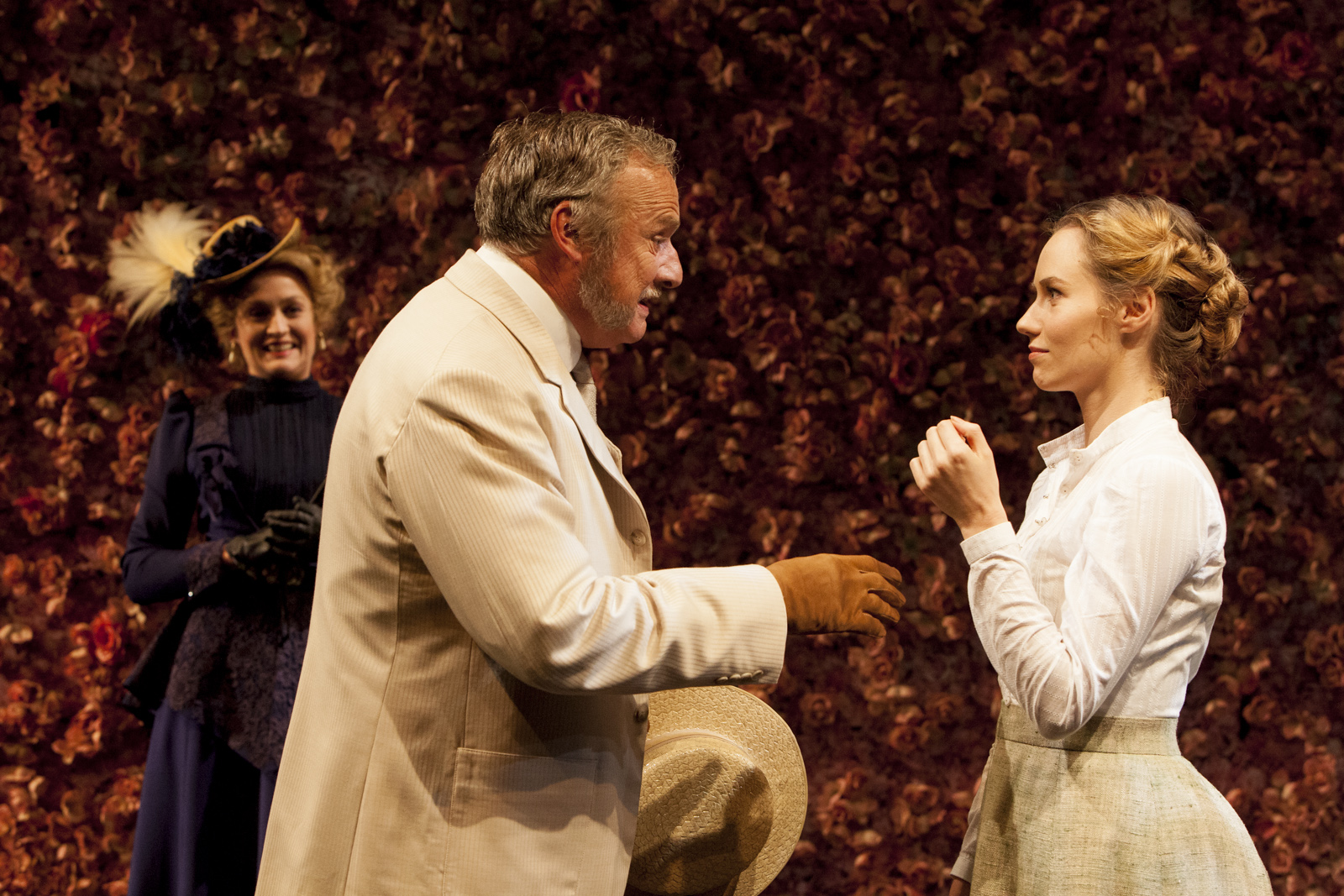
Friday, 5 April 2013

2013: Richard, Professor of Literature by Stéphane Georis and Francy Begasse

 Richard, Professor of Literature written and performed by Stéphane Georis; written and directed by Francy Begasse, at The Street Theatre, Canberra, April 4-7, 2013.

Reviewed by Frank McKone
April 5

Georis, visiting from Belgium, clearly works out of the French mime tradition and the European background of puppetry (which in England is represented by Punch and Judy).  I remember a puppet version of Blanc Neige for children in Paris some decades ago.  Somewhere there’s a memory of commedia dell’arte in Georis’ style as a comedian, as well.

I could say, street theatre at The Street rather than in the street :-)

The role of Richard, Professor (as in Professeur) of Literature is played by Georis as if he is not acting, but is merely a person talking directly to us – and interacting with the front row of the audience – out of role.  I’ve called him Professeur rather than Professor because his “lecture” on William Shakespeare’s Hamlet, Romeo and Juliet, and Richard III, is more in the style of a teacher of younger children than as a university academic.

But this is not a children’s show, though I would certainly recommend it for senior secondary students.  It deals with death as failure, death for love, and death for power.  It begins with the question “To be, or not to be” as an intellectual study of angst, works through the tragic sadness of the Montague and Capulet story, becoming gross in the gore of chopping up fresh meat to represent the Lancaster and Plantagenet families’ murderous history.

The lesson’s conclusion is “Why don’t we just stop the killing?”

Yet, to reach this conclusion, Richard uses his books, newspapers, cooking implements and ingredients (I could call this “kitchen bench drama”) to create the characters of Hamlet, Romeo, Juliet – and finally a piece of meat for Richard III, while he himself travels from point to point in time and space on a motorbike (or rather on a Vespa motor scooter as I imagined it).  As well, the Professor wears hats and masks, playing himself and William Shakespeare – every now and then revealing himself to remind us “It’s me”, like playing peek-a-boo.

So we are at times a bit embarrassed by his childishness, yet we can’t stop laughing at his ridiculousness – and nor can we ignore his message: don’t take things or ourselves too seriously, for that’s how we end up killing people.

I can only agree with the quote in the program notes from Ouest-France reviewing Richard, le polichineur d'écritoire, de Stephane Georis: “ingenious, full of surprises and screamingly funny.”  Just watch his upside-down coffee pot tell you about Life, and you’ll see what I mean.

© Frank McKone, Canberra

Thursday, 4 April 2013

2013: An Idea Takes Flight - NIDA (National Institute of Dramatic Art) showcase

An Idea Takes Flight: showcasing the work of NIDA’s Directing, Acting, Costume, Properties and Production students and graduates.  At Gorman House Arts Centre, Canberra, April 4-6, 2013

By Frank McKone
April 4

The NIDA (National Institute of Dramatic Art) showcase consists of an interesting exhibition of costumes, set and costume designs and portrait paintings, and three short performances: Play House by British playwright Martin Crimp; selections from I Love You, You’re Perfect, Now Change! by US musical team Joe DiPietro and Jimmy Robert; and a solo peformance of Roal Dahl’s children’s story, The Witches.

The visual art work in the exhibition was excellent quality, as were the skills demonstrated in the technical work in lighting and sound, the live musicians in I Love You..., and the acting, but I felt rather as though I was watching an audition session.

When I looked more closely at the program notes by NIDA’s Director/Chief Executive Officer, Lynne Williams, I found that the only purpose of the tour is to give experience to the creative and production teams, led by three of the six directors who studied and graduated from NIDA in 2012 – Luke Rogers, Derek Walker and Lucas Jervies.

Each of the actors and the musicians is labelled ‘Guest Artist’, but without biographies or any other kind of recognition.  Very strange!

The pieces chosen for what now I understood to be demonstration exercises were suprisingly light-weight.  Play House was a good exercise for the actors Sam O’Sullivan (Simon) and Kate Skinner (Katrina) who competently handled the instant changes of relationship; I Love You... required strong singing and musical comedy skills, again well demonstrated by Nat Jobe, Simon Brook McLachlan, Cinzia Lee and Canberran Amy Louise Dunham; while Guy Edmonds playing all the roles in a quite manic mime/movement format in The Witches turned the children’s story into almost a holocaust scenario.  Here the director, Lucas Jervies, tried too hard: Edmonds had to work hard to keep up the momentum when simple story-telling would have done the trick.

But since the actors were not the point of the productions, I’m left having to wonder why NIDA chose these items.  Surely there is Australian writing, for a start, of much greater significance than any of these pieces.

According to Lynne Williams’ notes “The recently launched National Cultural Policy ushers in an era of renewed vision for the arts in Australia.”  Really?  If this is meant to be NIDA’s contribution – and I assume that bringing the “showcase” to the Federal Capital has something to do with policy pushing – then I couldn’t see any “vision” taking flight here.

© Frank McKone, Canberra

Wednesday, 20 March 2013

2013: Thursday by Bryony Lavery

Thursday by Bryony Lavery.  Brink Productions and English Touring Theatre, director/dramaturg: Chris Drummond.  At Canberra Playhouse, March 20-23, 2013.

Reviewed by Frank McKone
March 20

Before seeing this play I chose to avoid reading any details of the story of Dr Gill Hicks who lost both her legs in the London bombing of the train taking her to work in 2005.  I had also missed hearing or seeing interviews she gave, including the one on Enough Rope which stimulated the interest of Chris Drummond and led to the cooperative venture between these two theatre companies, one in Adelaide – Dr Hicks’ home town – and the other in London, where she works.

I did not want to find myself judging how correctly the play told her story.  I was hoping for a play, based upon her story, but standing in its own right as an artistic work.  And, indeed, that’s what I saw tonight.

The structure of the work is from the general to the particular, beginning that Thursday with an intriguing picture, almost like a movie where the camera shots from many different locations can be juxtaposed to make a montage in motion of the lives of the people and their partners who, by chance, became placed on that train jam-packed next to the suicide bomber.

After the explosion, which was imaginatively – and very effectively – represented in movement and light rather than excessive sound, the work draws in bit by bit to focus on Rose, based on Dr Hicks, played by Kate Mulvaney, until she walks again in the company of all those who have given so much of themselves to help another human being.

As a work of art, it was the originality of the staging, the characterisations and especially the use of heightened language which made the play work for me.  The approach to presenting what could have been a purely melodramatic plot – however true to actual events – was like using lights from oblique and unexpected angles, rather than obvious spotlighting.  The language, and a figure representing Death working to persuade Rose to depart with him, kept our conventional reactions at bay, just enough to see and feel in response, yet not to be overwhelmed by emotion.

To achieve this, Laverty writes “If I had the choice, I would always make a play in the Brink way....I always felt Chris [Drummond] and I were making it together.”  She makes it clear that “We were turning fact into fiction and those two states are empirically different....  One is random, the other is constructed.”

Yet the art is that the constructed fiction tells us so much more about the nature of the real experience than any news report.  And the artistry of all the actors met the demands of the writing.  The result was demanding but exhilarating theatre, a great confirmation of Dr Gill Hicks’ words: My hope is that Thursday will make us more conscious of the everyday and the intricacy of our interconnected relationships, whether that be with those we know and love, or with strangers.

Not to be missed.

© Frank McKone, Canberra

2013: Vakomana Vaviri Ve Zimbabwe (Two Gentlemen of Verona) and Kupenga Kwa Hamlet. Feature article.

Tonderai Munyevu, Denton Chikura, Arne Pohlmeier in rehearsal
 Two Gents Productions Approaching End

by Frank McKone
March 20, 2013

Two Gents Productions is a cross-cultural theatre company based in London.  In Canberra at The Street we are seeing its penultimate program of Vakomana Vaviri Ve Zimbabwe (Two Gentlemen of Verona) and Kupenga Kwa Hamlet, before the company’s final season on international tour in May 2013.

I was fortunate to catch them between performances, wondering how it came about that a freelance director named Arne Pohlmeier has worked with actors Denton Chikura and Tonderai Munyevu since 2007 on Zimbabwean interpretations of Shakespeare.  Why Shakespeare?  Why Zimbabwe?  And, as it turned out, why Pohlmeier?

Arne Pohlmeier is German born, but spent his childhood in Cameroon, was educated in the US and lives in London.  This is the source of his concern with the migration experience.  What does it mean to leave one culture and join another? 

Travel back to Africa took him to Johannesburg, by this time as a theatre practitioner, where the idea began for a project exploring Shakespeare from a different cultural perspective.  Back in London, he found Shona-speaking actors rare.  Munyevu had come to London after a childhood in Zimbabwe and still had family connections there.  Chikura, after seven years’ insistence by his parents in London that only English must be used at home, came seeking work with much better English than Shona.  So the three began work, with little money, but what turned out to be a highly successful idea: Not only were we able to see the production (Vakomana) through a successful run at one of London’s premier fringe venues, the Oval House Theatre; but we were also able to honour invitations to perform at such exciting events as the 10th anniversary Harare International Festival of the Arts; The Market Theatre Laboratory’s 20th anniversary celebrations (in Johannesburg); and the celebrated Shakespeare Festival in Neuss, Germany.

They explained to me that the first production was, in my words, from outside in.  The two actors were exploring, in a collaborative style, to find ways of using their Shona traditions to express Pohlmeier’s idea.  But in doing this, both Munyevu and especially Chikura had to re-discover their culture, travelling back to Zimbabwe as adults.  For Munyevu the experience was more a matter of remembering, than re-learning; but Chikura found that he was treated and felt like a tourist – even having to pay ‘white’ prices because people heard his London-accented English and saw him dressed as an outsider.

Then, as work progressed, the next production became an inside out exploration of Hamlet, starting from the father-son relationships of Shona culture and connecting from that beginning with the story of Hamlet, his father and his uncle.

In this process, a new show telling the personal story of Munyevu’s return to Zimbabwe was devised by the group, called Magetsi.  This brings directly home to viewers the traditional storytelling style incorporating dance, voice calls, and drums, as well as words, which is used  in the Shakespeare works, now also including The Moors Project focussing on the black characters in Shakespeare’s plays: Othello, the Prince of Morocco from The Merchant of Venice, and Titus Andronicus.

There was such a strength of connection between the three as I spoke with them, grown from five years’ working together, understanding their different perspectives and finding such powerful forms of expression on stage, that I was quite shocked to find that Chikura now has a young daughter – to whom he speaks Shona every day – and not only will finish up with Two Gents in May, but will even give up acting in favour of a stable home life instead of touring as an actor must; while Pohlmeier is already working with a new group in Cameroon to explore his childhood experiences through a classical German text; and Munyevu simply says he will be ‘unemployed’.

I’m sure that the skills and experience they have gained over these five years will mean they all have a interesting future to look forward to, and I thank them for a conversation which opened up for me the beginning, the heights of the middle, and the necessary end of a professional and deeply committed theatre company.
www.twogentsproductions.com/ for further reading.
Denton Chikura
Arne Pohlmeier

Tonderai Munyevu
© Frank McKone, Canberra


Tuesday, 19 March 2013

2013: It’s My Party (And I’ll Die If I Want To) by Elizabeth Coleman


It’s My Party (And I’ll Die If I Want To) by Elizabeth Coleman.  Produced by Christine Harris & HIT Productions.  Directed by Denis Moore, designed by Shaun Gurton, sound by Chris Hubbard, costumes by Adrienne Chisholm.  At The Q, Queanbeyan Performing Arts Centre, March 19-27, 2013.

Reviewed by Frank McKone

Superficially an entertaining farce involving revelation, death and resurrection, It’s My Party... has a little something extra.  Elizabeth Coleman, in this – her first full length play – skilfully, smoothly, shifted the mood from laughter (on our part) at the characters’ family wrangling to moments of silent recognition of the truth of each adult child’s accusations against their father, and back to laughter in no time at all.

Quality writing gave all the actors every chance of establishing strong characters and clear relationships, and every one of the family members – Henri Szeps (father, Ron Patterson), Robyn Arthur (mother, Dawn Patterson), Trent Baker (son, Michael), Sharon Davis (elder daughter, Debbie) and Freya Pragt (younger daughter, Karen) – took full advantage of the offer.  Though Szeps is so well-known that he was applauded just for appearing on stage, there was no prima donna in this ensemble performance.

In the end (literally) the role of the undertaker, Ted Wilkins, emphasises the farcical nature of the situation but introduces a character from outside the web of the family’s relationships.  The writing is not so strong here, and I thought Matt Furlani could have made this character rather more absurdist in style to make the point.

One of the delights of this production was the set designed by Shaun Gurton.  Though the drama takes place in an internal room, above the “walls” are trompe-l'oeil pictures of the tiled roofs of the suburban house – at least I assume they were painted flats rather than the complete 3-dimensional structures they looked like.  This cleverly established for us, with the furniture in the room, the small business lower middle class status of Ron Patterson, stationery shop proprietor. 

Though first produced at La Mama in Melbourne 20 years ago, with a little updating of some references, It’s My Party... still works well as a study of the changing generations.  Even if our adult children don’t use Blackberries much any more, the question Ron wants to have answered by them – was I a good father? – is still relevant, and their answers are just as funny, or devastating, as ever.
Henri Szeps as Ron Patterson
© Frank McKone, Canberra

Friday, 15 March 2013

2013: The Chalk Pit by Peter Wilkins

The Chalk Pit by Peter Wilkins.  The Acting Company directed by Tom O’Neill at the Courtyard Studio, Canberra Theatre Centre, March 15-16 and 20-23, 2013.

Reviewed by Frank McKone

Based upon Wilkins’ research into the history of the Hon Thomas John Ley,  Parliamentarian and Minister in NSW and Commonwealth governments in the 1920s and 1930s, this play is a lengthy narrative displaying the personality of a charismatic murderer – a psychopath.  To this end, I must give credit where it is due: to Craig Higgs, who successfully presented this worst kind of politician.  His carefully managed charm covering up his megalomania, his corrupt dealings, gradually releasing more of his essential violence as life deals its inevitable disappointments, was well done.

Otherwise, what has been a long term project for Wilkins, which began in 1986 with a chance discovery of Ley’s papers at the National Library of Australia, to cover this quite extraordinary story from the 1890s to Ley’s death in Broadmoor Prison in 1947, still needs a great deal of work – to trim and focus the drama, and to establish a consistent style.

In the first half I was strongly reminded of the 1953 folk musical by Dick Diamond, Reedy River.  There were the rambunctious bush characters, fighting for their various political causes (in Reedy River’s case around the 1890s Depression and the Shearers’ Strike), the political speeches, the softer and sometimes grim tones of Henry Lawson’s poetry (such as The Faces in the Street), and a propensity to burst into song.  Though I came to Australia a couple of years after the New Theatre staged Reedy River, I quickly absorbed this traditional culture through songs like The Ballad of ’91 from the 10” Diaphon LP which I still have, and was grateful to see the whole play performed at the National Folk Festival a few years ago.

But even in the first half, the writing in The Chalk Pit could not match Reedy River.  Dee Sheville, the singer, and Sabrina Tesfouxis on piano, had an unenviable task.  Only once, as Miss Collins, did Sheville’s singing have a role to play in the action – when invited by Ley to sing to the crowd to follow his rousing electioneering speech.  After that, songs – usually only snatches of song – were interspersed among the dialogue, sometimes with some relevant words but often with no apparent purpose beyond filling in a gap.  In Reedy River all the traditional songs are integral to the action and mood of the play, and in fact drive the drama along.

The Lawson poems might have had a better impact if they had been given much more stage prominence, rather than coming from spaces outside the central acting area.  Though Martin Hoggart and Kristy Richardson tried hard, their skills as performers were not good enough to overcome the staging.  Lawson’s poems are powerful enough to have been used as deliberate action-stoppers which reflect critically at each point in the life of John Ley.  Perhaps this was the intention, but it was lost in this production.

By interval, the first apparent ‘suicide’ by one of Ley’s opponents, but probably a murder, has taken place.   If we were to pick up the folk drama tradition, we could expect the second half to expose Ley as he becomes step by step more paranoid, more aggressive, more violent, and literally more murderous.  The style for this development might use a melodrama form, or of course move into something Brechtian as in Mother Courage and her Children, the climax of which is devastating.

But it seems that Wilkins became tied up in the minutiae of the truth of Ley’s story, which moves to England and becomes almost a comic Cockney cop story with a detective who says things like “I can feel it in my bones” that Ley is guilty of murdering John McBain Mudie, with a representation of the Old Bailey trial full of cliché lawyers and seeming to belong to some early 19th Century court rather than anything like one which would have taken place in 1946.

Along the way, the genre shifted dramatically towards artifices like having Ley arguing with both his wife – in Australia – and his mistress – in London – as if they were in the same time zone.  And, finally, we see the device where characters from his past throw up at him remembered words, I suppose reinforcing his paranoia, while he declines and dies isolated in the insane section of Broadmoor Prison, ironically escaping being murdered by the State after all.

Were we supposed at this point to feel empathy and sympathy for this psychopath?  Hardly, especially after a tedious, far too long, second half.  We had been spoken to, during the court scene, as if we were the jury, but on the evidence in this script, I was certainly somewhere beyond reasonable doubt, not about Ley, but about the play.

It’s a shame, since the virtually unknown story of this figure, elected to both the NSW and the Federal Parliaments – and therefore a warning to us all for the need to be very, very careful about those who would claim to represent us – should be made into a drama for our times.  This will be a demanding task - as the effort that Wilkins has already put in shows.  It needs, perhaps, an Andrew Bovell.

© Frank McKone, Canberra

Tuesday, 5 March 2013

2013: Animal Farm by George Orwell

Animal Farm by George Orwell, adapted for the stage by shake&stir theatre company (Brisbane), directed by Michael Futcher.  At The Q, Queanbeyan Performing Arts Centre, March 5-7, 2013.

Reviewed by Frank McKone
March 5

shake&stir is essentially a theatre-in-education youth theatre group – and young people came along in considerable numbers.  The applause from them and from those of us who are somewhat beyond youth was for a very satisfying piece of theatre, which made the message of Orwell’s famous cautionary tale absolutely clear.

All of us benefitted from a reminder to watch out for the con men and women of politics, especially when they spout slogans which morph mysteriously from All animals are equal to All animals are equal, but some are more equal than others!  There could be no more salutary lesson for us in this election year.

The success of this 90 minute adaptation relied on high energy precision in movement and voice by the cast of five, playing over 30 animal characters plus brief narration roles; and on equally high energy and precision in the sound track and visuals.  It was a joy for me to see multi-media and stage action thoroughly integrated, yet never becoming robotic (as I have seen in some children’s shows, for example, like Dora the Explorer performed to a pre-recorded tape).

Here, Ross Balbuziente, Nick Skubij, Tim Dashwood, Bryan Probets, and Nelle Lee (especially in her role of Molly, the horse who could not resist sugar, ribbons and a properly brushed mane) were all spot on in their timing and mood creation.  This Animal Farm was a revolution in action from go to whoa, never a comfortable fable of talking quadrupeds.  Or rather: Two legs Bad, Four legs (or two legs with wings) Good – or the chooks would never have stayed.

The set was quite extraordinarily complex, especially for a touring group to cart around the country.  It must be constructed as a huge jigsaw of pieces of myriad shapes and sizes, including speakers, lights and projector.  I can only admire the designer, Josh McIntosh, for his ingenuity – and the lighting designer, Jason Glenwright, and composer/sound designer Guy Webster – in making a set where actors, lights and sounds, and visuals on screens could all come and go in the right places at dizzying speed.

No roadie’s name is recorded in the program, so I presume everyone must be congratulated for amazing teamwork just to bump in and bump out.  Maybe Michael Futcher whips them all into place every night, unless they have all become as compliant as 457 Visa holders in the mining industry.  Whatever – it’s a great show for old and young to learn or re-learn Orwell’s warning.

© Frank McKone, Canberra


Wednesday, 27 February 2013

2013: Mrs Warren’s Profession by George Bernard Shaw


Mrs Warren’s Profession by George Bernard Shaw.  Sydney Theatre Company directed by Sarah Giles, Wharf 1 February 19 – April 6 and July 4-20, 2013.

Reviewed by Frank McKone
February 27 (matinee)


Mr Praed (pronounced 'prayed') - gentleman caller
 All photos by Brett Boardman
Frank Gardner - the son next door
Rev Samuel Gardner - the father next door


An innocent introduction: Mrs Warren, Crofts, Vivie Warren


Sir George Crofts (who ought to be kicked),  Vivie


Decision


Reconciliation?
Truth


Reality


This is a brilliant production which makes me acutely aware of the skills of the author, the cast and designers.  It is especially a triumph for Sarah Giles in her first mainstage production for Sydney Theatre Company.

The actors played exquisitely. While it is understandable, especially because of her final-scene speech and exit, that Helen Thomson receives star recognition as Mrs Warren, which she absolutely deserves, every other actor – Lizzie Schebesta (Vivie Warren), Simon Burke (Praed), Eamon Farren (Frank Gardner), Drew Forsythe (Rev Samuel Gardner) and Martin Jacobs (Sir George Crofts) – matched her precision of expression and language.  This is a perfect team for a play which still rings true after 120 years.

The basic designs for set and costumes seem to be based on the photos of the 1902 production by the Theatre of the New Lyric Club, when the official censor finally agreed – to a private club production, as Shaw wrote, “at last, after a delay of only eight years”.  (These photos appear in the 1912 Constable publication.)

But how clever and effective it was to make the garden backdrop into a curtain representing a full-height manicured hedge, and to change scenes using a slow-revolving stage which gave us not just a sense of time passing, but time to absorb the effects of the scene just ended.  So we were treated to the preservation of the period to which the play belongs, in a frame of modern staging technique.

Despite my long association with the work of Bernard Shaw I had never seen Mrs Warren’s Profession on stage and had wondered how it would work to construct the set as Shaw described it in considerable realistic detail.  The creative team of Renée Mulder (designer), with lighting designer Nigel Levings and composer/sound designer Max Lyandvert took the key elements from Shaw, playing with them in the open space of the Wharf 1 theatre and, in doing so, illuminated the relationships between characters more clearly, I believe, than Shaw’s original description would have allowed.

Finally I must explain my enthusiasm for the quality of expression and language in this production.  As Alex Lalak states, in one of the excellent essays in the program, “For George Bernard Shaw, the most important things in life were words.”  For many directors and actors over the past century, Shaw’s words have seemed a bête noir.  There are just so many of them!  So much philosophy!  How do we act these words?

The answer is to understand that Shaw was using words to both express ideas (of the characters) and expose the relationships between the characters, within a frame of social criticism.  Each laugh makes us think; each word tells us how the speaker is thinking and how the receiver of the words is thinking – and feeling – in response.

This is complex work for each actor.  This is not ordinary “naturalism”, where a Stanislavsky-style technique of recalled feelings can work.  This is writing by an author who is in charge of the effects on us in the audience – on both our thoughts and our feelings.  Shaw wrote, in “The Author’s Apology” for Mrs Warren’s Profession, “Give me the critic who has just rushed from my play to declare furiously that Sir George Crofts ought to be kicked.”

And, indeed, this was exactly the effect that these actors and this director achieved for this critic, at least.  Further than this, I felt proud that we have in the Sydney Theatre Company practitioners who do such good service to one of the greatest dramatic writers in English since William Shakespeare. 

And if you would like to know the source of the director’s note that Shaw stole the play from the famous actress with whom he had worked on Ibsen’s plays, check out A Companion to Modern British and Irish Drama: 1880 – 2005 edited by Mary Luckhurst: “A New Woman Drama” and Mrs Daintree’s Daughter by Janet Achurch – who was a remarkable woman indeed.


© Frank McKone, Canberra

Tuesday, 26 February 2013

2013: Henry 4 adapted by John Bell

David Whitney as Henry IV

Arky Michael, Felix Joseps, Yalin Ozucelik, Matthew Moore, John Bell, Terry Bader, Wendy Strehlow

Jason Klarwein as Hotspur, Matthew Moor as Prince Hal

John Bell as Fir John Falstaff

Matthew Moore as Prince Hal

Yalin Ozucelik, Matthew Moore, John Bell, Felix Joseps, Wendy Strehlow, Terry Bader, Arky Michael
All photos by Lisa Tomasetti

Henry 4 adapted by John Bell from Henry IV Parts 1 and 2 by William Shakespeare.  Bell Shakespeare Company, co-directed by John Bell and Damien Ryan, at Canberra Playhouse, February 26 – March 9, 2013.

Reviewed by Frank McKone
February 26

If this version of the Henry IV plays were a game of soccer (I’ve read that the Romans brought football to Britain, and it has flourished there ever since), I think the score would be Sir John Falstaff 7, Prince Hal 2.  Or maybe, sympathy for The People 5, appreciation of The Royals 0.

John Bell has selected material, directed the action and played the role himself so that the play seems to owe too much to Falstaff’s grandiose sense of his own importance.

This is not to say that Bell’s interpretation of Falstaff is at fault: in fact, I would say it is probably the best I can recall.  We see the full flowering of Falstaff, the con man, who uses all and sundry for his own benefit – and finally faces his justified come-uppance as the new king rejects his fawning attempt to gain high office. 

But the focus on the ordinary people weakened the importance – and the audience’s understanding – of the internecine warfare among the nobility, which in the end was Shakespeare’s real concern. 

It is the speech by Rumour, “painted full of tongues” – which opens The Second Part of King Henry the Fourth – which links the two parts.  The whole society is torn apart by Rumour which “is a pipe / Blown by surmises, jealousies, conjectures, / And of so easy and so plain a stop / That the blunt monster with uncounted heads, / The still-discordant wavering multitude, / Can play upon it.”

I can see Bell’s intention and some reasoning behind the setting of the play in a kind of modern England torn by the social strife of the recent riots, but Shakespeare set his play at a specific point in history, some 200 years before his own time, as a warning, I suggest, to those taking revenge on the basis of the rumour mill.  It’s probably more appropriate to see the parallel with our current parliament and the upcoming election, than to see much connection with the street-level destructive behaviour of the modern riots, just because Shakespeare used low-life scenes as comic contrast.

The most significant failure, to me, of this production was that the playing of Prince Hal lost the charisma, intelligence and strategic thinking which is central to his character.  Either Matthew Moore was not up to the part – and indeed much of his dialogue was not even to be clearly heard – or it was not considered necessary in the play’s direction to make sure that his words came through to us not as mere banter or drug-induced mish-mash. 

For example, when his father is ill, Hal says to Poins “By this hand, though thinkest me as far in the devil’s book as thou and Falstaff for obduracy and persistency: let the end try the man.  But I tell thee my heart bleeds inwardly that my father is so sick; and keeping such vile company as thou art hath in reason taken from me all ostentation of sorrow.”  He goes on to make clear that he has to think strategically about how “every man would think me an hypocrite indeed”. 

I can only fairly report that none of this text was delivered powerfully, so that we would understand how it could be that this apparently dissolute young man could turn around when necessary to defeat the Percy opposition, could face up to the responsibility his father’s illness and subsequent demise would place upon him, and show the kind of strength of character that would be seen by his brother John of Lancaster, now the Lord Chief Justice, when he says, as the play concludes, “I like this fair proceeding of the king’s. / He hath intent his wonted followers / Shall all be very well provided for; / But all are banish’d till their conversations / Appear more wise and modest to the world.”

Where was this strength of character and Hal’s ability to see through the “devil’s book” of Poins and Falstaff, while also understanding their humanity, which takes him on to become the Henry the Fifth of Agincourt?  I’m afraid it just wasn’t there. 

So, despite the success of the playing of Falstaff, the failure of Prince Hal to score left me disappointed with Henry 4.


© Frank McKone, Canberra

Wednesday, 20 February 2013

2013: Our Lady by the Beach over the Sea by Joe Woodward

Our Lady by the Beach over the Sea written and directed by Joe Woodward.  Shadow House Pits at the Courtyard Studio, Canberra Theatre Centre, February 20 – March 2, 2013.

Reviewed by Frank McKone
20 February

This is a new play of the many shadows of regret.  Through a number of his productions, Woodward has created his own genre of imagist theatre, where characters’ psychological shadows – in the Jungian sense – become physically represented.  What interests him is the interplay between the ordinary “external reality” and the fantasy “internal reality” as people live at once in the present and the past.

The central character, Jay, an old man apparently in a nursing home, is confronted – perhaps in either or both realities – with the woman who, at the age of 16, was for Jay the goddess of youth, Hebe.  Her real name is Em, perhaps Emma, and it appears in the final scene that she has sent her daughter, Nim, to find Jay – and to tell him that she, Em, will kill him.

I interpret this to mean that because Jay failed to turn his youthful infatuation into a permanent ideal love relationship, his memory – now obsessive fantasy – of what should have been, will be, in ordinary language, “the death of him”.

In disciplined and skilled performances, Em and Jay are played as externally realistic characters by Trish Kelly and Oliver Baudert, while Kat Bramston plays the fantasy “Young Em” as well as the externally real Nim.  Then there are a male shadow and a female shadow, Lycius and Lamia, from the poem Lamia by John Keats, who are also named Lucas and Mia, played by Andrew Eddy and Lucy Matthews.

The mood of this piece, rather more than in previous Woodward works, is melancholy – perfectly appropriate for Jay’s fixation on Keats’ poetry, since Keats’ source for the story of Lycius and Lamia was Robert Burton’s Anatomy of Melancholy.

For me there is an odd, though interesting, disjunction between the intention of imagist theatre – to build an identification in the audience’s feelings with those of the characters – with the reality that the images become mysteries that demand intellectual interpretation by the audience: thus preventing the viewer from responding emotionally while they try to work out what’s going on and what it all means.

I couldn’t understand much of the beginning scene or two, and only towards the very end found myself working out the probable story of Jay’s mental life – too late to identify with him, despite my being of his age (and even going through my own version of infatuation with a goddess in the nineteen sixties as he did – even on the occasional beach, indeed!)

Part of the problem is, I think – based on my own experiments in the past – that the imagist technique is rather cartoon-like in effect.  It’s often better for creating humorous effects, as in fact happened on a few occasions in this show, but too easily becomes tedious or confusing.

The only escape I can suggest is to write heightened poetic language for all the characters throughout the play, to provide an emotional “spine” to hang the living body on.  In Our Lady by the Beach over the Sea this was only done when Keats’ or Yeats’ poetry was being quoted, although the device of the video of the surf on the beach, reflected in the mirrors behind the action, worked in a limited way.  If the surf had changed at significant times from calm to storm, the image would have had more effect.

The music, by Damien Foley, was also quite effective in this way at times, but needed a lot more variety to push the drama along – like a good movie soundtrack, rather than an accompaniment.

So my conclusion is that Woodward has made an original and serious work in Our Lady by the Beach over the Sea, interesting for its ideas and imagist concept, but not entirely successful as a unified theatrical experience for the audience.

© Frank McKone, Canberra

Thursday, 14 February 2013

2013: The Secret River adapted by Andrew Bovell

 The Secret River adapted by Andrew Bovell from the novel by Kate Grenville.  Sydney Theatre Company directed by Neil Armfield at Canberra Playhouse, February 14-17, 2013.

Reviewed by Frank McKone
February 14

It’s difficult to write about a play when the depth of sadness in it leaves me in silence.

This – me: my place.  These are the final words of the tragedy that was, and still is, the dispossession and mass murder of Aboriginal people throughout Australia.  The sadness of The Secret River is that the invaders were themselves the dispossessed of London, saved from the gallows only by being transported for life.  Their only hope of survival was a ticket-of-leave and a plot of land – Aboriginal land.

My feelings turn even darker when I think that only yesterday – 200 years from the arrival the fictional William Thornhill and the real Solomon Wiseman on the Hawkesbury River – has our Parliament passed an Act of Recognition saying that in law the Aboriginal people were the First People of this land.  I noticed when the camera scanned the House of Representatives while the Prime Minister spoke, and the Leader of the Opposition spoke, giving bi-partisan support, the Opposition benches were almost empty.  How sad that those Members could not turn up and show real respect on such an occasion.

The tragedy, I’m afraid, is not over yet.

I was hoping from the pen of Andrew Bovell and the directing of Neil Armfield that Kate Grenville’s novel would be more focussed on stage; while perhaps its more epic nature as a novel tended towards diffusion.  Though at interval I felt unsettled because I could not feel sure of how things were progressing dramatically, the second half put everything together.

What Bovell has done is to concentrate on the essence of the novel.  The stage play doesn’t allow us to escape from the immediacy of the situation; while when reading we can stop and distance ourselves a little from our feelings.

The casting is excellent throughout, but I have to say that Ursula Yovich was quite extraordinary in her role of narrator, and her singing at the very end drove the tragic feeling into our very souls.  The whole audience remained silent in the stillness which is the mark of great theatre, and then responded especially, I thought, to the hope for the future that the curtain call represented, as the cast – themselves in reality from both sides of the divide in the play – were united in the success of the performance.


Set model for The Secret River
© Frank McKone, Canberra

Tuesday, 12 February 2013

2013: It’s Culture, Stupid! by Leigh Tabrett / National Arts Summit 2013. Comment article.


It’s Culture, Stupid!  Reflections of an arts bureaucrat by Leigh Tabrett is Currency House’s quarterly essay in the Platform Papers series for February 2013, serendipitously contemporaneously launched the day after the National Arts Summit 2013, which was held at Llewellyn Hall, ANU School of Music, Canberra on 12 February, ably MC’d by ABC ClassicFM stalwart, Christopher Lawrence.

Commentator: Frank McKone

“It’s my job, and it matters!”

With an efficiency dividend in mind, in this election year, I thought it best to consider both of these together since so much of Tabrett’s analysis has bearing on what was said by the Federal Minister for the Arts, Peter Garrett and the other speakers –

Robyn Archer (Creative Director of the Centenary of Canberra);
David Throsby (Professor of Economics at Macquarie University);
Lisa Colley (heading up business advisory services through the Enterprise Connect Creative     Industries Innovation Centre);
Hugh Mackay (well-known social commentator, former Deputy Chair of the Australia Council and inaugural Chair of the Australian Capital Territory Community Inclusion Board);
Don Aitkin (historian and political scientist, Foundation Chair of the Australian Research Council, former Vice-Chancellor of University of Canberra, and currently Chair of the ACT Cultural Facilities Corporation and the National Capital Authority);
Monica Penders (Director of ScreenACT);
Richard Gill (cuurently Artistic Director of the Education Program for the Sydney Symphony Orchestra, and Founding Music Director and Conductor Emeritus of Victorian Opera among many posts in a long and distinguished career);
Claudia Visca (Professor of Voice, University of Music and Performing Arts, Vienna, Austria);
Deborah Stone (Editor of artsHub Australia);
Julie Dyson (National Director of AusDance).

There was even a poem about a magnificent fart by Les Murray, Australia’s larger than life most ascerbic poet of the small indignities of human existence.

We needed the laugh, when, for example, the people near me were aghast as a music teacher in a Canberra Government high school explained that her budget to run a music department including two bands, with all the purchases and maintenance of instruments (including one instrument needing $300 for repairs) for 35 students was $1000.  I remember my budget for some 120 drama students, including managing a studio space and a 250 seat theatre was $4 per student per year – and then only after I put on a typical drama queen tantrum in the school’s finance committee.

It seemed to me, at this Arts Summit, that nearly 20 years since my retirement from that fray, little has changed.  Robyn Archer, as only she can do, made a rousing speech about courage in the face of the natural fear of performing, the inspiration “in a miraculous way” of the arts, and how they drive us to the great moral, ethical questions.

But I thought, in the whole morning’s talk, it was Deborah Stone’s report of the artsHub’s National Arts Survey that brought us to the greatest question, encapsulated in the quote from the practising artists, of whom, according to Don Aitkin, 99.9% “do something else for a living”.  They say:

“It’s my job, and it matters!”

The question is “What can we do about the community attitude in this country which accords the artist such a low status – despite the fact that everyone benefits from what artists do, from the design of the clothes you wear to the heights of the Opera House; despite the fact that participating in creative arts literally makes sad people happier (and even alleviates pain in hospital patients); despite the fact that the arts industry is economically huge.”

This was the issue that was clear from all the speakers.  But I thought another key concern was not articulated at the Summit.

Minister Garrett touched briefly on how the arts can be a medium for cross-cultural understanding, but did not develop the point that for a multicultural society to be successful, the arts – that is, all people having the opportunity and support for actively creating and appreciating arts – are essential.  Our multicultural success, which we love to pat ourselves on the back about, is under pressure from right-wing forces.  If multiculturalism gets no further than the Multicultural Festival we have just had over the last weekend in Canberra – largely still just a folkloric affair – then watch out for the next Cronulla Riot, and the continuing horrifying rate of deaths of Aboriginal people in jail.

Though one has to be cynical about political leadership, we can only hope that the Minister’s insistence that the combination of the Gonski reforms in education – to give every child fair resources across the country – and the full implementation of the new National Curriculum, in which every child will have continuing arts education (with a little help from our friend, the National Broadband Network), will make the difference for the next generation.  So long as the State Governments, who are constitutionally responsible for schools, he pointed out, come to the party.

Which, of course, raises the question of the other party who might win the next election in September.

And even then will we ever reach the stage, described by Richard Gill, of Finland?  There, he says, only those in tertiary music schools who are not good enough to be selected  as teachers, are then diverted into training as performers.  Imagine what that does to the status of arts teachers.  And down the track what it would do to the status of artists in the community.

Which brings me to the practical conclusions reached by Leigh Tabrett in It’s Culture, Stupid!  Reflections of an arts bureaucrat.

This is about the development of the National Cultural Policy.  She writes: “Unfortunately, our political system tends to put a very limited life on any policy developed by a single government.  I will try to suggest some mechanisms which might be more enduring than such a policy, and which might provide a basis from which national, state and local policy can be developed, and collaboration across levels of government can take place.”

To move towards a culture which is not so stupid, Tabrett suggests what we can do.  Check out www.currencyhouse.org.au for the full story.  I hope all political parties will have the sense to take up these suggestions:

A nationally agreed statement on the importance of culture and the purpose of public investment in culture.

And then, agreed statements on

Support for both makers and consumers;
A framework on the scope of arts and culture;
An accord between the Australia Council and the States [and Territories];
A change of focus in support for organisations;
New ways of using funds, and new sources of funds;
If we really want ‘whole of government’ involvement;
 And finally – A language of cultural value.

However ‘bureaucratic’ these sound, Tabrett, former Deputy Director-General of Arts Queensland from 2005 to 2012 explains what was not discussed or very much thought about at the National Arts Summit: that bureaucrats must work from policy documents which political institutions (in other words, politicians in parliaments) agree on.

We can only hope that the commonsense of a bureaucrat combined with the perspectives – and factual information – of the National Arts Summit speakers can be put together by a Federal Arts Minister who has himself (he told us so) had the experience of starting in his church choir, moving on to the folk scene and then becoming a successful (though probably still not very rich) pop-rock singer who presented himself as a person of conscience and concern for our relations with Aboriginal and Torres Strait Islander peoples and the environment.

And before September, if possible.

© Frank McKone, Canberra

Saturday, 2 February 2013

2013: Out of the Cabinet Shortis & Simpson


Out of the Cabinet  Shortis & Simpson at Speakers Corner, National Archives of Australia, February 2 and 3, 2013, 11am and 2pm.

Reviewed by Frank McKone
February 2

I trust this review of John Shortis’s work will not have the same dire consequences as the execrable review in Sydney of The Boiling Frog, for which John wrote the music at the original Nimrod Theatre in 1984.  He now claims that he was the cause not only of the failure of that anti-nuclear show, but also of director John Bell’s moving on, ultimately to form Bell Shakespeare, and of Nimrod moving from Nimrod Street, and its demise, to ultimately become Belvoir Theatre.

On the other hand, despite everything, in that same year, the destitute John had to be driven to work by Moya, his new employer, and love blossomed in her car, ultimately to form Shortis & Simpson, our very own and obviously much-loved at the National Archives, Canberran satirical duo.

So I suppose, objectively speaking, that John’s loss in 1984 was everyone else’s gain.  Artistically even for him, I’m sure – though he pointed out that in that year a musician’s income on average was $5000.  And it’s still the same today – for two of us, said Moya.

Over the several years that Shortis & Simpson have sung the history of the years past as the Cabinet documents are made public, one performance has grown to four.  The enthusiasm, nods of recognition, and a vote of at least 10 on the worm, evident in the applause today, showed why.

Of course the real purpose of our coming together at the National Archives of Australia was to hear Dr Jim Stokes tell the story of Government in 1984-85.  On the nuclear issue, with New Zealand denying access to US ships, since the US would not “confirm or deny” that they might be carrying nuclear weapons, and the French blowing up atolls in the Pacific, the Boiling Frog story is nothing compared with Malcolm Fraser, before the 1983 election, having secretly agreed to let the US test MX missiles – to hit the ocean about 220 kilometres east of Tasmania – while Bob Hawke managed to get the message through to Ronald Reagan that, however important the ANZUS Treaty was, public opinion might be difficult to manage if the MX test went ahead.

The test was shelved – and I found myself wondering what would have happened if an MX had fallen a little bit short and hit New Zealand.  Indeed, was the planned test meant to threaten David Lange, the NZ PM?

No wonder we needed Shortis & Simpson!

They lightened our day with clever humour, lyrics and music, but with the right degree of ‘edge’ – or more often the left – for this politically savvy audience.  They gave us the social life of those days through the popular music and songs, with I think the most amazing performance by Moya, from Leonard Cohen’s gutter-level gravelly voice to the high point of Madonna (that was after she had been rejected by Richard Attenborough when she auditioned for A Chorus Line).  And, especially for me whose hearing has never easily picked up pop song lyrics, I heard every word.  Now I know the rest of the lines of “Girls just wanna have fun!” – wonderful!


© Frank McKone, Canberra

Thursday, 17 January 2013

2013: Rian co-produced by Fabulous Beast Dance Theatre (Ireland) and Sadler’s Wells, London

                                                              Photo: Ros Kavanagh
Rian co-produced by Fabulous Beast Dance Theatre (Ireland) and Sadler’s Wells, London.  Director and choreographer, Michael-Keegan-Dolan; Music Director, Liam Ó Maonlaí.  Sydney Festival at Theatre Royal, January 17-23, 2013.

Reviewed by Frank McKone
January 17

I rather wish that highly expert directors/choreographers, like Michael Keegan-Dolan, and equally highly expert musicians/composers, like Liam Ó Maonlaí, would refrain from writing deep and meaningful romantic guff in program notes.

Rian stands, or rather dances, sings and plays, on its own two feet, without the need for justifications like “We dance to be reunited with the creative core from which we came” or “Myth describes the marriage of heaven and Earth again and again.  And so it is.  The sun and the Earth give us life....”

And the audience on opening night stood, not just to applaud the artistic quality of this Irish based World Music and Dance creation, not even in simple response to the emotional ebb and flow, culminating in energy pouring off the stage, but even more in thanks to a company who drew us all into an understanding of community.  The externalised world of our “modern” society was gently, and often amusingly, put to one side to allow our imaginations the freedom to see the world differently.

Here am I, a critic, ironically of course, writing: Just do it; don’t write program notes to tell us beforehand what we are supposed to experience.

What isn’t explained in the program is the title ‘Rian’, meaning trace or mark, in Irish.  My Irish ancestors probably escaped their west coast poverty for the bright lights and industrial poverty of London about 250 years ago.  Watching Rian makes me regret the move and imagine what I might have become.  I don’t have the language, or even the pronunciation, but I do still have ‘Rian’ – the trace that made me enjoy playing Australian folk tunes on my mouth organ after the latest move of our family to this country, where the lilt and rhythm of Irish song and dance has been a major part of the culture since the days of the convicts, many of whom were political prisoners.

What Liam Ó Maonlaí has done is to explore the world beyond Ireland, with, in this show, a particular focus on Mali, seeking the musical connections with ancient traditions, while Michael Keegan-Dolan has found a choreographic style of movement using traditional elements of Irish dance as a basis for expression of the joy, the fun, the sadness, and the exuberance of the music. 

This is nothing like the commercialised simplicity of ‘Riverdance’.  This is art reflecting real life back to us, with a cast representing many different cultural backgrounds.  The traces are in their names: Saku Koistinen, Saju Hari, Keir Patrick, Hannes Langolf, Anna Kaszuba, Louise Mochia, Ino Riga and Louise Tanoto.

Rian is an exemplar of the best presentations for this international Festival, currently directed by Belgian-born Lieven Bertels.  Bryce Hallett has written that he is “bold, eclectic and surprising” and is “driven to connect with audiences in meaningful ways, with an unconventional approach that promises to add even more colour to Sydney Festival’s much-loved palette.”  Rian definitely fits the bill.

See http://www.smh.com.au/entertainment/strength-in-diversity-20121025-286ja.html?skin=text-only for more from Bryce Hallett.

© Frank McKone, Canberra

Wednesday, 16 January 2013

2013: Urban by CIRCOLOMBIA

Urban by CIRCOLOMBIA.  Presented by Sydney Festival in association with Arts Projects Australia.  Artistic Director, Felicity Simpson; directed by Mark Storer; original theatre director, Jean-Yves Penafiel; Company Captain, José Henry Caycedo Cassierra.  Riverside Theatre, Parramatta, January 15-27, 2013.

Reviewed by Frank McKone
January 16

If you think of Circus Oz as quintessentially Australian (see my review of From the Ground Up in Canberra Critics’ Circle, October 5, 2012), then you can see Circolombia as playing a similar role for Colombia.  The origin of the company lies in the Foundation Circo Para Todos, founded by Felicity Simpson in Cali, Colombia in 1995; the establishment of a professional circus school specifically dedicated to underprivileged children; and its development into Circolombia producing shows and providing jobs for the graduates of Circo Para Todos – and spreading Columbian culture around the globe.

I contrasted From the Ground Up against the Cirque du Soleil as “no-bullshit Australian culture, which grabs our audience by the throat and makes us cheer the daredevils on, laugh, and be made aware of social justice all at once.  This is the art of Circus Oz”.  The same can be said of Circolombia in Urban.  Just change the culture.

Cali is a city very unlike Melbourne, and Colombia quite unlike Australia.  Before Urban gets the exciting daredevil circus action under way, while we wait for rather too many latecomers to be settled in their seats, a continuous video is shown taken through the back window of a bus on its route around Cali.  At a stop, a young boy – maybe 8 or 9 – jumps up on the rear bumper and hangs onto a rope, obviously permanently attached for people to travel on the outside.  Looking in, he notices the camera on the inside looking out, giving us the steady gaze of the already worldly-wise, rather than the cheeky grin of a child that we might expect.

The action begins with a white figure lying dormant in a dim spotlight, brought to life in stages by puffs of breath from a dark mysterious figure who disappears in the gloom.  The silvery white figure rises to find herself alone, leaving the stage apparently in search of something.  There is a pause, in blackout, then a great explosion of a dozen men, of racial backgrounds from almost effete whites in street-wise hip-hop gear, as you might see in New York, through to tall startlingly muscular Afro-Americans.  And they dance – do they ever dance! – to the ever-present reggae rhythm of South American hip-hop, in Spanish rhyme, with all the athleticism of that urban counter-culture.  Circus Oz looks rather sedate in comparison!

The men’s circus work was focussed on floor and tightrope tumbling and somersaulting, often up to heights where I was afraid they would hit the lighting rig, while the two women concentrated on aerial work.  I can’t tell from the program which of Diana Valentina Ramirez Londono and Julia Alejandra Sanchez Aja did which solo, but one was original, beautiful and scary on a high suspended ring and the other equally so on a slack rope trapeze which swung over the audience.  At least she was attached to a safety harness, but there was nothing to save the ring performer if she had come off  many metres above the stage.

As in Circus Oz, where Ghenoa Gela, a Torres Strait Islander from Rockhampton, told some of his story as an Indigenous person in Australia, we were told the story of poverty in Columbia by one of the men, whose Spanish name passed me by too quickly, but whose story was displayed in English on the screen, which was also used throughout the show as a backdrop.  Mind you, I didn’t often notice what was on the screen when people were flying through space, always with the threat of an injurious landing.

In the end, for me, Urban works because the danger and risk inherent in the circus represented the danger and risks that these performers grew up with in Cali, Colombia.  Here is where Urban diverged from Circus Oz.  From the Ground Up was an artistic metaphor with a highly positive view of multicultural Australian life.  I’m sure there must be aspects of Colombian culture which could be viewed in this light.  But Urban is about the underbelly of city life – which could also be shown about Melbourne, of course – and the endemic poverty out of which has grown the success, at least for these performers, of creating a show, as Felicity Simpson describes it, “at the forefront of a revolutionary new style of circus”.

And, to conclude, watch for the man (again whose name I can’t distinguish from the program) who gyrates as the hub of a large hoop, becoming a spinning and rolling human wheel.  This scene, his solo piece in the dance of life, almost in darkness as if the twirling of his body is an existential force, was not only powerful dramatically, but was so much more significant artistically than the equivalent physical exercise I have seen in Cirque du Soleil.

© Frank McKone, Canberra

Tuesday, 15 January 2013

2013: School Dance by Matthew Whittet


L-R Amber McMahon, Matthew Whittet, Luke Smiles, Jonathon Oxlade
School Dance by Matthew Whittet.  Windmill Theatre (Adelaide) at Sydney Theatre Company, Wharf 1, for Sydney Festival, directed by Rosemary Myers.  Composer, Luke Smiles; designer, Jonathon Oxlade; lighting, Richard Vabre; choreographer, Gabrielle Nankivell; animation, Chris More.  January 10 to February 3, 2013.

Reviewed by Frank McKone
January 15

I remember the 1980s.  My senior high school drama students began the decade still seeking the deep and meaningful within themselves in the final throes of 1970s ‘creative drama’.  By 1986 they were writing a new form of fantasy theatre, and wanted to be taught performance skills so they could show the stuff of their weird imaginations to the world.

And weird it is tonight indeed.  Here I am watching these drama students (not mine personally) a quarter of a century later putting all that learning and excitement, all those technical and acting skills that have become the assumed norm for the modern professional actor / dancer / singer / audio, lighting, stage and costume designer, on stage at the Wharf.  Wow!  It just so reminds me!

And, of course, I was also there, supervising the breathalyser machine at the door into the school social – the school dance – in the canteen.
The boys on their bikes


Since the writer, designer and composer also performed as the three boys at a school dance, about Year 9, and hardly prepossessing, there was every opportunity for nostalgia.  They even used their own names for their characters.  The images and sound are taken from the popular television and films they knew from their teenage days.  But what they have done is to create an original, whimsical, humorous and at times satirical fantasy about how a nerdy girl and boy become invisible, discover their attraction for each other and so become visible once more.

For a modern, young audience, the show works as an absurdist cartoon take-off of shows like High School Musical, while maintaining an integrity of understanding about teenage sexual attraction.  There is no Disney sentimentality here.

For the generation that these performers represent, now well into their thirties, the show is a light-hearted thoroughly enjoyable reflection on their younger days.

For an older generation again, such as mine, there is amusement in remembering that period, but in addition an awakening, or at least a re-awakening, to how social changes are encapsulated in the young, at the point of their breaking through into early adulthood.  And how each generation therefore has its own distinguishing character. 

To complete the cast, the boys need their menacing hulk nemesis, which Maori performer Jack Wetere creates wonderfully well – stopped in the end from destroying all, by Luke aiming the remote and pushing the pause button.

And, of course, they need a girl.  Amber McMahon justifiably was awarded an extra burst of applause tonight after playing all the necessary girls, invisible and visible, fantasy and real.  Her costumes were magnificent, and there was a palpable sense of amazement that she could get out of one and into another so quickly.

Choreography, and skilled dance and mime performance,  is the key to this show: several times tonight a dance sequence received spontaneous applause, as we might have responded to a jazz soloist or an operatic aria.

School Dance, then, is 75 minutes of thorough theatrical satisfaction – and you’ll be surprised to find yourself dancing out of the auditorium to an 80s beat.  The energy of this show is catching.
In the invisible world: Matthew Whittet, Amber McMahon as Danika
Amber McMahon as Joanie as the fantasy unicorn making an urgent phone call

 
Amber McMahon as Hannah Ellis

© Frank McKone, Canberra