Saturday, 23 January 2016

2016: Jasper Jones by Craig Silvey, adapted for the stage by Kate Mulvaney

Guy Simon
Photo by Brett Boardman

Jasper Jones by Craig Silvey, adapted for the stage by Kate Mulvaney.  At Belvoir Street Upstairs, Sydney, January 6 – February 7, 2016.

Directed by Anne-Louise Sarks; Set Designer – Michael Hankin; Costume Designer –Mel Page; Lighting Designer – Matt Scott; Composer and Sound Designer – Steve Toulmin; Fight Choreographer – Scott Witt; Choreographer – Sara Black.  Indigenous Consultant – Jada Alberts.

Cast
Charlie Bucktin Tom Conroy
Mrs Bucktin / Warwick Kate Mulvaney
Laura Wishart / Eliza Wishart Matilda Ridgway
Mr Bucktin / Mad Jack Lionel Steve Rodgers
Jasper Jones Guy Simon
Jeffrey Lu Charles Wu

Reviewed by Frank McKone
January 23

Since it’s a very long time since I was a young adult (in fact the category didn’t even exist when I was that young), I went to Belvoir for the matinee unaware of Craig Silvey and his ‘iconic’ story with its referencing literature, especially Harper Lee’s To Kill a Mockingbird, and full of what Kate Mulvaney calls ‘favourite bits’.  The audience, which included quite a number of today’s young adults, as well as many who used to be, not too long ago, there were obviously favourite bits all over the place.

My favourite bit was the ending, and how it was staged.  D H Lawrence’s Sons and Lovers was not specifically mentioned, but Jasper Jones in 1965 – like Paul Morel in 1913 – walks away from constriction towards distant lights representing a new life in the wider world.  The symbolism of an off-stage spotlight on Guy Simon’s beautifully characterised Jasper as he exits was obvious, and brought the play to a veritable explosion of audience enthusiasm in response.

Anne-Louise Sarks’ direction and Michael Hankin’s set design kept up a sparkling pace from the opening scene, with scene changes becoming part of the drama that built the audience response.  And the acting of all concerned was clear, precise and strong, with all the energy of young adults on display.

And yet I had an odd feeling, as Jasper left his boots, whisky and cigarettes on Charlie’s window sill, swung his empty rucksack over his shoulder and walked at full height into the light.  Where was he going, in 1965?  Towards the 1967 Referendum which at last gave recognition of Aboriginal people as citizens of the country they had owned since time immemorial?  Towards 2008, when Silvey wrote his novel, and Prime Minister Kevin Rudd made his speech apologising to the Stolen Generations?  Towards 2016, when Reconciliation has still failed to give proper place to the original owners of this land in the Australian Constitution?

And towards today’s Australia where family men still abuse and cause the deaths of women  - every week – like Laura Wishart, daughter of the Corrigan Shire President?

Maybe, when the applause for the skilful adaptation and stage production of this novel had slackened off, I needed a reminder of Silvey’s theme – that the fictional town of Corrigan could be anywhere in Australia.  Then where could Laura Wishart and Jasper Jones go?  Then, or now?

Photos by Lisa Tomasetti


Tom Conroy as Charlie Bucktin
 
Tom Conroy as Charlie Bucktin and Charles Wu as Jeffrey Lu
Matilda Ridgway as Eliza Wishart
L to R: Jennifer Parsonage, Matilda Ridgway, Tom Conroy and Charles Wu
as cricketer, Eliza Wishart, Charlie Bucktin
and Jeffery Lu succeeding at cricket
Tom Conroy as Charlie and Kate Mulvaney as Mrs Bucktin
Steve Rodgers as Mr Bucktin and Tom Conroy as Charlie


Matilda Ridgway as Eliza Wishart and Tom Conroy as Charlie Bucktin
Matilda Ridgway as Eliza Wishart holding Laura Wishart's suicide note
Tom Conroy as Charlie and Kate Mulvaney as Mrs Bucktin
Steve Rodgers as Mad Jack Lionel
Tom Conroy as Charlie Bucktin and Guy Simon as Jasper Jones

Guy Simon and Tom Conroy
as Jasper Jones and Charlie Bucktin


Friday, 22 January 2016

2016: +51 Aviacón, San Borja by Yudai Kamisato


+51 Aviacón, San Borja written and directed by Yudai Kamisato.  Okazaki Art Theatre (Japan).  Sydney Festival About an Hour at Carriageworks, Redfern, Bay 17, January 21-24, 2016.

Performers – Masahiko Ono, Wataru Omura, Mari Kodama; Set Design – Yudai Kamisato; Sound Design – Masashi Wada; Lighting Design – Ryoya Fudetani; Dramaturg – Hinako Arao; Surtitles Translation – Aya Ogawa.

Reviewed by Frank McKone
January 22

This is a complex study of the place of socially critical theatre in modern times as the conceptual structures of left-wing / right-wing and Labour / Capital seem to be breaking down.  Kamisato takes his own family history intertwined with his imagined relationship with Seki Sano, the pre-WWII Japanese new theatre movement dramaturg who was driven out for ‘thought crimes’ and became the ‘Father of Mexican Theatre’ – an important figure in the left-wing anti-Capitalist theatre of South and Central America.

The complexity in the story comes about from the migration of Japanese within Japan and especially to and from the Americas mainly since the 1930s, resulting largely from the conflicts with and the influences of the USA.  Kamisato was born in Lima, Peru, where his grandmother from Okinawa still lives, while his father returned to Okinawa, and Kamisato to Tokyo.

The essence of the play is about how the modern day director of an Art Theatre in Tokyo, challenged by his family’s experiences in Okinawa, the one-time US base, and challenged again by his visions of the ghost of Seki Sano, can come to terms with visiting the emigrant Japanese community still mentally living in the past in Lima.  Where does Kamisato belong and what kind of theatre should he make today?

His attempt to fathom this out is, of course, the very piece of theatre he shows us.  Movement in action, yet often held in stillness, has been a core element of Japanese drama for many centuries, while the forms of the shapes of the actors’ bodies in this modern Art Theatre are oddly angular and seemingly distorted.  Then movements also become highly disturbing to watch.  The modern world is not a pretty place, nor a place of dignity.  And so we are taken finally to the grandmother in Lima, unable to ever return to her origin in Okinawa in the physical or emotional sense, yet whose grandson, no longer able to return to his origin in Lima, must leave her alone in her old age as he must search on – perhaps through some kind of spurious New Age ‘spirituality’. 

It’s a sad ending, for a play which certainly cannot be fitted into the old left-wing / right-wing boxes.  It’s about changing cultures, geographically as people migrate to escape or for a better future, and chronologically as the generations shift away from past identities.

+51 Aviacón, San Borja is an intelligent, sensitive exploration of not just this theatre director’s life, but of all our lives in the modern world.  It’s a very worthwhile example of cross-cultural experience, highly suitable for the Sydney Festival, and should be followed up with more work from Yudai Kamisato being brought to Australia.

©Frank McKone, Canberra

2016: All the Sex I’ve Ever Had by Mammalian Diving Reflex (Canada)


All the Sex I’ve Ever Had by Mammalian Diving Reflex (Canada).  Sydney Festival at Sydney Opera House Drama Theatre, January 21-24, 2016.

Writers (in collaboration with local panel members): Konstantin Bock (Berlin) – Director and Environment Designer ; Darren O’Donnell (Canada) – Director; and Eva Verity (Canada) – Producer, Director of Creative Production and Artistic Associate.

Sydney Panel Members: Jennie, Judith, Liz, Paul, Peter, Ronaldo

Reviewed by Frank McKone
January 22

This production of All the Sex I’ve Ever Had is the ninth ‘edition’ staged in cities around the world, each with a panel of local people currently aged in their 60s and 70s.  The show is in the form of an entertainment, a little bit like live reality television with an element of the now ancient tv show, This Is Your Life.

It’s raison d’être, however, is not entertainment for entertainment’s sake.  The company’s name, Mammalian Diving Reflex, with its theory of evolution context, reveals a serious intention to explore human behaviour with a view to opening up our understanding.  Recent productions have been titled These Are the People in Your Neighbourhood and Nightwalks with Teenagers, for example.

And so this All the Sex begins with a pledge.  The audience agrees, led by Eva Verity (a most appropriate name for this role), never to gossip – that is never to reveal any personal information about the panel members or participating audience members outside the confines of this two hours in the theatre.

Although, it has to be said, there can be no guarantee that every member of the audience has really signed on, and the agreement can never be policed after the event, the pledge creates a powerful feeling of trust between those of us anticipating exciting revelations and those on the stage prepared to reveal all.

Without this trust the show could not go on.  I found myself recalling, from my days as a drama teacher, how essential that trust within the group was for continuing to learn from working closely together.  Rather than thinking of All the Sex I’ve Ever Had as an entertainment, it is more appropriate to see it as a kind of directed improvisation workshop in a drama class, where participants have the freedom to express themselves in a safe environment.

The event is given structure by chronology: each decade begins with a signature tune –  for 1940, Vera Lynn sings her wartime heart out in The White Cliffs of Dover, for example.  Particular years are then nominated according to the material provided by the panel members in their four-hour long interviews with the writers in preparing the show.  Since sex begins with birth, my story, if I had been on the panel, would begin with the announcement ‘1941’ and I would read from my script something like “I was born.  The snow in Wales was said to be so deep that my father was not able to reach the hospital at 6pm on the 9th of January.  Though I didn’t know that at the time, of course, I’ve never forgotten being told about it.” 

By the end of stories, often very funny, sometimes very sad, from both the panel members and volunteers in the audience, we reach the sparklers and fireworks of the Year 2000, the date now, and then look forward to when the youngest on the panel reaches 100 years old (in 2044 in this case).

As an entertainment, the descriptions of people’s sexual behaviours are inherently fascinating, and cover a wide range of social issues: about a father mistreating his daughter, say, or the advent of AIDs, or the depth of feeling as a long term partner succumbs to heart disease – or indeed to cheers in celebration of successful treatment of breast cancer.

As an education, the show opened up for me a much wider understanding of my own experiences in common with other people, and of the variety of sexual relationships far beyond my way of life.  Because the stories were personal, yet prepared in script form for public presentation, I found myself recognising the reality of other peoples’ ‘lifestyles’.  So often sexual behaviour was driven by underlying inbuilt tendencies personal to each individual, and practical choices had to be made according to the demands, of other family members, of social expectations, and even of the law.

And it was fascinating to see how attitudes in all these areas have changed over the last 70 years – including the acceptance of sexual activity in old age.

All the Sex I’ve Ever Had is not a conventional theatrical entertainment, but I found it a highly successful staged experience.  On the night I was there, a small group at one point did not respect the trust asked for in the pledge, but the Mammalian team quickly managed the situation very calmly and professionally – and the interruption itself became something to reflect upon as part of our experience.

Highly recommended.

All the Sex I've Ever Had - Sydney Opera House Drama Theatre
Sydney Festival January 2016
Photo: Prudence Upton


©Frank McKone, Canberra

Thursday, 21 January 2016

2016: This Is How We Die by Christopher Brett Bailey


This Is How We Die written and performed by Christopher Brett Bailey (commissioned by Ovalhouse, UK).  Sydney Festival About an Hour, at Carriageworks, Redfern, Bay 17, January 20 – 24, 2016.

Dramaturg – Anne Rieger; Lighting Design – Sherry Coenen; Sound Design – George Percy, Christopher Brett Bailey; Musicians – Alicia Jane Turner, Christopher Brett Bailey, Matthew McGuigan, James Eccles; Produced by Beckie Darlington.

Reviewed by Frank McKone
January 21

Christopher Brett Bailey
Photo by Jamie Williams


In summary: superficially clever, but ultimately boring. 

The “action” consisted of Bailey, seated at a small desk with reams of paper and a microphone, apparently reading a sort of prose-poem for 60 minutes.  The opening was a very lengthy, very loudly and very rapidly spoken diatribe against every possible modern “issue” and fashionable mode of expression, which later became a “list” of all the “-ists” which had to be so thoroughly denigrated that even the “list” could not be used because it was an “-ist”.  At this point his girl-friend suggested it would be better to stick to criticising “-isms” because they were principles, rather than “-ists” because they were just the people who proposed the “-isms”.

Though undergraduate philosophical fun of this kind caused some laughter from younger members of the audience, it was hardly a dramatic opening, even if it was an over-theatrical performance on Bailey’s part of skilfully articulated voice work.

The rest of the speech became a series of stories from Bailey, ostensibly in character as himself, following a thin thread of his relationship with “Her” through all sorts of bizarre fantasy situations, including many “mother-fuckers” and many deaths; and raising concerns for us to cogitate upon, such as the nature of the presentation as fiction rather than fact.

At their best, some episodes were momentarily funny and I even caught a faint distant echo of Tim Minchin.  But it was a long hour until floodlights from the stage gradually brightened to the point of blinding the audience.  The storytelling stopped, but at what point or with what significance I am unable to say, and a form of repetitive music became apparent.

As the sound became louder and harsher, the time for our ear plugs came upon us.  I simply held my fingers in my ears so that I could vary the level a bit, but made sure I protected myself from tinnitus.  I think most others did not actually use their ear plugs, but several people got up and left during the almost unbearable ten minutes of aural attack. 

At last the blinding lights began to fade, followed by a lessening of the by now deeply battering-ram sound, until the musicians were revealed with silent instruments.  There was a little clapping as Bailey returned to his desk and asked us to encourage others to attend following performances, since they had “come a long way”.  And we were invited to buy, for $10, his book of the text of the show.

Though This Is How We Die could be seen as a brave attempt at iconoclastic theatre-making, for me it just lacked any subtlety – and I still cannot see what connection the title has with the content of the material, in words or in sound.  Maybe it’s just that I’m not subtle enough to appreciate any deeper meaning.  I declined the offer to spend $10, while I appreciated Bailey’s thanking us for taking the risk of coming to the show without knowing what to expect.

After all, that’s what a Festival is for.

Photos: Jemima Yong, Matthew Humphrey


©Frank McKone, Canberra


Thursday, 14 January 2016

2016: The Rabbits by John Marsden and Shaun Tan - Opera Australia


The Rabbits by John Marsden and Shaun Tan, adapted by John Sheedy.  Composer – Kate Miller-Heidke; libretto by Lally Katz; arrangements and additional music by Iain Grandage. 

Opera Australia in association with Sydney Festival – a co-production with Barking Gecko Theatre Company in association with West Australian Opera.  This production is assisted by the Australian Government’s Major Festivals Initiative, in association with the Confederation of Australian International Arts Festivals – Perth International Arts Festival, Melbourne Festival and Sydney Festival, and the Western Australian Government through the Department of Culture and the Arts.

Musical Supervisor – Iain Grandage; Musical Director – Isaac Hayward; Director – John Sheedy; Designer – Gabriela Tylesova; Lighting Designer – Trent Suidgeest; Sound Designer – Michael Waters; Indigenous Consultant – Rachael Maza; Assistant Designer – Michael Hili; Fight Choreographer – Scott Witt. Photo credits – Jon Green, Jeff Busby.

At Roslyn Packer Theatre (previously Sydney Theatre, 22 Hickson Road, Walsh Bay) January 14 – 24, 2016.

Cast
Bird – Kate Miller-Heidke

Marsupials
Coda – Hollie Andrew
Flinch – Jessica Hitchcock
Roxie – Lisa Maza
2Stripe – Marcus Corowa
3Stripe – David Leha

Rabbits
A Scientist – Kaneen Breen
A Society Rabbit – Nicholas Jones
A Convict – Christopher Hillier
A Lieutenant – Simon Meadows
The Captain – Robert Mitchell

Band
Piano, Cello and Piano Accordion – Isaac Hayward
Trumpet – Callum G’Froerer
Guitar and Electronics – Keir Nuttall
Violin – Stephanie Zarka
Bass and Tuba – Andrew Johnson

Reviewed by Frank McKone
January 14

There are very good reasons for going to the opera to hear and see this hour long allegory of the invasion of Marsupial country by The Rabbits.  But, despite the tremendous nation-wide support listed above, I was not entirely satisfied at the opening night of The Rabbits in Sydney.
Traditionally, for many people opera is as much or even more about the music than the play.  Opera is often claimed to be the greatest form of theatre because it combines all the arts in telling dramatic, often romantic, stories – but the 18th and 19th Century core of the operatic tradition leaves a legacy of melodrama and grand display.

As a text written for children, John Marsden kept to a carefully designed minimum, while Shaun Tan’s illustrations both amuse and horrify.  As a stage adaptation, John Sheedy gives us plenty of humour and just a touch of empathy for the plight of the Marsupials, but I think for adults the horror has slipped away.  The allegory is clearly to show the tragic consequences for the Indigenous peoples of Australia of the ruthless invasion of modern European culture. 

Kate Miller-Heidke’s composition has about it, in a surprising blend of the conventions of pop and traditional opera, just the right attitude in music to match Shaun Tan’s original illustrations.  The set design and the costumes use Tan’s images, but the effect is not, oddly enough for opera, on the grand scale of the book illustrations.  It might seem to some that I am asking too much, but I think the theme of The Rabbits needs something as huge and grotesque as the descent into hell in Don Giovanni.


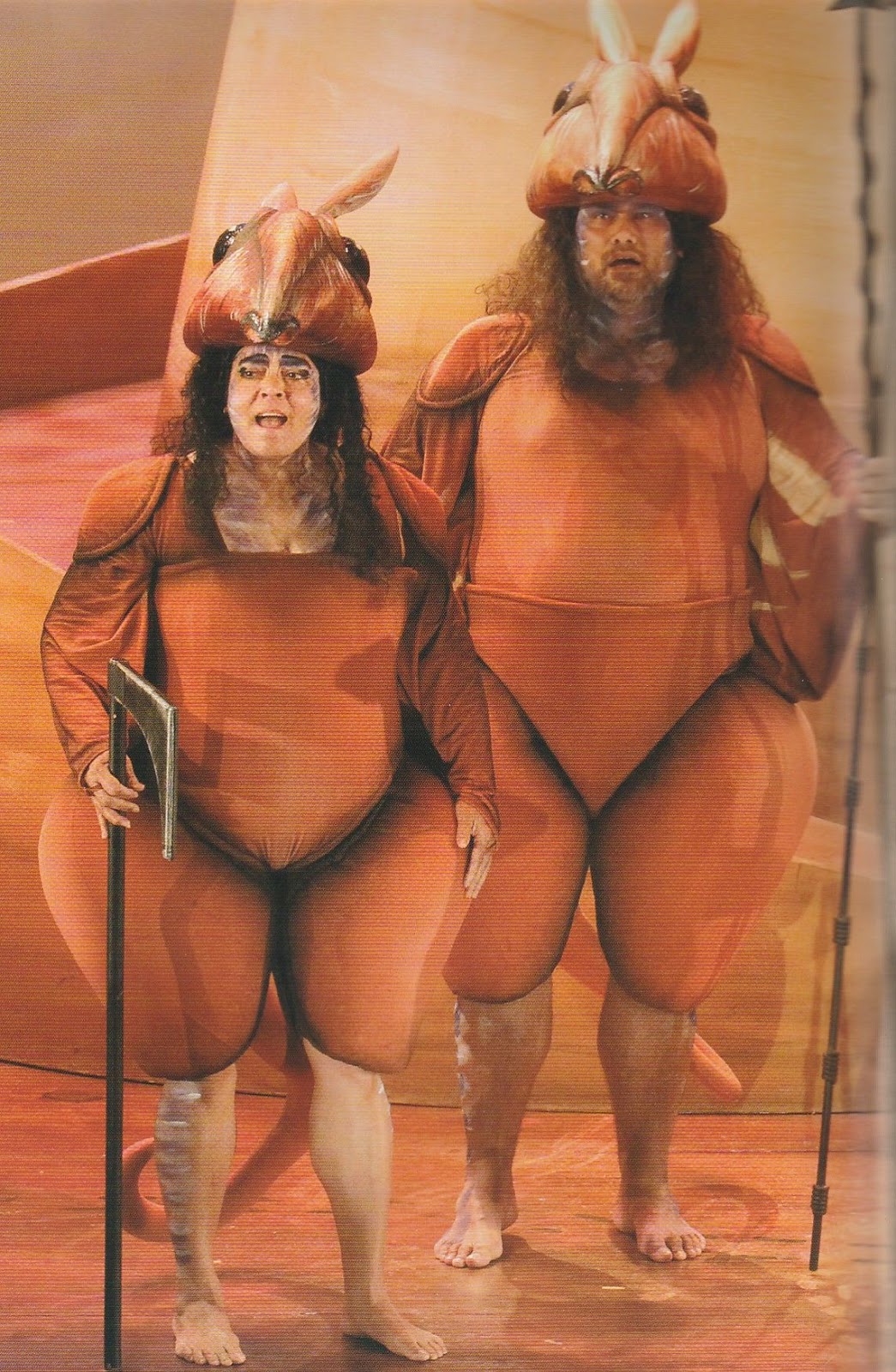
The Rabbit Captain


Bird - the narrator

Though these images of The Captain and Bird show the wonderful originality of both Shaun Tan’s art and of Gabriela Tylesova’s translation of that art into stage costumes, only bits and pieces of Tan’s pictures appeared in the set design.

I felt more oomph was needed while watching the performance. 


These images (which I’ve brought over from Shaun Tan’s webpage at http://www.shauntan.net/books/the-rabbits.html ) would have created the right impact, maybe as huge full-stage projections, instead of our seeing only the front section of the invading ship, or a few rather spindly smoke-stacks.


Though I appreciate the support of all those government and theatrical organisations for this opera, which was why I have quoted them all at the top, for my full satisfaction I think John Marsden and Shaun Tan deserve a grander production.  Then when the Marsupials express their final fear that everything – their country and even their children – have been taken away from them forever, we – especially those of us descended from The Rabbits – will feel the complete horror of the situation, and strengthen our resolve to make amends.

And though I fully appreciated the support and excitement in the audience for the performers, the quality of the presentation and the whole idea of such a new, original, and definitely Australian opera, I’m not so sure that the curtain call for actors and the band should have been quite so cheerful.

©Frank McKone, Canberra

Thursday, 7 January 2016

2016: Woyzeck - Thalia Theater Hamburg at Sydney Festival


Woyzeck adapted from the play by Georg Büchner: created by Tom Waits, Kathleen Brennan and Robert Wilson; songs and lyrics by Tom Waits and Kathleen Brennan. 

Thalia Theater Hamburg directed by Jette Steckel; text adapted by Ann-Christin Rommen and Wolfgang Wiens; stage design by Florian Lösche; musical director Laurenz Wannemacher (after Gerd Bessler, d. 14 June 2011); costumes by Pauline Hüners; lighting by Paulus Vogt; sound by Rewert Lindeburg and Gerd Mauff; dramaturg – Susanne Meister.

Sydney Festival at Carriageworks, Sydney, Bay 17 January 7-26, 2016.

Cast
Bernd Grawert (Tambourmajor, Woyzeck’s army drum major and seducer of Marie);
Julian Greis (Karl, an Idiot);
Franziska Hartmann (Marie, wife of Woyzeck);
Philipp Hochmair (Hauptmann, Woyzeck’s army captain);
Felix Knopp (Woyzeck, basic infantry soldier);
Jörg Pohl (Andres, soldier friend of Woyzeck);
Gabriela Maria Schmeide (Margreth, storyteller);
Tilo Werner (Doctor, psychologist ‘treating’ Woyzeck)

Reviewed by Frank McKone
January 7

Terrifyingly, disturbingly sad, is this version of the play that I am told is a necessary study at matriculation level in German schools.  Written in 1836, it is a classic ahead of its time as a drama of social criticism and as a forerunner of expressionist theatre.

I see this production as taking up the view that "The past is a foreign country: they do things differently there" (the famous opening sentence of the novel The Go-Between by L P Hartley.)  This Woyzeck is more than a translation of Büchner’s original script: it is a creative highly imaginative re-interpretation in a modern theatrical language.

It becomes the story of the child left behind by the deaths of its parents, Woyzeck and Marie – a story of mental mayhem and murder in which the perpetrator is as much a victim as the woman he kills.  The awful question the play begs for an answer is, Who can you blame?

The terror this production makes you feel is that there is no answer, but there is a reason.  The truth is that none of us have absolute control over our lives, but unless we can believe we are in control, we fall apart emotionally and lash out violently even against the ones we love. 

To present a naturalistic performance of characters interacting would not transport an audience out of ourselves.  Tom Wait’s music and especially Jette Steckel’s directing in Florian Lösche’s stage design shifts our perception.  Terrifying it may be, but theatrically stunning it certainly is.  This production of Woyzeck is a major work which should not be missed.  It is a mark of maturity of the Sydney Festival to bring us theatre of such quality from “a foreign country: they do things differently there.”

So how did they do it?  At the rear of the stage is a band of six musicians who produce any type of music from symphonic to an amusing clown trumpeter, but mostly concentrating on folk and jazz and a lot that sounds almost like Kurt Weill – as a reference I guess to the main period of development of expressionism in Germany influenced by Erwin Piscator’s 1928 staging of the The Good Soldier Schweik adapted from the unfinished Czech novel by Jaroslav Hasek, a play which has always seemed to me to be the most immediate follow-on, a century later, from Woyzeck.

Now it’s almost another century, and the music and songs underpin the emotions and the messages set up by Büchner at a level of audience engagement a step above the platform where we watched Brecht, purposefully ‘alienated’.

The main stage is bare, but suspended above, at first out of sight, is a horizontal rectangular frame which when lowered covers a large proportion of the stage area.  Strung on the frame is a net of substantial cables forming squares, which you can see in the program cover photo above.  Silent motors control the suspension cables so that the net can be tilted at any angle from horizontal to vertical by lifting or lowering the front or rear edge. 

Actors, as you can see if you look closely at the photo, can be hooked onto the net with harnesses, and can be suspended away from or underneath the net, or without a harness can walk or climb across or up and down the net, or go through the square holes to emerge forward or ‘hide’ behind the vertical or sloping net; or in the final scene, have the horizontal net lowered over them to reveal them standing on the stage floor as if trapped and unable to travel across the acting space.

The net, perhaps the ‘web of life’, is a great example of an essentially simple device with infinite symbolic possibilities.  Just one example was when Marie sits with the doll representing her child, after her seduction by the drum major and knowing that her husband is now uncontrollable.  Woyzeck is not there, but could appear at any moment.  Is she safe as the net lowers to just above her?  Does it protect her like a roof from the exigencies of life, or is she trapped as if walled in waiting for him in abject fear?

Light and shadow, as in so much expressionist stage and film work, make us identify with the situations the characters are in, emphasised by sound ‘concrète’ as well music and voice, and the result is total concentration for nearly two hours.

Susanne Meister writes in her program note: ‘...Lösche enables stunning images of people trying to hold on to something, losing their equilibrium and not being safe in a changing, unstable world....A Woyzeck of today.’  The feeling is terrifying, it is disturbing – and so sad.


Photos by Jamie Williams

Felix Knopp as Woyzeck

Tilo Werner as Doctor; Felix Knopp as Woyzeck

Felix Knopp as Woyzeck; Jörg Pohl as Andres

Franziska Hartmann as Marie; Bernd Grawert as Tambourmajor

Bernd Grawert as Tambourmajor; Franziska Hartmann as Marie

Julian Greis as The Idiot; Franziska Hartmann as Marie

Marie, Andres, Woyzeck and The Idiot


Andres, Tambourmajor, Marie, Woyzeck and The Idiot


Marie holding child; The Idiot above

Marie with The Idiot holding her child

Woyzeck lowers the murdered Marie
He then lowers himself to join her in death


For background info on the original play, see https://en.wikipedia.org/wiki/Woyzeck


©Frank McKone, Canberra

Monday, 21 December 2015

2015: A Christmas Carol adapted by Kirsty Budding


A Christmas Carol adapted by Kirsty Budding from the novella by Charles Dickens.  Budding Theatre directed by Jamie Winbank and Kitty Malam.  At Teatro Vivaldi, ANU, December 21-23, 2015.

Reviewed by Frank McKone
December 21

How can I remain in my habitual curmudgeonly role as a critic, now that I’ve seen the miser Ebenezer Scrooge turn his life towards empathetic Christmas cheer in just 45 minutes?

No.  No, I cannot!  I can only write positive comments, despite what happened to Scrooge: Some people laughed to see the alteration in him, but he let them laugh, and little heeded them; for he was wise enough to know that nothing ever happened on this globe, for good, at which some people did not have their fill of laughter in the outset.... [on the last page, p82, of A Christmas Carol in the 1907 Everyman’s Library edition of Christmas Books by Charles Dickens].

We all laughed at Kirsty Budding’s exaggerated representation of the pageant of the ghosts of Christmas Past (Jade Breen), Christmas Present (Anna Miley) and Christmas Yet To Come (Jason Sarossy), narrated well over the top by Zoe Swan.  Scrooge (Oliver Durbidge) could not contain himself in the negative nor the positive, from the vision of Marley’s Ghost (dead as a doornail!) to offering Bob Cratchit (Brendan Kelly) and his family Mrs Cratchit (Bridgette Kucher), Martha Cratchit (Abigail Mitchell), Belinda Cratchit (Olivia Adamow) and “Tiny” Tim Cratchit –  who did not die –  (Callum Doherty), not just Christmas Day off work, but the whole week!

Unfortunately for a reviewer, co-directors Kitty Malam and Jamie Winbank were so clever at moving masses off, on and around the tiny Teatro Vivaldi stage, that I’m left to record that only another 26 young people performed.  They remain nameless here as an encouragement for all those who haven’t yet booked, to see the show for the laughs, the program with all their names in, and for the message – still true to Charles Dickens’ intention – “as was always said [of the reformed Scrooge], that he knew how to keep Christmas well, if any man alive possessed the knowledge.  May that be truly said of us, and all of us!”

Brebdan Kelly as Bob Cratchit

Jade Breen as the Ghost of Christmas Past

Oliver Durbidge as Scrooge


Thursday, 17 December 2015

2015: Cara Carissima by Geoff Page


Cara Carissima by Geoff Page.  Produced by Peter Wilkins (The Acting Company) and Geoff Page; Associate Producer: Joe Woodward (Shadow House Pits).  Director: Tanya Gruber; Set Design: Charlotte Stewart; Lighting Design: Ben Pik.  At The Courtyard Studio, Canberra Theatre Centre, December 17-20, 2015.  Running time: 60 minutes.

Reviewed by Frank McKone
December 17

Cast
Peter Robinson – Barry, a senior public servant
Cara Irvine – Cara, Barry’s executive assistant / lover
Nikki-Lyn Hunter – Sarah, Barry’s wife / ex-wife
Kate Blackhurst – Jane, Sarah’s sister
Bruno Galdino – Bruno, barista

Lighter than a latte; skinny as in cap;
With a little bit of rum, and some froth on tap.

My apologies to the author, who likes his rhyming couplets.  It’s these that make Cara Carissima into a pleasantly humorous light entertainment on a theme of life in administration.

Or rather, what we see of that life out of the office in a convenient take-away coffee shop.  Here the barista – much too impressive a title, I thought – listens to his customers’ personal interactions and fills us in with the details between the scenes we observe, as Barry’s and Sarah’s marriage falls apart, Jane does what she can to keep things sensible; and Cara takes Sarah’s place, leaving Sarah hoping in revenge that the younger woman will soon find Barry as boring as she had. 

The venue is not kind to the actors, because of its acoustics.  Playing in the round – or in this case in the square with audience in all four sides – was perhaps not such a good idea, even though it meant a closer intimacy for each of us watching than the options of dividing the space in a conventional way.  Although actors made sure they spread their attention around fairly evenly, it was often difficult to pick up the words clearly from an actor when facing the opposite side.  And I have to admit that though Bruno’s accent made his title as barista seem more likely, many of his words were hard to understand.

Since Geoff Page is a very well-known poet, and words – especially how they sound – is so important in his work, I wondered if the play may not work very well on radio, even though seeing the characters live was good fun.


©Frank McKone, Canberra

Saturday, 5 December 2015

2015: King Lear by William Shakespeare

Geoffrey Rush as King Lear
All photos by Heidrun Löhr

King Lear by William Shakespeare.  Sydney Theatre Company directed by Neil Armfield.  Set design – Robert Cousins; Costumes – Alice Babidge; Lighting – Nick Schlieper; Composer – John Rodgers; Sound – Stefan Gregory; Voice and text coach – Charmian Gradwell.  At Roslyn Packer Theatre (one-time Sydney Theatre) November 24, 2015 – January 9, 2016.

Reviewed by Frank McKone
December 5

Magnificent!

There are a couple of points I want to query, but to have men in the audience, including me, in tears at interval, and again at the end is a measure of the power of this production of King Lear.

It’s thoroughly original in design and performance, taking the meaning of the play apart in a way I have never seen before.

First is the recognition that this is a mythical drama, placing Shakespeare in the company of Sophocles and Euripides.  Though it is partly about the nature of autocratic kingship, which in our modern democracy we may think is no longer relevant, we only have to remember that the Athenian democracy which produced the Ancient Greek theatre did not last long.  Beware!

Where it is about love – conditional or unconditional – this story of familial failings is certainly relevant to us all in any period of human history.  Take care!

In placing our abiding sense of self-importance against the uncomprehending reality of the universe,  this play, in this production, is huge.  We may rail against adversity, but the best we can manage is an acceptance of our human condition, though even this is no consolation.

Our tears at the tyrant’s gouging out the eyes of the naive old man Gloucester, at Lear’s haunting wail as he carries in his dead daughter, still hoping her breath will stir a feather, and at Edgar/Poor Tom’s words which conclude the drama, are as much for ourselves as for any character on the stage.  As Shakespeare wrote, we – “all the men and women” – are “merely players”. 

How much can we hope when the best Edgar can suggest is to “Speak what we feel, not what we ought to say”, in the face of “The weight of this sad time”?

But we can still hope in one important way.  We can place our hope in art, when we see it at its peak of humanity, maturity and skill.  As I saw it, watching this King Lear.

Being mythic does not imply that the setting must be in an ancient past, nor limited to any time or place.  Robert Cousins has understood this so well that clothing may be modern, words may be amplified with modern technology, nakedness may be explicit as it can at last be on a modern stage, rain may be real water, swords may be no more than short knives; and all may be presented for the first half in black empty space foreboding awful things to come, yet turn white in an even more frightening open space than before.  Every element in costumes, props, becomes significant and imbued with meaning in a weird way.  Every detail stands out in our minds because there are no boundaries which allow us to sit back satisfied.

And every word, every sound, every switch in tone of voice, every little stiffness in movement, or extreme looseness, turns our attention on.  With such a well-chosen cast almost every moment is perfect, dramatically.  Only two elements felt out of place, to me.

As we approach Dover and the invading/rescuing army is still at some distance, its presence is made known by faint and a little too staccato drumming which, at that point, distracted my attention from the characters on stage – until their words made it clear what the sound was.  I think this was a just a matter of timing, perhaps on the night (or in the afternoon as it was in my case).

More concerning for me was the directing of Eryn Jean Norvill as Cordelia.  I’m well aware of Norvill’s qualities as an actor from seeing her in previous shows, so I think even the doyen of directors, Neil Armfield, was in error in making her posture and voice more harsh in effect than seemed right to me.  I was not assuming that Cordelia should be as soft-spoken and forgiving as she is generally played.  I saw in the playing of the three sisters that they each in their own way had to find themselves as independent self-determined women, each at their different ages and stage in their relationship with their father.  Helen Buday’s Goneril had things in control, as she saw things, while Regan as Helen Thomson played her was still on the edge.

I saw in Cordelia the late teenage daughter, without a mother (which Shakespeare never explains) and needing to establish her self.  To that extent, with such an expectant father, I could see her pushing him too hard (which he doesn’t expect, assuming she had been compliant when younger).  So I saw her forcefulness which made sense, and I could explain to some degree her brittle quality of voice as she pushed herself forward with a new youthful sense of purpose.  But when Geoffrey Rush’s beginning-to-be-delusional father reacts as aggressively as he did, I felt there should have been more of a chance that she would soften and back off a little, and use a rounder tone with him – though still not giving in, of course.

I expected this would show her developing sense of maturity, which showed in her dealings with her two suitors.  For me, she left that first scene with less sympathy than I wanted to give her, and I have to say some of that feeling returned when she reappeared as a properly motivated but unsuccessful army commander, saying bitterly to Edmund “We are not the first / Who, with best meaning, have incurr’d the worst”, but then in rounder tones, I think, to her father “For thee, oppressed king, I am cast down; / Myself could else out-frown false fortune’s frown.” 

Again. maybe it was just on the day, but I felt the presentation of Cordelia was done with less subtlety than I saw in the other characters.

Which brings me to the four characters which are central to the success of the play: Robyn Nevin’s Fool, the Earl of Kent played by Jacek Koman, and the key figures of Edgar/Poor Tom and Lear himself.  Armfield’s direction and the skills of these four ensured they held the play together, notwithstanding the excellence all around them.

Robyn Nevin played with beautiful timing, in relation to the other characters and especially to the audience.  There was a softness in the stand-up comedy that made the question of the Fool’s almost fogotten death terribly poignant.  I’ll mention how effective the ending was a little later.

Being about or perhaps even a bit more than Lear’s age (I’m well past having a teenage daughter), I sometimes found Jacek Koman’s accent a little hard to follow, but his consistency in presenting the always reliable retainer in Kent was done with just the degree of variety needed to make us still willing to hear him out and want to go along with him on the very last page:  “I have a journey, sir, shortly to go; / My master calls me, I must not say no.” 

In some productions this becomes sentimental, but there was a shock and even tears to realise Kent’s sacrifice for the sake of humanity.

It may go without saying that Geoffrey Rush would be a great King Lear, but what made him so?  For me, in contrast with other Lears I’ve seen, it was his special relationship with Poor Tom, apparently mad, a guise taken on by Gloucester’s legitimate son, Edgar to escape attack from his jealous born-out-of-wedlock brother, Edmund.  Mark Leonard Winter plays Edgar, while Edmund is played by Meyne Wyatt.

Lear takes Poor Tom for real.  Poor Tom’s a-cold because he is, literally, naked.  As Edgar plays Poor Tom more and more wildly to maintain his disguise, Lear begins to match him, stripping off his clothes which barely protect him from the constant rain.  To the horror of the Fool and Kent, but to my admiration for the actors’ willingness to go for broke, Rush’s Lear joins Winter’s Poor Tom in a kind of devilish dance, reminding me of the witches’ sabbath scene in Berlioz’ Symphonie fantastique.

In other productions Poor Tom has been a-cold and timorous, while Lear has stayed too kingly, even as a pretence.  However justified in some directors’ analysis, Geoffrey Rush and Mark Leonard Winter transport us into a kind of euphoric state, almost ecstatic in their loss of normal constraint.  This was acting at its very best.

And so to the end, which for me has always posed a problem.  Most of the deaths – of Goneril, Regan and Edmund – are off-stage.  Only Lear, cradling the dead Cordelia, is on stage with his supporters Albany, Kent and Edgar.  Quite out of the blue, as he is dying, Lear says “And my poor fool is hang’d!”  Albany says “Bear them hence,” the last words are spoken, then Exeunt, with a dead march.

As a young student I thought this was a boring ending, and in other productions the energy has dropped even before Lear has finally died.  And how did Lear know the Fool was hanged, considering that we hadn’t seen or heard of him since Act III?  Another interpretation, though, is that Lear is referring to Cordelia as his “poor fool”, since we know that Edmund ordered her to be hanged.  Either way, the end concerned me.

But at last I have seen how to do the end properly.  As a play of mythical proportions, Armfield and the design team bring on the dead, including the Fool, bit by bit as the final scene proceeds.  Against white nothingness figures take their place, standing stiff, with the face and the palm of one hand blackened, just as Gloucester’s empty eye sockets had turned black.  At the point when Lear dies, the sense of dread from the surrounding dead reaches a climax, the last words are spoken, and the curtain drops steadily and deliberately. 

Magnificent!  And a standing ovation!

LtoR: Colin Moody, Helen Thomson, Eryn Jean Norvill, Geoffrey Rush, Mark Leonard Winter as
Duke of Cornwall, Regan, Cordelia, King Lear, Edgar. (Wade Briggs as King of France is out of shot)
Act I, Scene1


Robyn Nevin and Geoffrey Rush as
Fool and King Lear


Helen Buday, Colin Moody, Geoffrey Rush, Robyn Nevin, Nick Masters as
Goneril, Albany, Lear, Fool,


Mark Leonard Winter, Jacek Koman, Geoffrey Rush, Robyn Nevin as
Poor Tom, Earl of Kent, King Lear, Fool


Max Cullen, Mark Leonard Winter, Geoffrey Rush as
blinded Earl of Gloucester, Edgar/Poor Tom, King Lear


Meyne Wyatt and Helen Thomson as
Edmund and Regan


Geoffrey Rush and Eryn Jean Norvill as
King Lear and Cordelia
Act V, Scene 3


Friday, 4 December 2015

2015: Senate Arts Inquiry: 20 extraordinary, self-serving statements you need to read from the Government by Raymond Gill


Many articles were written about one-time Arts Minister and Attorney General George Brandis' attempt to undermine the success over many decades of the Australia Council's approach to funding the Arts.  In my view, this piece by Raymond Gill, published online in the Daily Review on 4 December 2015 was especially valuable for its analysis of the conservative Government's response to the submissions by the Arts community to the inquiry by Senate Standing Committee on Legal and Constitutional Issues. 
BRANDIS2web-5-1
When former Arts Minister, Senator George Brandis, unleashed his ill-thought raid on the independent Australia Council in May, taking $105 million from its budget to give to his own Ministry — where he and his appointees alone could decide which arts organisations were worthy of receiving tax-payer funds — the Greens and the ALP initiated a Senate inquiry.
Their inquiry into Brandis’ “National Program for Excellence in the Arts” drew an extraordinary and united response from artists and organisations across the country. They opposed the ludicrous plan that would severely damage — and possibly kill off — scores of small arts companies. These organisations act as the engine room and nurturers of talent for the big theatre, opera, ballet companies and orchestras that Brandis favoured by exempting them from the cuts.
“The Senate Standing Committee on Legal and Constitutional Issues inquiry into the impact of the 2014 and 2015 budget decisions on the arts” released its report on Wednesday night. It found that the $105 million taken from Australia Council would jeopardise the viability of many individual artists and small to medium arts organisations and it recommended the government fully restore the funding to the Australia Council.
The following 20 statements from the Government’s dissenting response to the inquiry are breathtaking in their cynicism and attempt to re-write recent events to serve their own political purposes. If there was ever any doubt that Brandis’ NPEA was about politics first, and arts a distant second, then these statements prove it.


Dissenting report from Government Members of the Committee
(Statements in bold have been highlighted by Daily Review)
“The Legal and Constitutional Affairs References Committee (‘the committee’) inquiry into the impact of the 2014 and 2015 Commonwealth Budget decisions on the arts (‘the inquiry’) was a cynical attempt by Opposition, Greens political party and some Independent Senators to politicise reform of arts funding mechanisms.”
“Claims by the Independent-Greens-Labor majority of the committee (‘the majority’) that the inquiry was not political in nature are clearly not supported. Throughout the conduct of the inquiry the majority has attempted to create a divisive and combative atmosphere that characterises the government as inherently opposed to supporting Australian arts and culture. This characterisation is unambiguously false.”
Government members of the committee are critical of attempts by the majority to marginalise the nation’s arts community, force them into taking a position against the government, and use arts and culture funding as a platform from which to launch cynical political attacks that lack factual basis and create uncertainty.”
Government Senators were effectively disenfranchised from the inquiry process by being disregarded in the scheduling of public hearings. This supports the conclusion that the conduct of the inquiry was for political rather than parliamentary (or, in fact, arts and culture-related) purposes.”
“Government Senators note that the ultimate client of all taxpayer-funded programming is the taxpayer him/herself. The government is mindful that in the main its funding activities must, as far as possible, reflect the interests and expectations of the Australian taxpayer rather than the interests and expectations of particular sectors or interest groups.”
“Austerity measures across all portfolios have been imposed to seek efficiencies that will reflect the public interest in national debt-management. The arts sector could not be said to have been asked to perform any ‘heavy lifting’ in pursuing this objective.”
“The arts funding pool provided to the Australia Council by the Commonwealth Government consisted of a total appropriation in 2012-13 of $188,000,000; 2013-14 of $218,800,000; a total appropriation in 2014-15 of $211,800,000; and a total appropriation in 2015-16 of $184,500,000. The government’s reduction in Australia Council funding, following the increased appropriation in 2013-14, reflects the austerity that has been applied across multiple portfolios in light of the serious national debt position inherited from the previous government. This reduction also reflects the government’s confidence in the spirit of arts funding reform measures.”
“The inquiry was established to investigate the proposed National Programme for Excellence in the Arts (‘NPEA’) however the subsequent replacement of the NPEA with the Catalyst model during the conduct of the inquiry—and the endorsement of this change by the Australia Council—is not reflected in the committee Chair’s inquiry report (‘the report’) that instead quotes heavily from highly emotive submissions and evidence gathered in the early stages of the inquiry.”
“The evidence to the committee—in the form of submissions and testimony at public hearings—was inherently incomplete in that only a very small range of like-minded interest groups were invited, or volunteered, to present their case. Page 77 of the report characterises this evidence as the response of ‘..the broader community’ which is an irresponsible and misleading statement. Government members of the committee note that the ‘broader community’—that is, every Australian other than those with some connection to the arts sector—did not on this occasion take the opportunity to make their feelings known.”
“Page 17 of the report cites the ‘…remarkable level of consistency in the evidence provided’, which comes as no surprise considering the evidence provided to the inquiry came, almost without exception, from artists and arts organisations who have a vested interest in attacking the government’s budgetary efficiencies.”
“The number of submissions with a common approach is also unsurprising in view of the many peak groups whose websites actively encouraged and assisted with the wording of letters of concern to the inquiry.”
“It is noted that the particulars of the efficiencies imposed by the Australia Council in response to budget measures were within the remit of the Australia Council itself. The inquiry heard evidence that was highly critical of, for example, the decision to discontinue the ArtStart program. The majority were willing to incorrectly characterise this as a decision of government rather than promote the true facts that this was a decision of the Australia Council.”
“In responding to the shift from peer-reviewed funding decisions to a more accountable and transparent process vested in the minister and the Department of Communications and the Arts, the Chair’s report warns at page 34 of ‘…political interference…’ in the allocation of arts funding. Government Senators are disturbed, but not surprised, that the majority consider that funding directions made in the public interest by duly-appointed ministers of a lawfully-elected representative government could constitute ‘interference’.”
“Government Senators also note the inconsistency of the majority report which, while it condemns the Commonwealth for its processes, had no words of condemnation for arrangements in state jurisdictions. The arrangements put in place by the Commonwealth Department of Communications and the Arts in relation to arts funding grants largely replicate current arrangements in all state and territory jurisdictions, four of which are run by Labor governments.”
“Government Senators recognise the importance of fostering the on-going development of Australian cultural and artistic expression however they are not persuaded that the peer-review model is in all cases the most reliable manner of expressing the wishes and interests of the Australia taxpayer regarding support for the arts.
“Government members of the committee have concerns regarding the transparency and accountability of the Australia Council peer-review process and note that submissions and evidence to the inquiry have failed to reassure them that the Australia Council peer review process is not susceptible to bias.”
“Government members were concerned by elements of the testimony provided to the committee that seemed to betray an unhealthy sense of entitlement to the financial support of the taxpayer in the absence of an effective oversight or regulatory regime.”
“The decision by the Minister for the Arts, Senator the Hon Mitch Fifield, to create a new arts fund ‘Catalyst’ should be recognised for the valuable contribution it will make to an innovative arts and cultural industry. Instead it has been incorrectly portrayed by the majority as an attack on the autonomy of the arts sector. On the contrary, the Catalyst model lays the foundations for a sustainable arts funding model that will ensure our nation’s diverse arts sector continues to flourish.”
The Australia Council is effectively accountable only to itself. It provides an annual statement to the parliament but in operational terms continues to be independent. The Catalyst program, as a facet of the Department of Communications and the Arts, will be conducted with far greater oversight by government and the parliament. Catalyst will make funding decisions in alignment with the guidelines approved by the minister, an elected parliamentarian whose role is to guide departmental operations in a manner that reflects the wishes of the taxpayer. For a portion of arts funding to be deployed within such a framework is a good step towards ensuring that, across the spectrum, arts funding fosters innovation, provides cultural development, supports industry and reflects the wishes of the Australian people.
Government members acknowledge concerns about duplication of administrative costs however note that much of the burden will be shouldered by existing operational infrastructure within the Department of Communications and the Arts. When asked about the cost of administering the Catalyst program, the Executive Director of the Ministry for the Arts remarked that ‘Most of it we have absorbed within our current resources’.Additionally, with a smaller funding remit the Australia Council will benefit from being able to reduce its organisational footprint.”
Illustration: Michael Agzarian

2015: Not Quite Christmas. Shortis&Simpson


 Photo: canberraticketing.com.au

Not Quite Christmas. Shortis&Simpson (shortisandsimpson.com) - A satirical, seasonal tour 14 Nov 2015 – 5 Dec 2015 at Café Wood Works, Bungendore;  Robertson Community Technology Centre; Nerrigundah AG Bureau, Nerrigundah (25 minutes drive west of Bodalla on Eurobodalla Road); Teatro Vivaldi, ANU campus, Fri/Sat December 4/5.

Reviewed by Frank McKone
December 4

It isn’t really Christmas that’s “not quite”.  It’s more about what we might get for Christmas after the last year or two politically.  Not quite what we would like.

Most of the songs use music that’s well known, and often easy to sing along with, but John Shortis’ words and his and Moya Simpson’s performances are much more than “quite”.  This year’s satire is very good – and at the same time very traditional.

This is anything but a criticism, but may need to be explained to readers around the world outside the Bungendore – Queanbeyan – Canberra axis of goodness.  If New York is the Big Apple, Shortis&Simpson is like the trunk of the tree of knowledge, which was planted in the Queanbeyan School of Arts Café at the dawn of time in 1996 and bears fruit at this time of each year, harvested at various scrumptious locations.

Vivaldi’s has become a worthy descendant of the original Q School of Arts Café – which closed in 2000 after too much excitement for Bill, Pat and Tim Stephens to handle – and since the untimely end of Dominic Mico’s ownership of Smith’s Alternative Bookshop.  Looking vaguely like the Famous Spiegeltent (the real one will be here in Canberra early next year), and dressed up with several thousand Christmas LEDs, the atmosphere enhanced by a three-course meal and stimulated by wine from the bar was ready for knowing laughter.

I could legitimately mention every number in the show, all being equal.  But for the sake of witty brevity I’ll give space to three, for their different qualities.

For clever rhyming, John’s forté, the Bill Shorten song took the unwrap the parcel prize.  Every line rhymed with Bill in the manner of all those nasty parliamentarians’ name calling – like “Electricity Bill”.  But none of them ever came near to the rhyme “pterodactyl”.  You had to listen very carefully to see how that came about!  I hope John will publish the words of his songs as a lasting record.

For Moya’s voice, after her gravelly rendition of Bob Dylan’s new song “The 21st Century’s been reinstalled: The Times They are A-Changing”, I could not go past her commemoration “Vale Cilla Black” – a quite extraordinary range to match “the woman with two voices”.

And for unstoppable laughter there was the old trick of the two drunkards talking about our political leaders: Shill Bortern, Talcum Murnbull and Ony Tabbott who let Creta Pedlin cun the runtry when he was Mine Primister.  It doesn’t look so funny on paper, but after a good five minutes of sincere drunken commentary on our lopitical peaders, vivatro tealdi was a lyot of rafter.  It was amazing how much seemed to make sensible critical political commentary.  A glass or so of sauvignon blanc made even better sense of it.

And on a serious note, apart from asking God to take Eric Abetz and Cory Bernardi away somewhere – anywhere – there was no need to unwrap the parcel for the asylum seeker children still in detention.  We all knew what their best Christmas present would be.

I think I’m right to point out that Shortis&Simpson have succeeded where many others have fallen by the wayside.  In their 20th year they constitute the longest running professional theatre company in our history, excepting Canberra Youth Theatre and The Jigsaw Company.  I think that makes John and Moya an Institution – not to be sneezed – or laughed at!


© Frank McKone, Canberra