Babyteeth by Rita Kalnejais. Directed by Eamon Flack for Belvoir at Belvoir St Theatre, Sydney, February 11 – March 8, 2012
Reviewed by Frank McKone
February 25
It
scares the life out of me to see a play that can so emotionally shake
me, written by such a young person. Then I look back in history and
realise that William Shakespeare was about the same age as Rita
Kalnejais when his first plays began to be noticed. Babyteeth is her second.
I
remembered that Shakespeare died when he was 20 years younger than I am
now and ten years older than I was when I made my only serious attempt
to write a play (which got no further than a professional reading).
But, looking back again, I did try to persuade Broken Hill Repertory to
put on the legendary beginning of kitchen sink drama: John Osborne’s Look Back in Anger
(1956). They thought it was too radical and risqué for 1964 (Alison
wears her petticoat while she does the ironing), so I directed Arthur
Miller’s All My Sons instead.
Why all this reminiscing? Because Babyteeth
is literally a kitchen sink play, and because it is so good to see a
new play with all the strengths of the best of its tradition.
In fact I reckon Rita has done better than William did in plays like Two Gentlemen of Verona. There’s more guts here (I’ll explain later) as well as a similar wild sense of humour. Babyteeth is, in a modern way, even more succinct than The Taming of the Shrew concerning falling in love and maintaining a marriage, and deals with these matters with more depth than Look Back in Anger.
Kalnejais’ parents (Anna played by Helen Buday, and Henry played by
Greg Stone) show more complexity in response to the death of their
daughter (Milla, played by Sara West) than Miller’s parents do to the
death of their son. And where Shakespeare could have written about the
Black Death but never did, she dares to write about the inevitability of
death – a teenager dying of cancer.
That’s where guts
and vomiting come into the picture. It took all of the 40 minutes in
first gear crawling from Belvoir Street along Cleveland Street and South
Dowling Street before my palpitations slowed as the traffic at last
sped up.
The structure of the play is a twist on a
fairly common device. The end is played at the beginning, which morphs
into the past and leads to the end we thought we had already seen.
Except that only then do we learn what really happened. Then there is a
coda – a quite lengthy positive musical note, which is a surprise at
first but completes the narrative and eases us out of the harsh reality
of sex and death. Yet, as I found out while driving home, even this
resolution cannot assuage the hidden feelings.
To the
production: it’s clear from the author’s and director’s notes that the
play on stage is a cooperative creation of writer, director, actors and
designers – just as good plays have always been. Not only is the play
good, but all the work of these practitioners is top quality. Kathryn
Beck – you’ll remember her eyes and a fascinating
going-in-all-directions quality on tv in East of Everything –
makes pregnant Toby and her dog the lively comic foil exactly as needed
for the tragedy besetting Milla, her unlikely boyfriend Moses (archly
played by Eamon Farren), her psychologist father and distraught mother,
whose relationship with Milla’s violin teacher (Gidon, played
extravagantly by Russel Dykstra) and his small boy student (Thuong –
David Carreon or Sean Chu according to the day) is unexpected, quite
remarkable, and finally crucial to her coming to grips with death.
To
top it all, I drove home towards brilliant dramatic blood-red sunset
clouds against a fragile teal blue sky, a wonderful reminder of the
cloud Milla sees, of her tragic death, and of a beautiful play.
When
you buy the program you have the traditional Currency Press publication
of this new Australian playscript. It’s this total collaboration of
author, production team, actors and publisher that makes the best of
Belvoir about as good as you can get in theatre today.
© Frank McKone, Canberra
Saturday, 25 February 2012

Saturday, 18 February 2012
2012: To Silence: Kabir & Maria Chekhova by Subhash Jaireth
To Silence: Kabir & Maria Chekhova by Subhash Jaireth. Directors: Caroline Stacey (Kabir) & Camilla Blunden (Maria Chekhova) at The Street Theatre, February 16-26, 2012.
Kabir played by Raoul Craemer and Maria by Naoné Carrel.

For information about Subhash Jaireth go to:
http://asianaustralianstudies.org/resources/asian-australian-writers/bio/subhash-jaireth1/
Reviewed by Frank McKone
February 18
This presentation by The Street Theatre establishes the importance of the work of Artistic Director Caroline Stacey, and the role The Street plays within Canberra’s theatre life. The news, published on the front page of The Canberra Times just yesterday (http://www.canberratimes.com.au/act-news/curtain-raised-on-3m-street-revamp-20120216-1tc8f.html) that “Canberra’s professional theatre practitioners will have the city’s first custom designed rehearsal space when The Street Theatre’s new $3.18 million extension, a modern bright structure, is built” is confirmation of the support of the ACT Government and theatre community for Stacey’s efforts.
Following last year’s commissioning of Alana Valentine’s MP – a play based upon interviews with Members of Parliament and bureaucrats here in the Federal Capital city – this year has begun with a work by another successful published writer, nowadays resident in Canberra. And, in the wake of the Canberra Multicultural Festival, if Jaireth represents anything it must be multiculturalism, writing as he does in Hindi, Russian and English. Whatever some jaundiced sections of Australian society would like to believe, multiculturalism is alive and well and living in the centre of goverment.
However, the two historical characters we see presented by Jaireth are dead, though we see them as they approach their final silence. The Indian mystic poet Kabir died in 1518. Shakespearean in his poetry and significance in his society, it is fascinating to realise he died so long before Shakespeare’s own death in 1616. Maria Chekhova was the keeper of her older brother’s spirit for the 53 years of war, revolution and dictatorship after Anton Chekhov’s death in 1904 until her own demise at the age of 94 in 1957. We see her here on the day of the announcement of Josef Stalin’s death in 1953.
Based on extensive documentary evidence, Jaireth has written two separate monologues, each just an hour long, making a solid evening’s theatre with a 20 minute interval between. It’s concentrated listening for the audience, but well worthwhile for the quality of the language, the story that develops in the life of each character, and the implications for our own lives today. It is the continuity of human experience from 1500 to 1950 and beyond that we come to understand as Jabir and Maria speak their minds.
Both Craemer and Carrel speak their character’s mind with clarity and feeling. Jaireth has given them the language they need for the storytelling, and both miss no opportunity offered them by the author. But this production gives us a theatrical context for the storytelling which places each character emotionally in their world.
For Maria, restricted in her wheelchair to the house in Yalta, with memories sometimes mixed up and fading, the set is a minimal representation of significant objects, like half-seen paintings on the wall, a blank high wall section which turns out to represent for her the dust-covered statue of Anton, while her writing desk is just as she might have used it in real life for her correspondence and telephone calls to Anton’s wife, the actress Olga Knipper.
Kabir, though, is a mystic poet, living in the past and the present alternately in his poems and memories of family, friends and social figures, such as the religious pundits he despises for their deliberate manipulation of ordinary people’s understanding of reality. He, a weaver in real life, is caught in a net of feelings and experiences, sometimes inescably entwined, other times in control of the warp and the weft, sometimes fascinated by the artistry and beauty of his surroundings and his part in life. Light and colour, even darkness, become elements in our experience as Craemer changes physically through Kabir’s feelings, criticisms and philosophical analyses at different ages and circumstances.
The stage design and lighting – by Imogen Keen and Gillian Schwab respectively – work very well in both parts, but are more exciting, more integrated and poetically thematic in the Kabir piece than for Maria Chekhova.
And then there is the sound. Seth Edwards-Ellis has, for both parts, created a subtle sound environment, which fills in the background space around us in the audience (though I wasn’t quite sure on my visit whether all the thunder in Kabir’s life was recorded or real, considering the great storm unfolding outside the theatre). In both parts, the essence of the sound design was to establish something of the social, historical and emotional context, and then allow the sound to unobtrusively fade away until the point of silence was reached – in Kabir’s case with his death and ‘sky’ burial, and in Maria’s case with her horror at her failure to save Anton’s Jewish first love from the Treblinka concentration camp. Silence fell as we understood she saved his house, his stories, his plays, his reputation, but was not brave enough to save Dunya from Hitler. And in the silence we are left wondering if she had received Dunya at Yalta in the 1930s whether the other great dictator Stalin might not have been as bad.
The two parts together say, ironically, as the illiterate Kabir says when his son has his poems written down, goes to read them, and finds they are not the same: writing is not the best way to record the spoken word. But Caroline Stacey and Camilla Blunden and their design team have shown that theatre can do the trick – so long as the writer is as good as Subhash Jaireth.
© Frank McKone, Canberra
Kabir played by Raoul Craemer and Maria by Naoné Carrel.

For information about Subhash Jaireth go to:
http://asianaustralianstudies.org/resources/asian-australian-writers/bio/subhash-jaireth1/
Reviewed by Frank McKone
February 18
This presentation by The Street Theatre establishes the importance of the work of Artistic Director Caroline Stacey, and the role The Street plays within Canberra’s theatre life. The news, published on the front page of The Canberra Times just yesterday (http://www.canberratimes.com.au/act-news/curtain-raised-on-3m-street-revamp-20120216-1tc8f.html) that “Canberra’s professional theatre practitioners will have the city’s first custom designed rehearsal space when The Street Theatre’s new $3.18 million extension, a modern bright structure, is built” is confirmation of the support of the ACT Government and theatre community for Stacey’s efforts.
Following last year’s commissioning of Alana Valentine’s MP – a play based upon interviews with Members of Parliament and bureaucrats here in the Federal Capital city – this year has begun with a work by another successful published writer, nowadays resident in Canberra. And, in the wake of the Canberra Multicultural Festival, if Jaireth represents anything it must be multiculturalism, writing as he does in Hindi, Russian and English. Whatever some jaundiced sections of Australian society would like to believe, multiculturalism is alive and well and living in the centre of goverment.
However, the two historical characters we see presented by Jaireth are dead, though we see them as they approach their final silence. The Indian mystic poet Kabir died in 1518. Shakespearean in his poetry and significance in his society, it is fascinating to realise he died so long before Shakespeare’s own death in 1616. Maria Chekhova was the keeper of her older brother’s spirit for the 53 years of war, revolution and dictatorship after Anton Chekhov’s death in 1904 until her own demise at the age of 94 in 1957. We see her here on the day of the announcement of Josef Stalin’s death in 1953.
Based on extensive documentary evidence, Jaireth has written two separate monologues, each just an hour long, making a solid evening’s theatre with a 20 minute interval between. It’s concentrated listening for the audience, but well worthwhile for the quality of the language, the story that develops in the life of each character, and the implications for our own lives today. It is the continuity of human experience from 1500 to 1950 and beyond that we come to understand as Jabir and Maria speak their minds.
Both Craemer and Carrel speak their character’s mind with clarity and feeling. Jaireth has given them the language they need for the storytelling, and both miss no opportunity offered them by the author. But this production gives us a theatrical context for the storytelling which places each character emotionally in their world.
For Maria, restricted in her wheelchair to the house in Yalta, with memories sometimes mixed up and fading, the set is a minimal representation of significant objects, like half-seen paintings on the wall, a blank high wall section which turns out to represent for her the dust-covered statue of Anton, while her writing desk is just as she might have used it in real life for her correspondence and telephone calls to Anton’s wife, the actress Olga Knipper.
Kabir, though, is a mystic poet, living in the past and the present alternately in his poems and memories of family, friends and social figures, such as the religious pundits he despises for their deliberate manipulation of ordinary people’s understanding of reality. He, a weaver in real life, is caught in a net of feelings and experiences, sometimes inescably entwined, other times in control of the warp and the weft, sometimes fascinated by the artistry and beauty of his surroundings and his part in life. Light and colour, even darkness, become elements in our experience as Craemer changes physically through Kabir’s feelings, criticisms and philosophical analyses at different ages and circumstances.
The stage design and lighting – by Imogen Keen and Gillian Schwab respectively – work very well in both parts, but are more exciting, more integrated and poetically thematic in the Kabir piece than for Maria Chekhova.
And then there is the sound. Seth Edwards-Ellis has, for both parts, created a subtle sound environment, which fills in the background space around us in the audience (though I wasn’t quite sure on my visit whether all the thunder in Kabir’s life was recorded or real, considering the great storm unfolding outside the theatre). In both parts, the essence of the sound design was to establish something of the social, historical and emotional context, and then allow the sound to unobtrusively fade away until the point of silence was reached – in Kabir’s case with his death and ‘sky’ burial, and in Maria’s case with her horror at her failure to save Anton’s Jewish first love from the Treblinka concentration camp. Silence fell as we understood she saved his house, his stories, his plays, his reputation, but was not brave enough to save Dunya from Hitler. And in the silence we are left wondering if she had received Dunya at Yalta in the 1930s whether the other great dictator Stalin might not have been as bad.
The two parts together say, ironically, as the illiterate Kabir says when his son has his poems written down, goes to read them, and finds they are not the same: writing is not the best way to record the spoken word. But Caroline Stacey and Camilla Blunden and their design team have shown that theatre can do the trick – so long as the writer is as good as Subhash Jaireth.
© Frank McKone, Canberra
Saturday, 4 February 2012
2012: Pygmalion by George Bernard Shaw
Pygmalion by George Bernard Shaw, directed by Peter Evans. Sydney Theatre Company at Sydney Theatre, February 4 to March 3, 2012
Reviewed by Frank McKone
February 4

I have so much to write about this quite startling production that I’m a bit afraid of boring you with my excitement. If this happens, you can take it that I’m rather too much like Professor Henry Higgins – so determined to push through his bet with Kim Gyngell’s genuinely sincere Colonel Pickering, and sooo bored as soon as he saw that his Eliza would pass as a duchess at the garden party. Everyone in the audience was absolutely on Andrea Demetriades’ side when she threw the precisely aimed slippers at Marco Chiappi, even including boring old farts like me. Actually I have a suspicion they were meant to miss and fly off-stage, since Chiappi had to kick one off ready for Eliza's line deadpan “Your slippers.” But we were very satisfied that Demetriades hit her target.

Bernard Shaw was always a favourite playwright of mine, and now I know why. It’s just wonderful to watch a production where Shaw’s special kind of language is recognised thoroughly, showing that this most popular of his plays is not populist and certainly anything but sentimental. Sentimentality was anathema to Shaw. There is no way Eliza will go back to Higgins, and Peter Evans' direction shows why.
So I am happy that the playwright has been properly respected, because this production shows how his dialogue reveals his characters in the context of their society, and in doing so makes universal the complexities of human relationships which ring as true today as when Pygmalion was written, exactly a century ago. For me, as a long-time student of Shaw’s work, it’s great to see how Pygmalion is an important development in Shaw’s capacity to integrate character and polemics, in a direct line from previous plays like Candida, Arms and the Man and Major Barbara, leading 10 years later to his Nobel Prize winning Saint Joan.
The startling quality of Evans’ work is in using an unencumbered open black stage for a work which traditionally has required a realistic representation of the columns of Covent Garden, the bachelor pad at Wimpole Street, the sensible opulence of Mrs Higgins’ morning room, and on film scenes of a royally appointed ballroom. Instead the design here seems to me to have been strongly influenced by the cartoon-like illustrations by Feliks Topolski done for the Penguin publication of Shaw's original screenplay.
Voice over, video projection and the use of laptop and monitors to represent Higgins’ recording equipment, with furniture and props brought on and off as part of the action, bring this production into the post-modern era. By obviously exposing the fact that this is actors performing on a stage, using modern technical devices, while keeping strictly to Shaw’s original dialogue, Evans focusses our attention on the meanings, implicit and explicit, of what the characters say. The result is that the humour is funnier because the implications (for example of David Woods’ on-the-take Alfred Doolittle complaining about being thrust unwillingly into the middle class instead of retaining the freedom of being ‘undeserving poor’) become apparent on many different levels at once. The same is then true for the clashes between Eliza and Higgins, which reach tragic proportions on this stage. This is no My Fair Lady. More like Heartbreak House.
At interval I talked with Bob Ellis who was doubtful, in his characteristic ennui-style manner, about what seemed to be an unnecessary anachronism of laptop and monitors being referred to by Higgins as a phonograph. By the end of the play, however, as Higgins/Marco pursued Eliza/Andrea backstage with a live video camera, catching just a brief shot of her reflection in her dressing room mirror, I saw the purpose of the modern technology. The mirror image was a symbol built up on screen from the early scene at Wimpole Street when Deborah Kennedy’s incisive Mrs Pearce had reported how Eliza was too embarrassed to see herself naked in the bathroom mirror. The use of video established this as a play of symbols, issues and relationships, creating much more meaning in the drama than I have seen before, but which I have always felt needed to be revealed when reading the script.
With casting – Wendy Hughes as the redoubtable Mrs Higgins, Vanessa Downing as terribly conventional Mrs Eynsford Hill, Harriet Dyer as her daffy daughter Clara, Tom Stokes as love-struck Freddy, as well as Deborah Kennedy, David Woods, Kim Gyngell, Marco Chiappi and especially (remember her in Crownies) Andrea Demetriades – being spot-on, costumes exactly right (with modern styles reflecting the intentions of the 1912 originals), lighting, sound and video highly effective, and the visual effects of movement and use of space all working together, I must conclude by saying that I was never even faintly bored – not bloody likely.
The enthusiastic continuing applause supported my feelings, but I didn’t stay for the after-first-night drinks, and didn’t see Bob Ellis again. It would be interesting to know his final thoughts in the dark night.
© Frank McKone, Canberra

Reviewed by Frank McKone
February 4
Photos by Brett Boardman

Andrea Demetriades
Garn! Oh do buy a flower off me, Captain
I have so much to write about this quite startling production that I’m a bit afraid of boring you with my excitement. If this happens, you can take it that I’m rather too much like Professor Henry Higgins – so determined to push through his bet with Kim Gyngell’s genuinely sincere Colonel Pickering, and sooo bored as soon as he saw that his Eliza would pass as a duchess at the garden party. Everyone in the audience was absolutely on Andrea Demetriades’ side when she threw the precisely aimed slippers at Marco Chiappi, even including boring old farts like me. Actually I have a suspicion they were meant to miss and fly off-stage, since Chiappi had to kick one off ready for Eliza's line deadpan “Your slippers.” But we were very satisfied that Demetriades hit her target.

Andrea Demetriades and Marco Chiappi
I knew you'd strike me one day
Bernard Shaw was always a favourite playwright of mine, and now I know why. It’s just wonderful to watch a production where Shaw’s special kind of language is recognised thoroughly, showing that this most popular of his plays is not populist and certainly anything but sentimental. Sentimentality was anathema to Shaw. There is no way Eliza will go back to Higgins, and Peter Evans' direction shows why.
So I am happy that the playwright has been properly respected, because this production shows how his dialogue reveals his characters in the context of their society, and in doing so makes universal the complexities of human relationships which ring as true today as when Pygmalion was written, exactly a century ago. For me, as a long-time student of Shaw’s work, it’s great to see how Pygmalion is an important development in Shaw’s capacity to integrate character and polemics, in a direct line from previous plays like Candida, Arms and the Man and Major Barbara, leading 10 years later to his Nobel Prize winning Saint Joan.
The startling quality of Evans’ work is in using an unencumbered open black stage for a work which traditionally has required a realistic representation of the columns of Covent Garden, the bachelor pad at Wimpole Street, the sensible opulence of Mrs Higgins’ morning room, and on film scenes of a royally appointed ballroom. Instead the design here seems to me to have been strongly influenced by the cartoon-like illustrations by Feliks Topolski done for the Penguin publication of Shaw's original screenplay.
Voice over, video projection and the use of laptop and monitors to represent Higgins’ recording equipment, with furniture and props brought on and off as part of the action, bring this production into the post-modern era. By obviously exposing the fact that this is actors performing on a stage, using modern technical devices, while keeping strictly to Shaw’s original dialogue, Evans focusses our attention on the meanings, implicit and explicit, of what the characters say. The result is that the humour is funnier because the implications (for example of David Woods’ on-the-take Alfred Doolittle complaining about being thrust unwillingly into the middle class instead of retaining the freedom of being ‘undeserving poor’) become apparent on many different levels at once. The same is then true for the clashes between Eliza and Higgins, which reach tragic proportions on this stage. This is no My Fair Lady. More like Heartbreak House.
At interval I talked with Bob Ellis who was doubtful, in his characteristic ennui-style manner, about what seemed to be an unnecessary anachronism of laptop and monitors being referred to by Higgins as a phonograph. By the end of the play, however, as Higgins/Marco pursued Eliza/Andrea backstage with a live video camera, catching just a brief shot of her reflection in her dressing room mirror, I saw the purpose of the modern technology. The mirror image was a symbol built up on screen from the early scene at Wimpole Street when Deborah Kennedy’s incisive Mrs Pearce had reported how Eliza was too embarrassed to see herself naked in the bathroom mirror. The use of video established this as a play of symbols, issues and relationships, creating much more meaning in the drama than I have seen before, but which I have always felt needed to be revealed when reading the script.
With casting – Wendy Hughes as the redoubtable Mrs Higgins, Vanessa Downing as terribly conventional Mrs Eynsford Hill, Harriet Dyer as her daffy daughter Clara, Tom Stokes as love-struck Freddy, as well as Deborah Kennedy, David Woods, Kim Gyngell, Marco Chiappi and especially (remember her in Crownies) Andrea Demetriades – being spot-on, costumes exactly right (with modern styles reflecting the intentions of the 1912 originals), lighting, sound and video highly effective, and the visual effects of movement and use of space all working together, I must conclude by saying that I was never even faintly bored – not bloody likely.
The enthusiastic continuing applause supported my feelings, but I didn’t stay for the after-first-night drinks, and didn’t see Bob Ellis again. It would be interesting to know his final thoughts in the dark night.
© Frank McKone, Canberra

I want to know what I may take away with me.
I dont want to be accused of stealing.
Saturday, 21 January 2012
2012: Buried City by Raimondo Cortese
Buried City by Raimondo Cortese. Alicia Talbot, concept and
director. Urban Theatre Projects at Belvoir Street Theatre Upstairs for
Sydney Festival, January 6 – February 6, 2012.
Reviewed by Frank McKone
January 21

If you think that living down and out among scaffolding on a construction site might be less than exciting, then avoid Buried City for it is a kind of faithful representation described by the author as follows:
What strikes me about Alicia Talbot’s work is that it is not about presenting a metaphor on stage, or at least it’s not about seeing theatre as a metaphor that transforms the performance into a poetic representation. It feels much fresher, much more contemporary, in that what is aimed for is the presentation of a new form of theatre based on ritual everydayness.

Well, the director has succeeded in this aim, but unfortunately this is not exactly a new form of theatre. Eugene O’Neill did it in The Iceman Cometh (1939) and even Beckett’s Waiting for Godot with Ian McKellen and company, which we saw in Sydney in 2010, more powerfully showed life getting nowhere. It’s just a bit of a pity that director Sean Mathias said Godot is “like an incredible poem or a very beautiful piece of music”, and this is what makes it effective over the generations of theatre goers. Iceman was rather more like Buried City, in that nothing happens in an apparently naturalistic scene, but O’Neill knew how to make us feel the awful necessity of self-destructive ritual which the characters play out, which also becomes a picture not just of a few drunks in a bar but of America as a nation still in the Great Depression.
Cortese and Talbot show up their artistic problem in describing their work as “rather like a living film set with no close ups”, while also writing about revealing “how as human beings we build temporary bridges and alliances in an effort to have a meaningful purpose to how we live our lives.” In fact there are some “close ups”: the two that work theatrically are Aboriginal actor Meyne Wyatt and Effie Nkrumah, of Ghanaian descent, particularly in their clash over belief in their different ‘spirits’. Otherwise, the other characters are predictable, even though much of the action is unfathomable because there is no development of motivation.
The result for me was that I could not see or feel any sense of ritual in this ‘everydayness’, nor much reality. At the end it was difficult for me to know how to respond. I felt I should applaud the actors for their work – and they did manage to achieve some moments of dramatic tension – but this was despite the script which really didn’t help them. They did come back for a second brief curtain call, but I noticed others in the audience also hesitating about clapping, perhaps from the same kind of confusion as I felt.
I guess the intentions of Urban Theatre Projects are worthwhile in principle – to expose the terrible empty space of living without purpose, and I suppose to show that this is a dreadful feature of our society – but this attempt is not ‘much fresher, much more contemporary’ theatre. In her notes, Alicia Talbot writes The text has been stripped of its conventional theatrical content…. There’s no backstory and almost no personal information provided about any of the characters, no classic plot to speak of….
Perhaps then I am the problem: maybe I am just not fresh and contemporary enough for this play.
© Frank McKone, Canberra
Reviewed by Frank McKone
January 21
Photos by Heidrun Lohr
Top: Effie Nkrumah
Below:Meyne Wyatt

If you think that living down and out among scaffolding on a construction site might be less than exciting, then avoid Buried City for it is a kind of faithful representation described by the author as follows:
What strikes me about Alicia Talbot’s work is that it is not about presenting a metaphor on stage, or at least it’s not about seeing theatre as a metaphor that transforms the performance into a poetic representation. It feels much fresher, much more contemporary, in that what is aimed for is the presentation of a new form of theatre based on ritual everydayness.

Well, the director has succeeded in this aim, but unfortunately this is not exactly a new form of theatre. Eugene O’Neill did it in The Iceman Cometh (1939) and even Beckett’s Waiting for Godot with Ian McKellen and company, which we saw in Sydney in 2010, more powerfully showed life getting nowhere. It’s just a bit of a pity that director Sean Mathias said Godot is “like an incredible poem or a very beautiful piece of music”, and this is what makes it effective over the generations of theatre goers. Iceman was rather more like Buried City, in that nothing happens in an apparently naturalistic scene, but O’Neill knew how to make us feel the awful necessity of self-destructive ritual which the characters play out, which also becomes a picture not just of a few drunks in a bar but of America as a nation still in the Great Depression.
Cortese and Talbot show up their artistic problem in describing their work as “rather like a living film set with no close ups”, while also writing about revealing “how as human beings we build temporary bridges and alliances in an effort to have a meaningful purpose to how we live our lives.” In fact there are some “close ups”: the two that work theatrically are Aboriginal actor Meyne Wyatt and Effie Nkrumah, of Ghanaian descent, particularly in their clash over belief in their different ‘spirits’. Otherwise, the other characters are predictable, even though much of the action is unfathomable because there is no development of motivation.
The result for me was that I could not see or feel any sense of ritual in this ‘everydayness’, nor much reality. At the end it was difficult for me to know how to respond. I felt I should applaud the actors for their work – and they did manage to achieve some moments of dramatic tension – but this was despite the script which really didn’t help them. They did come back for a second brief curtain call, but I noticed others in the audience also hesitating about clapping, perhaps from the same kind of confusion as I felt.
I guess the intentions of Urban Theatre Projects are worthwhile in principle – to expose the terrible empty space of living without purpose, and I suppose to show that this is a dreadful feature of our society – but this attempt is not ‘much fresher, much more contemporary’ theatre. In her notes, Alicia Talbot writes The text has been stripped of its conventional theatrical content…. There’s no backstory and almost no personal information provided about any of the characters, no classic plot to speak of….
Perhaps then I am the problem: maybe I am just not fresh and contemporary enough for this play.
© Frank McKone, Canberra
2012: I’m Your Man created and directed by Roslyn Oades
I’m Your Man created and directed by Roslyn Oades. Presented
by Belvoir and Sydney Festival at Belvoir St Theatre Downstairs, January
21 – February 5, 2012
Reviewed by Frank McKone
January 21

Billy McPherson
Mohammed Ahmed

Photos by Heidrun Lohr
L to R:
Justin Rosniak, John Shrimpton,
Mohammed Ahmed, Billy McPherson, Katia Molino

Using interviews recorded by boxers and trainers, I’m Your Man is another example in this year’s Sydney Festival of what I have termed ‘factional theatre’. And, like Force Majeure’s Never Did Me Any Harm (see my review January 11), it works with explosive effect. Reality bites, theatricality soars – like the ambitions of these ordinary men, typically the ‘little kid from Marrickville’ who ‘travelled the world'.
How it works, though, is a little different from Force Majeure’s ‘dance theatre’. Katia Molino, the only non-male and non-boxing background performer, explained in conversation with me after the show, that I’m Your Man is acting, not dance.
In both these shows, the words are the actual recorded words of the interviewees – in this case even more immediate because each actor has headphones in which the original recording is being played, while the actor reproduces the words, mannerisms, voice qualities at a slight delay. Billy McPherson, who is also a professional boxing trainer, said it took four weeks’ rehearsal to create the characters using the technique, the five actors covering the experiences of seven professional boxers. But the role of the choreographer, Lee Wilson, was to create a moving total image in the setting of a boxing training ring, but to allow the actors to put the appropriate individual movements to the words, personal style and the story being told by each character.
So I’m Your Man is ‘factional acting theatre’ while Never Did Me Any Harm is ‘factional dance theatre’, two variations of a quite new form of theatre – one which I hope will develop and last well into the future, because it gives theatre a new lease of life in the age of digital media and documentary recording. There will always be a place for fictional drama, but, as I found watching I’m Your Man, factional theatre reveals to the audience truths about ordinary people’s real lives in a different way from great fictional work. There is a sense of objectivity in the experience as an observer of others’ experiences that, oddly enough, is more telling about the nature of society than, say, Brecht’s attempts at ‘alienation’ which have had such a looming effect through most of the past century in Western theatre.
The performances of the five actors – Justin Rosniak, John Shrimpton, Michael Mohammed Ahmad, as well as Katia Molino and Billy McPherson – are quite extraordinary. Physically the sparring, pummelling and other training exercises are done at the kind of speed and intensity which the real boxing training would require. If this were not achieved, the characterisations would not be believable. But within the first few minutes of this 70 minute show, as each character takes the floor, I found myself completely drawn into the boxing gym life – something completely outside my own experience.
At the same time, the stories showed how boxing, for these men of varied backgrounds, though with a common bond through poverty and discrimination, provided them with a structure to their lives – even down to the four rules (break the rules of no alcohol, no drugs, no smoking and no swearing and you’ll go back to New Zealand, as one was told by his trainer), and the fifth rule (no sex before a fight). There’s a discipline here that I hadn’t imagined, and a growth of self-worth in the minds of these ‘Marrickville’ boys when they succeeded in competition.
This is Belvoir Downstairs at its best.
P.S. The seven boxers whose lives are glimpsed in I'm Your Man are Billy 'The Kid' Dib, Wale 'Lucky Boy' Omotoso, Gus Mercurio, Jeff Fenech, Tony Mundine, Wally Carr and the mysterious CJ.
© Frank McKone, Canberra
Reviewed by Frank McKone
January 21

Billy McPherson
Mohammed Ahmed

Photos by Heidrun Lohr
Katia Molino
L to R:
Justin Rosniak, John Shrimpton,
Mohammed Ahmed, Billy McPherson, Katia Molino

Using interviews recorded by boxers and trainers, I’m Your Man is another example in this year’s Sydney Festival of what I have termed ‘factional theatre’. And, like Force Majeure’s Never Did Me Any Harm (see my review January 11), it works with explosive effect. Reality bites, theatricality soars – like the ambitions of these ordinary men, typically the ‘little kid from Marrickville’ who ‘travelled the world'.
How it works, though, is a little different from Force Majeure’s ‘dance theatre’. Katia Molino, the only non-male and non-boxing background performer, explained in conversation with me after the show, that I’m Your Man is acting, not dance.
In both these shows, the words are the actual recorded words of the interviewees – in this case even more immediate because each actor has headphones in which the original recording is being played, while the actor reproduces the words, mannerisms, voice qualities at a slight delay. Billy McPherson, who is also a professional boxing trainer, said it took four weeks’ rehearsal to create the characters using the technique, the five actors covering the experiences of seven professional boxers. But the role of the choreographer, Lee Wilson, was to create a moving total image in the setting of a boxing training ring, but to allow the actors to put the appropriate individual movements to the words, personal style and the story being told by each character.
So I’m Your Man is ‘factional acting theatre’ while Never Did Me Any Harm is ‘factional dance theatre’, two variations of a quite new form of theatre – one which I hope will develop and last well into the future, because it gives theatre a new lease of life in the age of digital media and documentary recording. There will always be a place for fictional drama, but, as I found watching I’m Your Man, factional theatre reveals to the audience truths about ordinary people’s real lives in a different way from great fictional work. There is a sense of objectivity in the experience as an observer of others’ experiences that, oddly enough, is more telling about the nature of society than, say, Brecht’s attempts at ‘alienation’ which have had such a looming effect through most of the past century in Western theatre.
The performances of the five actors – Justin Rosniak, John Shrimpton, Michael Mohammed Ahmad, as well as Katia Molino and Billy McPherson – are quite extraordinary. Physically the sparring, pummelling and other training exercises are done at the kind of speed and intensity which the real boxing training would require. If this were not achieved, the characterisations would not be believable. But within the first few minutes of this 70 minute show, as each character takes the floor, I found myself completely drawn into the boxing gym life – something completely outside my own experience.
At the same time, the stories showed how boxing, for these men of varied backgrounds, though with a common bond through poverty and discrimination, provided them with a structure to their lives – even down to the four rules (break the rules of no alcohol, no drugs, no smoking and no swearing and you’ll go back to New Zealand, as one was told by his trainer), and the fifth rule (no sex before a fight). There’s a discipline here that I hadn’t imagined, and a growth of self-worth in the minds of these ‘Marrickville’ boys when they succeeded in competition.
This is Belvoir Downstairs at its best.
P.S. The seven boxers whose lives are glimpsed in I'm Your Man are Billy 'The Kid' Dib, Wale 'Lucky Boy' Omotoso, Gus Mercurio, Jeff Fenech, Tony Mundine, Wally Carr and the mysterious CJ.
© Frank McKone, Canberra
Thursday, 19 January 2012
2012: Blood Brothers – The Musical by Willy Russell

Reviewed by Frank McKone
January 19
What I liked about this production, which has already won Canberra Critics’ Circle awards in 2011, is that Stephen Pike captured the right style of performance for a script with an interesting mix of intentions. This showed a knowledgeable approach which drew from his cast a sincerity in their singing and acting which made the musical worthwhile to watch for its meaning as much as for entertainment.
It’s not hard to find some rather different examples on You Tube for contrast, since the show has been produced, on all sorts of stages, just about continuously since its original incarnation in 1981 in the Merseyside Young People's Theatre program
( http://en.wikipedia.org/wiki/Blood_Brothers_%28musical%29#cite_note-1 ) .
It attracts comments like This is one of those songs [Tell Me It’s Not True] that is really sad when you hear it on its own, but when you find out the real story behind it, it is actually so upsetting and shocking. Amazing song, I went to see this show for a school trip, I was crying so much my teacher had to check if I was alright during it. . . AbsolutelyAllybum, as well as a raging argument about Spice Girl Melanie C’s accent because it wasn’t proper scouse since she was actually born across the water in Birkenhead, not in Merseyside in Liverpool.
I’m originally a Londoner, so I couldn’t tell the difference, but I was impressed that Doreen Robinson as accent coach succeeded in gaining consistency, and showing up the characters’ class differences, so the setting seemed real enough to me. And, after all, class was the central issue that you would expect to find in a theatre-in-education script in Maggie Thatcher’s England, especially in Liverpool. Keeping the original setting, I think, was the right decision – I’m not sure Blood Brothers in Cronulla would have worked without a major re-write.
Russell’s ‘mix of intentions’ as I see it relates to Blood Brothers’ origins. On the one hand, it seems, there was a literary source in the 1844 novella The Corsican Brothers by Alexandre Dumas, père, which provided not only the basic melodramatic plot, but allowed the issue of the role of the devil (which fitted with the Liverpool tradition of Catholicism) and immoral behaviour resulting in guilt and inevitable death to be a major theme. This would be a great source for discussion in the classroom.
On another hand, Russell seems to have wanted to emphasise in a Brechtian manner the inevitable results of capitalist social class warfare. British drama teachers I met in the 1980s seemed obsessed with a revival of Marxism, and Thatcher was certainly a major force to be opposed. Interestingly enough, this theme also takes Blood Brothers back to the 19th Century, to a then famous melodrama called The Factory Lad by John Walker (1832). It also shows connections to Brecht’s The Threepenny Opera, especially in the role of the Narrator/Devil, and, in its ending, to Mother Courage and her Children.
On a third hand, psychology is a major theme on two fronts: is Mrs Lyons driven insane by her natural woman’s need to have a child leading to her forcing her social advantage on Mrs Johnstone to gain the twin Edward, then trying to murder the mother when the secret in the locket is revealed, and then revealing to the other twin, Mickey, that Edward loves the girl in common, Linda? Is this real psychology, or some kind of hangover from 19th Century / Freudian ideas of women’s hysteria? Or Jungian myth? Or just a literary device to push the plot along? I’m not sure what Russell meant here.
But on the second front, there is the important issue of depression and the proper treatment of it. Mickey’s depression has a real cause – unemployment, desire to support his wife and child, and imprisonment when crime seemed the only alternative. But is the addiction he develops to the medication, and his uncontrolled and violent behaviour when he stops the medication, true to life? Here’s another great classroom topic.
Where Stephen Pike and his team, backstage and onstage, got it right was to recognise that Russell has written a work full of symbols. It is not naturalism – no musical is, in the sense that people don’t normally sing at every emotional opportunity – and so the singing of each song stops the action with just enough Brechtian alienation effect to make the thematic ideas stand out, and this is carried through into the choreography, for example very effectively in presenting the 7 going on 8-year-olds, and then the changes in their movement style as they do a slide show through 15, 16, 17 and 18.
This was nice work which meant that the melodrama of a kind of OK Corral ending (quite appropriate for grown ups who had played cowboys and Indians with real airguns as children) did not become sentimental. It allowed us in the audience to be aware of tragedy in real life, without merely wallowing in terrible sadness. Director Stephen Pike was, like AbsolutelyAllybum’s teacher, considerately checking out that we are ‘alright’.
Thanks, Stephen.
© Frank McKone, Canberra
Thursday, 12 January 2012
2012: I Am Eora by Wesley Enoch with co-writer Anita Heiss
I Am Eora written and directed by Wesley Enoch with co-writer
Anita Heiss, presented by the Balnaves Foundation for the Sydney
Festival at Carriageworks, Redfern. January 8, 10-14, 2012.
January 12
Described in the program as World Premiere, I have to say that I Am Eora is a show still in need of further development before I would give it such an impressive introduction.
The theme of a new way of finding reconciliation between Aboriginal and the European cultures, of Sydney in particular, is of very great importance. The essential point is to understand that the land of the Eora is still here – Aboriginal land was, is, and always will be. Time – the past, present and future – changes, and the stories of the people living change with it. But the land is permanent. In this sense we are all Eora.
Wesley Enoch has put this in the program notes as “the most provocative thing we could do was to issue an invitation …How could we create a world where everyone living in Sydney could say I Am Eora…I am from this place?”
However, I found the presentation of three well-known stories of Eora heroes from the invasion period – Pemulwuy, The Warrior, who died in action; Barangaroo, The Nurturer, who stood for maintaining culture, stood up for political and economic rights, and died soon after childbirth; and Bennelong, The Interpreter, who sought to create understanding across the cultural divide – was powerful only in patches. As I am currently reading Kim Scott’s novel That Deadman Dance I can’t help seeing the strength of his oblique poetic writing which creates imagery and feeling from his Aboriginal characters’ perspective as a great contrast to the often too literal representation of Pemulwuy and Barangaroo in I Am Eora, though it is true that there is strength in the old Bennelong’s philosophy and death.
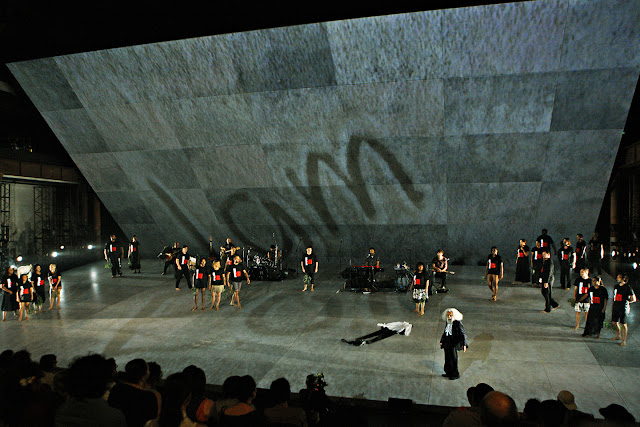
On the other hand, Enoch has written “I Am Eora has broken the mould in so many ways. It pioneers new ways of making Indigenous theatre [and] hopes to redefine Indigenous theatre and celebrates the resilience of a community.” It does this by using music and songs in non-Aboriginal forms, such as rap, rock, blues, some almost Pacific Island style, most of which works well as individual items. Dance, often in mimetic form, is also used extensively to illustrate in movement the words spoken and sung. Speeches were also used, such as the Inaugural Speech of the first Indigenous (also a woman) to serve in the New South Wales Parliament, Linda Burney. The skillion stage design, as the photo shows, was simple in concept and very effective for projections of images and text on both the floor space and the backdrop, which seemed to me to represent the overhanging caves in which I have seen many examples of magnificent art work.

 My
concern though is that it seemed the story–line of this history was
that Aboriginal people survive, even after disease, genocidal massacres
and the removal of their children, by being adaptable and taking on
features of the European culture; while for the Europeans (or rather, in
today’s Sydney, people from dozens of non-Indigenous cultures) there
was little of Aboriginal culture for them to adapt to.
My
concern though is that it seemed the story–line of this history was
that Aboriginal people survive, even after disease, genocidal massacres
and the removal of their children, by being adaptable and taking on
features of the European culture; while for the Europeans (or rather, in
today’s Sydney, people from dozens of non-Indigenous cultures) there
was little of Aboriginal culture for them to adapt to.
I sensed, especially from the audience reaction, that the main point of real contact between the two sides was the presentation of the gutsy strength of Aboriginal women in dealing with men. Elaine Crombie’s piece as The Bride was the point when people were stirred into real excitement. This was the moment of the WOW factor which the show needed as a whole rather than only in parts. There was nothing, for example, quite like Gurrumul Yunupingu’s songs and singing style in English and in language which would have been the show-stopper I Am Eora needs, nor dance which creates meaning beyond illustration, such as we often see from Bangarra.
So, although the house was full the night I attended, the audience response at the end was more muted than the theme of this work deserves. I think this Festival presentation should be seen as a trial run, and I hope the Balnaves Foundation can see its way to continuing its support for development to the point of a new World Premiere which might take Sydney and the world by storm.
© Frank McKone, Canberra

Photos by Prudence Upton
Reviewed by Frank McKoneJanuary 12
Described in the program as World Premiere, I have to say that I Am Eora is a show still in need of further development before I would give it such an impressive introduction.
The theme of a new way of finding reconciliation between Aboriginal and the European cultures, of Sydney in particular, is of very great importance. The essential point is to understand that the land of the Eora is still here – Aboriginal land was, is, and always will be. Time – the past, present and future – changes, and the stories of the people living change with it. But the land is permanent. In this sense we are all Eora.
Wesley Enoch has put this in the program notes as “the most provocative thing we could do was to issue an invitation …How could we create a world where everyone living in Sydney could say I Am Eora…I am from this place?”
However, I found the presentation of three well-known stories of Eora heroes from the invasion period – Pemulwuy, The Warrior, who died in action; Barangaroo, The Nurturer, who stood for maintaining culture, stood up for political and economic rights, and died soon after childbirth; and Bennelong, The Interpreter, who sought to create understanding across the cultural divide – was powerful only in patches. As I am currently reading Kim Scott’s novel That Deadman Dance I can’t help seeing the strength of his oblique poetic writing which creates imagery and feeling from his Aboriginal characters’ perspective as a great contrast to the often too literal representation of Pemulwuy and Barangaroo in I Am Eora, though it is true that there is strength in the old Bennelong’s philosophy and death.
On the other hand, Enoch has written “I Am Eora has broken the mould in so many ways. It pioneers new ways of making Indigenous theatre [and] hopes to redefine Indigenous theatre and celebrates the resilience of a community.” It does this by using music and songs in non-Aboriginal forms, such as rap, rock, blues, some almost Pacific Island style, most of which works well as individual items. Dance, often in mimetic form, is also used extensively to illustrate in movement the words spoken and sung. Speeches were also used, such as the Inaugural Speech of the first Indigenous (also a woman) to serve in the New South Wales Parliament, Linda Burney. The skillion stage design, as the photo shows, was simple in concept and very effective for projections of images and text on both the floor space and the backdrop, which seemed to me to represent the overhanging caves in which I have seen many examples of magnificent art work.


I sensed, especially from the audience reaction, that the main point of real contact between the two sides was the presentation of the gutsy strength of Aboriginal women in dealing with men. Elaine Crombie’s piece as The Bride was the point when people were stirred into real excitement. This was the moment of the WOW factor which the show needed as a whole rather than only in parts. There was nothing, for example, quite like Gurrumul Yunupingu’s songs and singing style in English and in language which would have been the show-stopper I Am Eora needs, nor dance which creates meaning beyond illustration, such as we often see from Bangarra.
So, although the house was full the night I attended, the audience response at the end was more muted than the theme of this work deserves. I think this Festival presentation should be seen as a trial run, and I hope the Balnaves Foundation can see its way to continuing its support for development to the point of a new World Premiere which might take Sydney and the world by storm.
© Frank McKone, Canberra
Wednesday, 11 January 2012
2012: Never Did Me Any Harm by Force Majeure

Never Did Me Any Harm dance theatre devised by Force Majeure, directed by Kate Champion. Sydney Festival and Sydney Theatre Company, Wharf 1, January 11 – February 12 2012.
Reviewed by Frank McKone
January 11
Initially stimulated by her reading of Christos Tsiolkas’ The Slap, Kate Champion’s work on child rearing / parenting leaves me – a parent and grandparent – unable to suggest any advice beyond ‘Do what you can; don’t feel guilty (when you find yourself disliking your feral three-year-old); and don’t harbour any expectations that your child will turn out as you thought / hoped they might, whatever form your parenting takes’.
You might find, however, as a mother, that you are more in love with the little boy who smiles so directly at you than you ever loved any other man.
Using material from some 60 hours of interviews, and therefore quoting real people’s thoughts rather than creating purely fictional dialogue, Force Majeure have made what I suppose must be called factional dance theatre. The result is impressive for its strength of feeling and its reversal of theatrical convention. I have always seen movement as the core of drama, though emphasis is traditionally placed on the text. Here Champion shows that indeed words are superficial, while action, down to the choreographed flicking of a wrist, the placing of a hand or lifting of an eyebrow, is where the depth of emotion, communication and meaning is expressed.
This is the essence of what some are now calling a new genre – dance theatre.
The great thing about a Festival is being able to see such a difference in dance theatre one night – Babel (words) – and dance theatre the next night – Never Did Me Any Harm.
Speed, rhythm, structured design, speeches one night; slow, gradual building of intensity, naturalistic mess with highly original lighting and projections, and ordinary people’s talk the next. Theatricality one night; drama the next. Standing ovation with cheering one night; measured applause for three curtain calls with heightened sense of having learned from the experience the next.
Force Majeure certainly never did me any harm. May its honest facing up to reality do all of us some good.
© Frank McKone, Canberra

Tuesday, 10 January 2012
2012: Babel(words) Dance theatre (Antwerp)
Babel(words) Dance theatre by Sidi Larbi Cherkaoui, Damien
Jalet and Antony Gormley. Eastman vzw (Antwerp) and Theatre Royal de la
Monnaie for Sydney Festival at Sydney Theatre, January 9-11 and 13-14,
8pm.
Reviewed by Frank McKone
January 10

Two main elements make this show a success, justifying the standing ovation Babel received on Tuesday.
First, the quality of the dance work by individuals and by the group in ensemble was outstanding, indeed quite frighteningly good, including especially the occasion when it seemed that a speeding performer had crashed into the constantly moving metallic frame set. It was a Pirandello moment – remember Six Characters in Search of an Author – and worked beautifully.
Alongside the movement was percussion, instrumental work and singing which would have made the evening exciting on their own.
The second main element was one of surprise for me. Over several Sydney Festivals I have seen “important” continental European works which failed by being essentially pretentious, sometimes overloaded with grand ideas, sometimes self-consciously post-modern in style but with little new to say. When I read how Babel came about I thought uh-oh, another “Let’s get everyone together from all over the world and show how we can overcome the babble of languages and conflicting cultures.” A good multicultural theme for Sydney, of course, but ripe for overloading.
But this show works, with “18 performers from 13 countries, with 15 languages, seven religious backgrounds and numerous performance modes between them” as dramaturge Lou Cope writes, because the basic structure – bringing disparate people together – is kept simple and in the end is grounded in the experience of the group itself rather than trying to make too much of the implications for the world. These ideas are played out – and even given as lectures – but what comes through to the audience is not that conflict will be resolved in a fantasy “real” world of politics and commercialism. We see a group of highly talented and individual people working together across all their differences as dancers, to produce a powerful ending which just made people stand up and cheer.
What a contrast this was with a determinedly modern piece some years ago repetitively showing us boring images of social failure for two and a quarter hours. Those audience members who had not walked out finally got to experience one more self-regurgitating movement sequence which, for no apparent reason, just stopped, and the lights just went out, with absolutely no emotional response possible except to be glad that it stopped.
Mind you Babel did need to stop after 1 hour 40 minutes. Some of the ideas in some episodes were too shallow, needing development or cutting; some images – though meant to be satirical – were too cliché; and there was a sense that, just as a jazz band has to give every member a solo, all 18 performers had to have their day on display. But then, their talent and skills would have made it hard to cut.
So, whatever God did to the Tower of Babel, the result for Sydney has been well worth the trip.
© Frank McKone, Canberra
Reviewed by Frank McKone
January 10

Two main elements make this show a success, justifying the standing ovation Babel received on Tuesday.
First, the quality of the dance work by individuals and by the group in ensemble was outstanding, indeed quite frighteningly good, including especially the occasion when it seemed that a speeding performer had crashed into the constantly moving metallic frame set. It was a Pirandello moment – remember Six Characters in Search of an Author – and worked beautifully.
Alongside the movement was percussion, instrumental work and singing which would have made the evening exciting on their own.
The second main element was one of surprise for me. Over several Sydney Festivals I have seen “important” continental European works which failed by being essentially pretentious, sometimes overloaded with grand ideas, sometimes self-consciously post-modern in style but with little new to say. When I read how Babel came about I thought uh-oh, another “Let’s get everyone together from all over the world and show how we can overcome the babble of languages and conflicting cultures.” A good multicultural theme for Sydney, of course, but ripe for overloading.
But this show works, with “18 performers from 13 countries, with 15 languages, seven religious backgrounds and numerous performance modes between them” as dramaturge Lou Cope writes, because the basic structure – bringing disparate people together – is kept simple and in the end is grounded in the experience of the group itself rather than trying to make too much of the implications for the world. These ideas are played out – and even given as lectures – but what comes through to the audience is not that conflict will be resolved in a fantasy “real” world of politics and commercialism. We see a group of highly talented and individual people working together across all their differences as dancers, to produce a powerful ending which just made people stand up and cheer.
What a contrast this was with a determinedly modern piece some years ago repetitively showing us boring images of social failure for two and a quarter hours. Those audience members who had not walked out finally got to experience one more self-regurgitating movement sequence which, for no apparent reason, just stopped, and the lights just went out, with absolutely no emotional response possible except to be glad that it stopped.
Mind you Babel did need to stop after 1 hour 40 minutes. Some of the ideas in some episodes were too shallow, needing development or cutting; some images – though meant to be satirical – were too cliché; and there was a sense that, just as a jazz band has to give every member a solo, all 18 performers had to have their day on display. But then, their talent and skills would have made it hard to cut.
So, whatever God did to the Tower of Babel, the result for Sydney has been well worth the trip.
© Frank McKone, Canberra
Wednesday, 4 January 2012
2012: INDIG-CURIOUS Who can play Aboriginal Roles? by Jane Harrison. Platform Papers No 30.

Jane Harrison
Photo by permission of Currency House
INDIG-CURIOUS Who can play Aboriginal Roles? by Jane Harrison. Currency House: Platform Papers No 30, January 2012
Review by Frank McKone
Way back in my innocent youth I played the part of Lick Jimmy in the stage version of Ruth Park’s novel Harp in the South. (If you would like to see the evidence, click
http://www.smithnts.com/Repertory-Harp-In-The-South.htm )
Self-aggrandisement is not my desire nowadays, but Jane Harrison’s essay in the Currency House quarterly Platform Papers has raised an embarrassing question. Who gave me permission to play a Chinese character, presumably entirely fictional, with all my cultural assumptions about his mannerisms which I mimed (or rather mined, since it was a Broken Hill Rep production) for comic effect?
Considering the treatment of Chinese people in Australian history, was my performance an insult rather than a light-hearted touch in a warm-hearted drama (actually about Irish Catholics in down-at-heel Surry Hills)?
Jane Harrison is a playwright, a descendant of the Muruwari people of NSW, who describes herself as “light-skinned”. Her plays, Stolen, Rainbow’s End, Blakvelvet and Custody have variously won significant prizes, have been produced in Australia and overseas, and been placed on English syllabi in Victoria and NSW. This essay was based on the thesis which gained her an MA in Playwriting at Queensland University of Technology (QUT).
In other words, who am I, a one-time British immigrant, to criticise?
Well, here goes…. What I have found is a highly interesting study written from within the experience of a person accepted and identified as Aboriginal, while able to stand outside as a researcher and creative writer coming to terms herself with the fact that “Those [non-Indigenous people] who do know something about Aboriginal culture might assume that everybody shares in that knowledge, but in my experience ‘everybody’ doesn’t. [I am] regularly asked … maybe because, as a light-skinned Aboriginal person, I am not seen as ‘threatening’…”
From her interviews and references to almost everyone one can think of involved in Aboriginal theatre, before as well as since Kevin Gilbert’s The Cherry Pickers (1968), and even including careful use of Germaine Greer’s Quarterly Essay 11 Whitefella Jump Up: The Shortest Way to Nationhood, Harrison reveals the complexity involved in the apparently simple question Who can play Aboriginal roles?
I represent the people she curiously calls ‘Indig-curious’. She writes: “We need Indig-curious audiences and an Indig-curious readership. No Aboriginal person I know wants to exclude non-Aboriginal people from the mix, or expects to see them excluded, but whether it be in matters of research or writing, Aboriginal people have a set of knowledges that we want to express and don’t want to feel like our intellectual property is there for the taking. So, right now, at this point in our history, we need Aboriginal people to be in control of the message and the way in which that message is expressed.”
This is Jane Harrison’s message, after following up many issues: What causes offence?; Who is writing about us and why?; Aboriginal themes, can they be defined?; Why are they writing (and painting) like us?; Responsibility, anxiety and guilt: the burdens of the message maker; Can Aboriginality be learnt?; Lessons learnt – no longer ‘blacking up’; Why white girls don’t Dreamtime.
If you are Aboriginal, I think Harrison’s discussion will help clarify how to control your message and how to express it. If you are Indig-curious like me (and I hope we all are) her work turns our cross-cultural mess into understandable elements which might be mixed with care into a new recipe for an Australian culture in this century.
In the meantime, I had better apologise to the Australian Chinese community for my Lick Jimmy act in 1965. My only excuse is, as Germaine Greer wrote concerning Aboriginal people: “White Australians are in the main anxious to avoid upsetting black Autralians by referring to them in ways they might find offensive, but at the same time they are so unfamilar with black people that they have no way of knowing what gives offence and what doesn’t.”
Reading INDIG-CURIOUS Who can play Aboriginal roles? is well worthwhile.
Go to www.currencyhouse.org.au for more info about Platform Papers.
© Frank McKone, Canberra
Thursday, 8 December 2011
2011: Mikelangelo and the Black Sea Gentlemen

Mikelangelo and the Black Sea Gentlemen Michael Simic and Band at The Street Theatre, Canberra, December 8 and 9, 8pm; Sunday December 11, 6pm, following a Special Tribute to David Branson from 12.30pm.
Reviewed by Frank McKone
Life is never predictable, as Mikelangelo himself might sing. Unforeseen circumstances beyond my control meant I had to leave at interval, but the first hour was already showing signs of predictability on the part of the Black Sea Gentlemen.
The disappointment for me was that Michael Simic’s style and songs had seemed so much better when I saw him as the Master of Ceremonies of La Clique in the Famous Spiegeltent at the Sydney Festival 2007. I wrote then of ‘his particular style of jaunty, naughty, funny songs of sex and violence’. This show is a retrospective of, as one song puts it, Ten years in the saddle, waiting for death to come, so it was not surprising that I should see reprises of material I might have seen before.
The difference was that La Clique was a cabaret-circus full of varied, surprising, intrinsically funny and often startling acts, counterpointed by the Mikelangelo droll gruesome humour. Simic’s critical evaluation of life had a special place thematically and dramatically, hanging the total show together on threads of spurious homily.
In this show, the songs, though macabrely clever and twisting conventions, felt repetitive in theme and style – even musically. This effect was surprising when, in later analysis, I could recall Hungarian, Jewish, Russian, Spanish and even some modern ‘classical’ atonal elements in different songs. Yet, listening, it seemed I was hearing one song with some variations rather than discreet and markedly different works. In La Clique the other acts broke the spell of Mikelangelo, but tonight transitional invasions of the audience’s privacy were not enough to carry the show forward, and even by interval were beginning to feel rather tedious.
It would not be fair of me to say more without having seen the second half, especially when there were joyous responses from many in the audience at the deliciously gruesome images, and in recognition of many favourite songs. The success of Mikelangelo and the Black Sea Gentlemen internationally as well as in Australia over the last ten years must counter my thoughts tonight, but I wonder if it’s possible to maintain a cult style for just a bit too long.
An important aspect of their visit to Canberra is to celebrate the memory of David Branson, the original Black Sea violinist Senor Handsome, with Rufino the Catalan Casanova on violin, The Great Muldavio on clarinet, Guido Libido on piano accordion, Little Ivan on double bass and Mikelangelo himself as lead singer and guitarist. Tragically killed in a car accident on December 11, 2001, David was the heart of iconoclastic theatre and music at the time of the Black Sea Gentlemen’s arising from the deep. If you would like to offer something musical or dramatic on Sunday afternoon that has particular relevance to David's life, please contact pipbranson@hotmail.com to discuss.
© Frank McKone, Canberra
Friday, 2 December 2011
2011: Waxing Lyrical by John Shortis and Peter J Casey

Waxing Lyrical written by John Shortis (with segments by Peter J Casey). Directed by Carissa Campbell. Performed by John Shortis, Moya Simpson, Peter J Casey, Ian Blake, Jon Jones and Dave O'Neill at The Q, Queanbeyan Performing Arts Centre Friday 2 December 2011 - 8.00pm, Saturday 3 December 2011 - 8.00pm, Sunday 4 December 2011 - 5.00pm.
Reviewed by Frank McKone
Shortis & Simpson are purveyors of a certain kind of Canberra culture: unpretentious, whimsical, research-based mains with critical political commentary on the side. Even though Queanbeyan is a country town in New South Wales, it’s obvious from last night’s audience response that our culture flows over the border like a sweet rasberry coulis. Very tasty, nouveau cuisine, rim-of-fire Canberra kind of cooking.
This show is about writing lyrics – good lyrics, bad lyrics, hilarious history of lyrics, including one-time Prime Minister John Howard’s comment that he liked Bob Dylan's songs but couldn't understand Bob Dylan’s lyrics, and even songs without lyrics.
On the research side I was fascinated to learn about song-writers and how words and music somehow end up suitably in tune with each other, as well as hearing so many songs by famous writers of musicals, popular songs, jazz, blues and blue-grass. Rather than try to enumerate the songs, I just want to praise the range and quality of Moya Simpson’s voice across extraordinary styles from a Paul Robeson Old Man River to Kate Bush’s Wuthering Heights.
Peter J Casey’s satirical take on the song with the worst lyrics is quite extraordinary, the band is up to playing in a dozen different styles without hesitation, and John Shortis’ traditional diffidence has blossomed into a new strength of confidence – and quality of singing voice.
It’s now fifteen years since I first reviewed Shortis & Simpson, and the quality of their performances just keeps getting better. It’s such a short run: you only have this weekend to get to The Q, but I would certainly like to see this show go further afield.
Maybe we can think of Queanbeyan as off-Broadway, or like the English provinces. Let’s see Waxing Lyrical in whatever we can call Broadway or the West End.
© Frank McKone, Canberra
Saturday, 29 October 2011
2011: In Praise of Nepotism - Philip Parsons 2011 Memorial Lecture by Katharine Brisbane. Feature article.
In Praise of Nepotism, ‘the unfair preferment of nephews’ or To Every Age its Art, to Art its Freedom.

Philip Parsons 2011 Memorial Lecture by Katharine Brisbane founder and chair of the cultural activist association, Currency House, her major activity since 2000, after leaving Currency Press which she also founded, now exactly 40 years ago.
Belvoir St Theatre, Sydney. Sunday November 27.
Reviewed by Frank McKone
Although the audience for the doyenne of theatre in Australia was smaller than I had expected, the presence of the high-energy young new playwrights waiting for the annual Young Playwright’s Award which accompanies the Memorial Lecture, made Katharine Brisbane’s theme especially significant.
Though she is, in her words, "on the cusp of 80", she is not afraid of the risk that this may be like standing on a berm on a Sydney beach – a narrow shelf of sand which might suddenly collapse into the oncoming tide. Her speech was a disturbing interpretation of the history and the current state of Australian theatre. Are we all on the cusp of something unpredictable?
You will be able to hear the full speech on the ABC, Radio National: Big Ideas in February 2012 – keep an eye on the ABC website for details in January – but in the meantime I would like to wrap up her surprising theme In Praise of Nepotism for the coming Season of Goodwill and Cheer.
Brisbane concludes by saying “… we, the public and the artists at the centre, need more than just goodwill. We need curiosity.” And her very last words are “Our Indigenous artists must have the last word. They understand this. While we are arguing about economic imperatives, the imperative of Aboriginal artists is community culture, its interpretation, appropriation and preservation. This is just as contentious a task as it is in the white community. But they know that if they let it go, it will be gone forever. We need to learn that lesson too.”
Nepotism, she explains, is about “the creation of an in-group to achieve a common purpose, defend itself from outside attack and directly contravene our democratic belief in a fair go for all.” Nepotism showed its good profile in Melbourne’s Australian Performing Group, beginning with Marvellous Melbourne, in the graduates of early NIDA (The Legend of King O’Malley) and through to the establishment of the Victorian College of the Arts (before it was absorbed into Melbourne University) and the creation of Sydney’s Performance Syndicate by “the only real philosopher our theatre has produced”, Rex Cramphorn.
But she laments the huge government subsidies from the mid-1970s which, though they have led to state theatre companies and high-quality training, have taken audiences away from ‘dingo’ theatre (Jack Hibberd’s description) into safe territory according to the still “fundamental influence of our respectable [British colonial] emancipist classes”, avoiding our “[Irish] convict stain”. This has been done, she says, as “Commerce was now in conflict with culture. The 70s was, remember, the time when the Nobel prizewinner Friedrich von Hayek was leading a movement to replace our former measures of cultural value – on the ground that we humans were unstable creatures – with the more reliable face value imposed by the economy.”
The dark side of nepotism, Brisbane says, is that “Security in your own arts sector is what enables work to flow. But if timidity and arrogance is a consequence … then it is anti-art. That arrogance is bred by the old order of received opinion, which leads to tired revivals and preservation of one’s territory. But because our pursuit of excellence from the start excluded from government funding that whole layer of popular entertainment, amateur groups, private studios, end of year concerts and regional extravaganzas which once engaged people in the making of art, our artists have become a collection of specialists for whom communication outside their art has become more and more difficult. The less they try to break through this barrier the more they are misunderstood. It seems that only for artists is the word ‘elite’ a pejorative. In the sports world they are heroes. Why is this? Because, when the opportunities came in the 70s, the arts sector did not take their audiences with them."
The reason I go to Belvoir St is because it is the grandchild of Nimrod, the child of Jane St and the early NIDA graduates. I can only hope that Belvoir’s annual hosting of the Philip Parsons Memorial Lecture, this year presented by his wife Katharine Brisbane – former critic, publisher with him of Currency Press, and long-time cultural activist – will generate the curiosity our culture needs to survive among the new writers like Zoe Coombs Marr, who won the 2011 Young Playwright’s Award, and that they take their audiences with them. The electric energy that sparked around the theatre as the announcement was made augurs well for a collapse of the old berm and the creation of the new.
Thanks to Katharine Brisbane for such a highly stimulating address – and listen to Radio National to hear the full story, or read the final version of Katharine's speech now on the Currency House website at:
http://www.currencyhouse.org.au/sites/default/files/transcripts/In%20Praise%20of%20Nepotism%20final_0.pdf
© Frank McKone, Canberra

Philip Parsons 2011 Memorial Lecture by Katharine Brisbane founder and chair of the cultural activist association, Currency House, her major activity since 2000, after leaving Currency Press which she also founded, now exactly 40 years ago.
Belvoir St Theatre, Sydney. Sunday November 27.
Reviewed by Frank McKone
Although the audience for the doyenne of theatre in Australia was smaller than I had expected, the presence of the high-energy young new playwrights waiting for the annual Young Playwright’s Award which accompanies the Memorial Lecture, made Katharine Brisbane’s theme especially significant.
Though she is, in her words, "on the cusp of 80", she is not afraid of the risk that this may be like standing on a berm on a Sydney beach – a narrow shelf of sand which might suddenly collapse into the oncoming tide. Her speech was a disturbing interpretation of the history and the current state of Australian theatre. Are we all on the cusp of something unpredictable?
You will be able to hear the full speech on the ABC, Radio National: Big Ideas in February 2012 – keep an eye on the ABC website for details in January – but in the meantime I would like to wrap up her surprising theme In Praise of Nepotism for the coming Season of Goodwill and Cheer.
Brisbane concludes by saying “… we, the public and the artists at the centre, need more than just goodwill. We need curiosity.” And her very last words are “Our Indigenous artists must have the last word. They understand this. While we are arguing about economic imperatives, the imperative of Aboriginal artists is community culture, its interpretation, appropriation and preservation. This is just as contentious a task as it is in the white community. But they know that if they let it go, it will be gone forever. We need to learn that lesson too.”
Nepotism, she explains, is about “the creation of an in-group to achieve a common purpose, defend itself from outside attack and directly contravene our democratic belief in a fair go for all.” Nepotism showed its good profile in Melbourne’s Australian Performing Group, beginning with Marvellous Melbourne, in the graduates of early NIDA (The Legend of King O’Malley) and through to the establishment of the Victorian College of the Arts (before it was absorbed into Melbourne University) and the creation of Sydney’s Performance Syndicate by “the only real philosopher our theatre has produced”, Rex Cramphorn.
But she laments the huge government subsidies from the mid-1970s which, though they have led to state theatre companies and high-quality training, have taken audiences away from ‘dingo’ theatre (Jack Hibberd’s description) into safe territory according to the still “fundamental influence of our respectable [British colonial] emancipist classes”, avoiding our “[Irish] convict stain”. This has been done, she says, as “Commerce was now in conflict with culture. The 70s was, remember, the time when the Nobel prizewinner Friedrich von Hayek was leading a movement to replace our former measures of cultural value – on the ground that we humans were unstable creatures – with the more reliable face value imposed by the economy.”
The dark side of nepotism, Brisbane says, is that “Security in your own arts sector is what enables work to flow. But if timidity and arrogance is a consequence … then it is anti-art. That arrogance is bred by the old order of received opinion, which leads to tired revivals and preservation of one’s territory. But because our pursuit of excellence from the start excluded from government funding that whole layer of popular entertainment, amateur groups, private studios, end of year concerts and regional extravaganzas which once engaged people in the making of art, our artists have become a collection of specialists for whom communication outside their art has become more and more difficult. The less they try to break through this barrier the more they are misunderstood. It seems that only for artists is the word ‘elite’ a pejorative. In the sports world they are heroes. Why is this? Because, when the opportunities came in the 70s, the arts sector did not take their audiences with them."
The reason I go to Belvoir St is because it is the grandchild of Nimrod, the child of Jane St and the early NIDA graduates. I can only hope that Belvoir’s annual hosting of the Philip Parsons Memorial Lecture, this year presented by his wife Katharine Brisbane – former critic, publisher with him of Currency Press, and long-time cultural activist – will generate the curiosity our culture needs to survive among the new writers like Zoe Coombs Marr, who won the 2011 Young Playwright’s Award, and that they take their audiences with them. The electric energy that sparked around the theatre as the announcement was made augurs well for a collapse of the old berm and the creation of the new.
Thanks to Katharine Brisbane for such a highly stimulating address – and listen to Radio National to hear the full story, or read the final version of Katharine's speech now on the Currency House website at:
http://www.currencyhouse.org.au/sites/default/files/transcripts/In%20Praise%20of%20Nepotism%20final_0.pdf
© Frank McKone, Canberra
2011: The Fall of the City by Archibald MacLeish
The Fall of the City by Archibald MacLeish, directed by Andrew
Holmes. ANU School of Cultural Inquiry, College of the Arts and Social
Sciences at ANU Arts Centre Drama Lab October 26-29, 2011.
Reviewed by Frank McKone
October 29
Following Andrew Holmes’ production of MacLeish’s Panic (on the blog August 25, 2011), The Fall of the City is his next research project. Holmes writes “I am currently undertaking a PhD in Drama, with a focus on revaluing Archibald MacLeish’s early achievements in the genre of verse drama. However, rather than focussing on the more traditional methods of analysis that have accompanied much discourse around MacLeish’s career as a playwright, I am seeking to understand how his plays work in their performance context rather than, as MacLeish himself would have put it, how they read as ‘thin little books to lie on front parlor tables.’”
Holmes states that The Fall of the City was the first American verse play written for broadcast radio, in 1937, which places it in context as an early example of work such as Australian poet Douglas Stewart’s Fire on the Snow (1941) and Dylan Thomas’s Under Milk Wood (1954). The latter will be staged in May 2012 by Sydney Theatre Company as a “play with voices” rather than as a “play for voices” on radio.
Perhaps taking a cue from the original 1953 presentation at the YMHA New York of Under Milk Wood before it was broadcast by the BBC, where five actors stood on stage without moving, except for Thomas himself who stepped forward for the Reverend Eli Jenkins’ morning prayer, Holmes had his audience seated on the flat stage of the Drama Lab looking up at figures with white masks in the raked seating. Only Duncan Ley, as the radio reporter, was without a mask, speaking into his microphone.
In this role, Ley found just the right degree of precision of voice and clarity of descriptive expression for an announcer giving the radio audience a detailed mental picture of the scene in the city square, the flurries of movement and silences among the crowd (perhaps of 10,000, he tells us) as the Conqueror approaches. His commentary is interspersed with speeches, such as from a woman in the crowd expressing her fear for the future, a state minister on a podium seeking a peaceful response rather than violence in the face of terrorism, ‘messengers’ who report what has happened in a nearby city through which the Conqueror has just passed, a man in the crowd expressing the need to defend freedom. While each individual speaks s/he removes the mask, and the whole crowd (of 20 actors) move in stylised unison in response to the changing moods until the Conqueror arrives. Despite what has to be a deep apprehension, the crowd succumbs to the charisma of the Conqueror and cheer him as if he is a hero rather than a controlling dictator taking their freedom away from them.
This simple visual representation of the scene seemed to me to enhance the effect that the play would have if it were presented on radio today. Whereas radio in the 1930s had nation-wide sway (Orson Welles’ The War of the Worlds proving a highly disturbing example, apart from Hitler’s speeches), today perhaps only the talkback shock-jocks can claim to have anything like the same impact. I guess that MacLeish’s poetry would quickly fade into the ether, while Holmes’ stage treatment, though for a small audience, had strength in a message that is a warning that today we are not far from the dangers that developed in the 1930s. Only an hour or so before seeing The Fall of the City tonight, I saw the breaking news intrude across the ABC website that Alan Joyce had just announced the complete shutdown of Qantas indefinitely, until the unions ‘come to agreement’.
I certainly think that Holmes’ approach to taking MacLeish’s work out of ‘thin little books’ and onto the stage has worked effectively to show the quality of MacLeish’s writing. Since it would not be practical to take so many actors on tour, it could be worthwhile videoing this production of The Fall of the City. Even a limited television or YouTube distribution could bring MacLeish’s warning to the fore, at the very time we need it. After all, PhDs in the sciences have direct impacts in the real world. Why shouldn’t a Drama PhD?
© Frank McKone, Canberra
Reviewed by Frank McKone
October 29
Following Andrew Holmes’ production of MacLeish’s Panic (on the blog August 25, 2011), The Fall of the City is his next research project. Holmes writes “I am currently undertaking a PhD in Drama, with a focus on revaluing Archibald MacLeish’s early achievements in the genre of verse drama. However, rather than focussing on the more traditional methods of analysis that have accompanied much discourse around MacLeish’s career as a playwright, I am seeking to understand how his plays work in their performance context rather than, as MacLeish himself would have put it, how they read as ‘thin little books to lie on front parlor tables.’”
Holmes states that The Fall of the City was the first American verse play written for broadcast radio, in 1937, which places it in context as an early example of work such as Australian poet Douglas Stewart’s Fire on the Snow (1941) and Dylan Thomas’s Under Milk Wood (1954). The latter will be staged in May 2012 by Sydney Theatre Company as a “play with voices” rather than as a “play for voices” on radio.
Perhaps taking a cue from the original 1953 presentation at the YMHA New York of Under Milk Wood before it was broadcast by the BBC, where five actors stood on stage without moving, except for Thomas himself who stepped forward for the Reverend Eli Jenkins’ morning prayer, Holmes had his audience seated on the flat stage of the Drama Lab looking up at figures with white masks in the raked seating. Only Duncan Ley, as the radio reporter, was without a mask, speaking into his microphone.
In this role, Ley found just the right degree of precision of voice and clarity of descriptive expression for an announcer giving the radio audience a detailed mental picture of the scene in the city square, the flurries of movement and silences among the crowd (perhaps of 10,000, he tells us) as the Conqueror approaches. His commentary is interspersed with speeches, such as from a woman in the crowd expressing her fear for the future, a state minister on a podium seeking a peaceful response rather than violence in the face of terrorism, ‘messengers’ who report what has happened in a nearby city through which the Conqueror has just passed, a man in the crowd expressing the need to defend freedom. While each individual speaks s/he removes the mask, and the whole crowd (of 20 actors) move in stylised unison in response to the changing moods until the Conqueror arrives. Despite what has to be a deep apprehension, the crowd succumbs to the charisma of the Conqueror and cheer him as if he is a hero rather than a controlling dictator taking their freedom away from them.
This simple visual representation of the scene seemed to me to enhance the effect that the play would have if it were presented on radio today. Whereas radio in the 1930s had nation-wide sway (Orson Welles’ The War of the Worlds proving a highly disturbing example, apart from Hitler’s speeches), today perhaps only the talkback shock-jocks can claim to have anything like the same impact. I guess that MacLeish’s poetry would quickly fade into the ether, while Holmes’ stage treatment, though for a small audience, had strength in a message that is a warning that today we are not far from the dangers that developed in the 1930s. Only an hour or so before seeing The Fall of the City tonight, I saw the breaking news intrude across the ABC website that Alan Joyce had just announced the complete shutdown of Qantas indefinitely, until the unions ‘come to agreement’.
I certainly think that Holmes’ approach to taking MacLeish’s work out of ‘thin little books’ and onto the stage has worked effectively to show the quality of MacLeish’s writing. Since it would not be practical to take so many actors on tour, it could be worthwhile videoing this production of The Fall of the City. Even a limited television or YouTube distribution could bring MacLeish’s warning to the fore, at the very time we need it. After all, PhDs in the sciences have direct impacts in the real world. Why shouldn’t a Drama PhD?
© Frank McKone, Canberra
Tuesday, 25 October 2011
2011: Four Flat Whites in Italy by Roger Hall
Four Flat Whites in Italy by Roger Hall. Sydney’s Ensemble Theatre at The Street, Canberra. October 25-29, 2011.
Reviewed by Frank McKone
October 25
It’s a nice play, like Mrs Worthington’s daughter, “But,” as Noel Coward sang, “Mrs Worthington, dear Mrs Worthington, don’t put your daughter on the stage, Mrs Worthington.” I don’t mean the actors shouldn’t have been on the stage last night, but the author has some questions to answer.
Every play has a context within which it might be judged. Having just seen the so much cleverer Woody Allen’s Midnight in Paris, I can’t help thinking Roger Hall needs some critical advice. However worthy, he’s a Kiwi who shouldn’t go out in the midday sun without a proper pith helmet.
My reason for taking such a critical position – rather than simply saying that this production is as entertaining as one would normally expect from Ensemble Theatre – is reading commentary in NZ Herald TV like ‘Rather than batting away the question of whether he sees himself as New Zealand's greatest playwright, he considers it through a rational commercial lens. "The merit or otherwise of my plays aside, I've written more plays and fed more into the box office than any other New Zealand playwright."’ http://www.youtube.com/watch?v=wlfVahGfutE, while elsewhere the idea has been put around that Roger Hall is New Zealand’s David Williamson.
Though I have at times been critical of Williamson’s penchant for one liner comedies, Four Flat Whites in Italy can’t be compared with, say, Travelling North, which also deals with an older couple rediscovering the truth in their relationship in making a change. On the other hand, if Four Flat Whites is meant to be no more than light comedy, it hasn’t the delicate touch of a Noel Coward play like, say, Private Lives which has a similar pair of couples format.
Hall makes his themes – nowadays called ‘tropes’, I guess – far too explicit by using the husband Adrian as both commentator on and participant in the action. Sandra Bates as director and Michael Ross, the actor, handle this as well as the script allows, but you only have to look at Tennessee Williams’ The Glass Menagerie to see how it should be done. The problem here is that Adrian’s action in the past (falling asleep at the wheel and causing his and Alison’s daughter’s paraplegia and early death) is so central to the serious side of the play that it is embarrassing to have Adrian speak directly to the audience in comedy mode.
Because we see Alison – played very well by Sharon Flanagan with the full depth of the emotions resulting from her reaction to her life as Joanna’s carer – as a realistic character coming to terms with tragedy, it is difficult to know how to respond to the revival of her love for Adrian who, to us, has been outside the story as much as inside. The dance under the stars at the end, to me at least, became a simplistic sentimental romance conclusion which undermined the reality of Alison’s experience, while apparently her forgiving Adrian simply lifted all guilt and emotional weight from his shoulders. All too easy, for my liking.
The other themes, of wealth, of political positioning, of being Kiwi, of realising that someone else needs a bit of help when life has treated them unfairly, are all embedded in the other two characters. Henri Szeps and Mary Regan play Harry and his second wife Judy skilfully and to great comic effect as well as neatly handling the change of attitude towards Alison and Adrian as they discover more about Joanna’s life and death.
Yet these characters are there as ciphers, obviously symbolising points that the author wants to include in the play that New Zealanders will respond to. The success of the play at home, and the recognition by the audience on opening night here of the right times to laugh, showed that Hall has found his marks.
It was a bit problematical last night, though, that in real life the All Blacks had just beaten France and won the World Cup, when in the play, set in 2007, France had just beaten the All Blacks in a quarter-final and the Kiwis were in mourning for the loss. Perhaps this affected my response to the scene watching the rugby. Though the actors did it all very well, it went on far too long for me, watching their reactions to a screen I couldn’t see. Maybe this was a case where multi-media could have been used and we could all have seen famous footballers flailing in the face of French infallibility.
So though the night was enjoyable, I can’t say it was fully satisfying. Perhaps it’s being too harsh to say that, like Mrs Worthington’s daughter, it shouldn’t be on the stage. But it does seem to me not to be a play of the same standing as Neil Simon or David Williamson who have been a standard for Ensemble Theatre over the years.
____________________________________________________________________
Those readers who are probably much younger than me (or perhaps you’ve just lost your memory) can see a fair representation of Mrs Worthington by Fenton Gray at
http://www.youtube.com/watch?NR=1&v=RA8XKb8OFfA (Uploaded by FentonGray on 16 May 2010)
and, though I think you will have to buy Coward’s original recording of this song, you can watch him singing others (like Mad Dogs and Englishmen) in his inimitable impeccable style at
http://www.youtube.com/watch?NR=1&v=1ccGh8-Ipww (Noel Coward's first television appearance! Uploaded by kitschbitch on 4 Feb 2007).
© Frank McKone, Canberra
Reviewed by Frank McKone
October 25
It’s a nice play, like Mrs Worthington’s daughter, “But,” as Noel Coward sang, “Mrs Worthington, dear Mrs Worthington, don’t put your daughter on the stage, Mrs Worthington.” I don’t mean the actors shouldn’t have been on the stage last night, but the author has some questions to answer.
Every play has a context within which it might be judged. Having just seen the so much cleverer Woody Allen’s Midnight in Paris, I can’t help thinking Roger Hall needs some critical advice. However worthy, he’s a Kiwi who shouldn’t go out in the midday sun without a proper pith helmet.
My reason for taking such a critical position – rather than simply saying that this production is as entertaining as one would normally expect from Ensemble Theatre – is reading commentary in NZ Herald TV like ‘Rather than batting away the question of whether he sees himself as New Zealand's greatest playwright, he considers it through a rational commercial lens. "The merit or otherwise of my plays aside, I've written more plays and fed more into the box office than any other New Zealand playwright."’ http://www.youtube.com/watch?v=wlfVahGfutE, while elsewhere the idea has been put around that Roger Hall is New Zealand’s David Williamson.
Though I have at times been critical of Williamson’s penchant for one liner comedies, Four Flat Whites in Italy can’t be compared with, say, Travelling North, which also deals with an older couple rediscovering the truth in their relationship in making a change. On the other hand, if Four Flat Whites is meant to be no more than light comedy, it hasn’t the delicate touch of a Noel Coward play like, say, Private Lives which has a similar pair of couples format.
Hall makes his themes – nowadays called ‘tropes’, I guess – far too explicit by using the husband Adrian as both commentator on and participant in the action. Sandra Bates as director and Michael Ross, the actor, handle this as well as the script allows, but you only have to look at Tennessee Williams’ The Glass Menagerie to see how it should be done. The problem here is that Adrian’s action in the past (falling asleep at the wheel and causing his and Alison’s daughter’s paraplegia and early death) is so central to the serious side of the play that it is embarrassing to have Adrian speak directly to the audience in comedy mode.
Because we see Alison – played very well by Sharon Flanagan with the full depth of the emotions resulting from her reaction to her life as Joanna’s carer – as a realistic character coming to terms with tragedy, it is difficult to know how to respond to the revival of her love for Adrian who, to us, has been outside the story as much as inside. The dance under the stars at the end, to me at least, became a simplistic sentimental romance conclusion which undermined the reality of Alison’s experience, while apparently her forgiving Adrian simply lifted all guilt and emotional weight from his shoulders. All too easy, for my liking.
The other themes, of wealth, of political positioning, of being Kiwi, of realising that someone else needs a bit of help when life has treated them unfairly, are all embedded in the other two characters. Henri Szeps and Mary Regan play Harry and his second wife Judy skilfully and to great comic effect as well as neatly handling the change of attitude towards Alison and Adrian as they discover more about Joanna’s life and death.
Yet these characters are there as ciphers, obviously symbolising points that the author wants to include in the play that New Zealanders will respond to. The success of the play at home, and the recognition by the audience on opening night here of the right times to laugh, showed that Hall has found his marks.
It was a bit problematical last night, though, that in real life the All Blacks had just beaten France and won the World Cup, when in the play, set in 2007, France had just beaten the All Blacks in a quarter-final and the Kiwis were in mourning for the loss. Perhaps this affected my response to the scene watching the rugby. Though the actors did it all very well, it went on far too long for me, watching their reactions to a screen I couldn’t see. Maybe this was a case where multi-media could have been used and we could all have seen famous footballers flailing in the face of French infallibility.
So though the night was enjoyable, I can’t say it was fully satisfying. Perhaps it’s being too harsh to say that, like Mrs Worthington’s daughter, it shouldn’t be on the stage. But it does seem to me not to be a play of the same standing as Neil Simon or David Williamson who have been a standard for Ensemble Theatre over the years.
____________________________________________________________________
Those readers who are probably much younger than me (or perhaps you’ve just lost your memory) can see a fair representation of Mrs Worthington by Fenton Gray at
http://www.youtube.com/watch?NR=1&v=RA8XKb8OFfA (Uploaded by FentonGray on 16 May 2010)
and, though I think you will have to buy Coward’s original recording of this song, you can watch him singing others (like Mad Dogs and Englishmen) in his inimitable impeccable style at
http://www.youtube.com/watch?NR=1&v=1ccGh8-Ipww (Noel Coward's first television appearance! Uploaded by kitschbitch on 4 Feb 2007).
© Frank McKone, Canberra
Tuesday, 18 October 2011
2011: Debt Defying Acts – The Wharf Revue
Debt Defying Acts – The Wharf Revue by Jonathan Biggins, Drew
Forsythe and Phillip Scott, with Amanda Bishop. Sydney Theatre
Company at The Playhouse, Canberra, October 18-22, 2011.
Reviewed by Frank McKone
October 18
At the urinal, conversation flowed, fulsome and pithy:
“They really are clever.”
“They are! They are!”
Taking the piss out of politicians certainly worked on Canberra’s public servants.
Powers must have been specially delegated from DFAT considering the inordinate responses not only to the present Foreign Minister Kevin Rudd in the guise of the Phantom of the Opera, but also the mysterious appearance in the downstairs disabled toilet of ex-Foreign Minister Alexander Downer, who didn’t want to be told anything about anything. The Phantom, of course, was holding his ambition (i.e. the Prime Minister Julia Gillard) incognito, insisting in magnificent song on his undying love for her.
Why is the disabled toilet downstairs where disabled people can’t get to it? – exactly. Just the place for a quiet read (Alexander had come to recover a forgotten tome), or for holding someone incognito, and indeed for a final stab in the back. As Julia made clear, this time she will do it properly, while Kevin slumped across the piano keyboard – I could say, “dead, buried and cremated”.
Which reminds me of the other phantom of this circus: a clown who appeared only briefly at the beginning as a shadow figure with big ears – Tony Abbott, the evil Dr No with his Invisible Mandate. Julia, Queen of the High Wire Balancing Act, was there, though actually riding a nameless (faceless?) pony. Wild Barry O’Farrell (or was it Farry O’Barrel?) got his gun with the help of the religious right. Even the Faded Rose of Yesteryear, Miss Kittie Keneally, had her day. The Tragedy of King Rupert played out to its inevitable conclusion as his favourite seeming daughter Rebekah took nothing, while his Crouching Tiger wife took everything. But no show for Tony Abbott.
Was the problem that there is simply nothing funny to write about an Opposition in a political revue? Or just about this Opposition?
Getting a bit more serious, a good revue should edge towards satire. If it’s edgy enough it should reach some kind of horrible truth. This was achieved in this year’s Wharf Revue in a shadow puppet presentation of the shock-jock horror, Alan Jones and those he has spawned. Using recordings of their broadcasts, including the ring-ins, this segment was parallel to wayang puppetry which might bring down a dictator in another country. If only, in our case.
And getting very serious, this production is magnificent. The action is fast-paced with great timing throughout, in a circus-tent set which incorporates its own lighting, sound and visual media, reminding me of the amazing Famous Spiegeltent. We are used to the annual Wharf Revue, of course, but this year I thought Amanda Bishop’s singing, dancing and athleticism stood out (upside down at the very end), as did Drew Forsythe’s Rupert Murdoch as King Lear. Switching so many roles – and some very complicated costumes – in short order, with each new character instantly recognisable, was a strength in all four performers.
My conclusion is that the Canberra Theatre Centre should have employed this team to launch its 2012 Program (see Love Song blog posted October 6) as well as including The Wharf Revue again next year (as they have).
© Frank McKone, Canberra
Reviewed by Frank McKone
October 18
At the urinal, conversation flowed, fulsome and pithy:
“They really are clever.”
“They are! They are!”
Taking the piss out of politicians certainly worked on Canberra’s public servants.
Powers must have been specially delegated from DFAT considering the inordinate responses not only to the present Foreign Minister Kevin Rudd in the guise of the Phantom of the Opera, but also the mysterious appearance in the downstairs disabled toilet of ex-Foreign Minister Alexander Downer, who didn’t want to be told anything about anything. The Phantom, of course, was holding his ambition (i.e. the Prime Minister Julia Gillard) incognito, insisting in magnificent song on his undying love for her.
Why is the disabled toilet downstairs where disabled people can’t get to it? – exactly. Just the place for a quiet read (Alexander had come to recover a forgotten tome), or for holding someone incognito, and indeed for a final stab in the back. As Julia made clear, this time she will do it properly, while Kevin slumped across the piano keyboard – I could say, “dead, buried and cremated”.
Which reminds me of the other phantom of this circus: a clown who appeared only briefly at the beginning as a shadow figure with big ears – Tony Abbott, the evil Dr No with his Invisible Mandate. Julia, Queen of the High Wire Balancing Act, was there, though actually riding a nameless (faceless?) pony. Wild Barry O’Farrell (or was it Farry O’Barrel?) got his gun with the help of the religious right. Even the Faded Rose of Yesteryear, Miss Kittie Keneally, had her day. The Tragedy of King Rupert played out to its inevitable conclusion as his favourite seeming daughter Rebekah took nothing, while his Crouching Tiger wife took everything. But no show for Tony Abbott.
Was the problem that there is simply nothing funny to write about an Opposition in a political revue? Or just about this Opposition?
Getting a bit more serious, a good revue should edge towards satire. If it’s edgy enough it should reach some kind of horrible truth. This was achieved in this year’s Wharf Revue in a shadow puppet presentation of the shock-jock horror, Alan Jones and those he has spawned. Using recordings of their broadcasts, including the ring-ins, this segment was parallel to wayang puppetry which might bring down a dictator in another country. If only, in our case.
And getting very serious, this production is magnificent. The action is fast-paced with great timing throughout, in a circus-tent set which incorporates its own lighting, sound and visual media, reminding me of the amazing Famous Spiegeltent. We are used to the annual Wharf Revue, of course, but this year I thought Amanda Bishop’s singing, dancing and athleticism stood out (upside down at the very end), as did Drew Forsythe’s Rupert Murdoch as King Lear. Switching so many roles – and some very complicated costumes – in short order, with each new character instantly recognisable, was a strength in all four performers.
My conclusion is that the Canberra Theatre Centre should have employed this team to launch its 2012 Program (see Love Song blog posted October 6) as well as including The Wharf Revue again next year (as they have).
© Frank McKone, Canberra
Wednesday, 12 October 2011
2011: Bloodland by Kathy Balngayngu, Stephen Page (director) and Wayne Blair
Bloodland by Kathy Balngayngu, Stephen Page (director) and
Wayne Blair. Sydney Theatre Company at Wharf 1, October 7 – November
13, 2011.
Reviewed by Frank McKone
October 12
We need patience for Bloodland just as the Yolgnu need it in their own culture and to survive in “Australia Fair”. Be patient, allow yourself to gradually become absorbed into the twists and turns of cross-cultural existence, and you will be rewarded with a new understanding at the end.
There is humour in this drama – Mrs White, who teaches the children Advance Australia Fair and kills them if they speak language, Donkey the Dog who howls when AAF is sung, and Cherish who collects mobile phones, including ones whose service has been disconnected. But laughter is relief from tragedy in the Shakespearian sense.
In Romeo and Juliet tragedy derives from the opposing families, the Montagues and the Capulets whose children must not cross an unnecessary boundary. It is a romantic tragedy, because the deaths force the issue of the moral imperative of peace upon us. For the Yolgnu life is much more complicated because there are clans based in different parts of Yolgnu country, while a person in any clan may be Dhuwa or Yirritja and is forbidden to marry a person from their own group.
So the opportunities for conflict over romantic attachments which cross boundaries are rife. Whereas the Duke could lay down the law, which would have made it clear that Romeo and Juliet should have been allowed to come together in peace, and that Juliet’s father’s choice of who she must marry had no standing, Yolgnu law says that the man Billy, although having been away for years while gaining an education in the city, remains the only correct husband for Gapu. She makes the proper decision despite her feelings for Runu and his for her. There is no romance in this tragic ending, for Runu or Gapu. The law has been fulfilled, as it has been established over thousands of years for the survival of the people as a whole.
Add to all of this the imposition and the attractions of a culture of individual demands for freedoms, and conflicts become irreconcilable, even when elders try to maintain the proper ceremonies. For those of us whose forebears have come to these shores in very recent times, the best – in fact the only – offer we can make is patience, respect and proper treatment of those who came here so long before us. Advance Australia fair is what this brave drama says to all of us.
Looking at this production from a theatrical point of view, it is impressive to see such a range of Indigenous performers working at top quality level. For me the concluding ceremony represents a major shift in drama – which of course Stephen Page’s Bangarra Dance Company has made in pure dance – from the attempts to imitate non-Indigenous naturalistic plays, which I remember from the beginnings of Black Theatre in the early 1970s, to work where scenes both display Yolgnu practice and create symbolic meaning for a non-Indigenous audience, even including performance in Yolgnu language. This takes Indigenous theatre beyond even work such as Richard Frankland’s Conversations with the Dead which in my view was a major development – and was performed by Wayne Blair.
From a practical point of view, if it is difficult to get to Sydney for 8pm performances, take advantage of STC’s matinees at 1pm on Wednesdays or Mondays at 6.30pm. Try not to miss Bloodland.
© Frank McKone, Canberra
Reviewed by Frank McKone
October 12
We need patience for Bloodland just as the Yolgnu need it in their own culture and to survive in “Australia Fair”. Be patient, allow yourself to gradually become absorbed into the twists and turns of cross-cultural existence, and you will be rewarded with a new understanding at the end.
There is humour in this drama – Mrs White, who teaches the children Advance Australia Fair and kills them if they speak language, Donkey the Dog who howls when AAF is sung, and Cherish who collects mobile phones, including ones whose service has been disconnected. But laughter is relief from tragedy in the Shakespearian sense.
In Romeo and Juliet tragedy derives from the opposing families, the Montagues and the Capulets whose children must not cross an unnecessary boundary. It is a romantic tragedy, because the deaths force the issue of the moral imperative of peace upon us. For the Yolgnu life is much more complicated because there are clans based in different parts of Yolgnu country, while a person in any clan may be Dhuwa or Yirritja and is forbidden to marry a person from their own group.
So the opportunities for conflict over romantic attachments which cross boundaries are rife. Whereas the Duke could lay down the law, which would have made it clear that Romeo and Juliet should have been allowed to come together in peace, and that Juliet’s father’s choice of who she must marry had no standing, Yolgnu law says that the man Billy, although having been away for years while gaining an education in the city, remains the only correct husband for Gapu. She makes the proper decision despite her feelings for Runu and his for her. There is no romance in this tragic ending, for Runu or Gapu. The law has been fulfilled, as it has been established over thousands of years for the survival of the people as a whole.
Add to all of this the imposition and the attractions of a culture of individual demands for freedoms, and conflicts become irreconcilable, even when elders try to maintain the proper ceremonies. For those of us whose forebears have come to these shores in very recent times, the best – in fact the only – offer we can make is patience, respect and proper treatment of those who came here so long before us. Advance Australia fair is what this brave drama says to all of us.
Looking at this production from a theatrical point of view, it is impressive to see such a range of Indigenous performers working at top quality level. For me the concluding ceremony represents a major shift in drama – which of course Stephen Page’s Bangarra Dance Company has made in pure dance – from the attempts to imitate non-Indigenous naturalistic plays, which I remember from the beginnings of Black Theatre in the early 1970s, to work where scenes both display Yolgnu practice and create symbolic meaning for a non-Indigenous audience, even including performance in Yolgnu language. This takes Indigenous theatre beyond even work such as Richard Frankland’s Conversations with the Dead which in my view was a major development – and was performed by Wayne Blair.
From a practical point of view, if it is difficult to get to Sydney for 8pm performances, take advantage of STC’s matinees at 1pm on Wednesdays or Mondays at 6.30pm. Try not to miss Bloodland.
© Frank McKone, Canberra
Thursday, 6 October 2011
2011: Little Day Out by Justine Clarke
Little Day Out. Justine Clarke and her three-piece band at Canberra Theatre, October 6, 2011.
Reviewed by Frank McKone
As a theatre experience for littlies on an imaginary day out – when they are actually on a real littlies’ day out to the theatre – Justine Clarke’s show is not to be missed. But you will have to try to squeeze your way in to the Sydney Opera House on Saturday October 8. The original Canberra tour publicity mentioned only the 10am show that I saw today, but this was followed by a 12 noon performance as well, so I can only assume that bookings for Saturday will be overflowing.
And so they should be. Justine (I’m sure I can use first names like all the ABC Playschool viewers do) is not just multi-talented but speaks personally to every child in the audience, fully justifying her claim “If you imagine there’s one child sitting on the floor watching, and you might actually get that child up on her feet, spark her imagination, that’s really everything you want to do as an actor. You want to tell a story and for that to ignite something.”
She certainly ignited a toddler’s mosh pit in the Canberra Theatre and absolutely nobody cried despite the crush. Good training for when they become teenagers. Adulation training – but without the negative overtones they will have to learn to watch for in later years.
Acculturation training is another way of looking at this show, and others like it. Over the years I’ve seen a few. They are not all so alike when I look back.
The Playschool tradition, stretching at least from Justine Clarke back to Monica Trapaga clearly stands out because these performers are experienced actors and musicians who are expert at communicating, through the tv screen and on stage.
Shows not in this league that I recall are the Gary Ginivan style in Pooh (2000) when I heard a parent explain to her 3-year-old after the show, "A movie's on a big screen. This was a play." It was hard to tell the difference. Much the same was true of the Dora the Explorer Live! show Dora’s Pirate Adventure (2008) where the whole performance was in lock-step with a pre-recorded sound track and everything from eye-flashing to emotional expression was pure formula. Even Humphrey B Bear, which perhaps ironically began Justine’s career when she appeared as a littlie in an Arnott’s biscuit advertisement, never matched Playschool for personality and quality contact with children.
Learning to appreciate good theatre is one aspect of acculturation which I think children can never get enough of. And I could never complain about the wide range of musical styles, as well as the basics of singing, rhythm and dancing in Justine’s work. But there are aspects of the content of the songs which had me thinking.
Almost everything in the show is colonial white and British. Although it is secular, as it should be to maintain independence from religious affiliation, one would think that Australia is absolutely monocultural except for one feature: the music, which varied from jazz, reggae, country and western, and even Aussie 70’s to a smidgeon of Beatles in the pre-show intro. This was reinforced when under the sea Justine found a yellow submarine.
Otherwise the only non-British bit was in the Gum Tree Family song, where we find in and around the tree a kookaburra, a koala, a platypus and a kangaroo. But soon after we are back hopping with bunnies as if we don’t have an Australian hopping mouse – or a bilby. Even the sun is merely ‘yellow’ shining mildly through – on the big screen – English green oak leaves (though I could be mistaken – perhaps they were Canadian maple). And, despite the range of people in the audience, there was nothing to discover on this Little Day Out about all the different coloured people who live in Australia, or the people who live in dry red country and have never built a sandcastle at the seaside or even seen the sea.
So, educationally speaking, I would dearly love to see Justine’s wonderful theatrical skills turned more towards our children’s lives in this country. Even Dora the Explorer teaches American children the Spanish they will need when Latinos outnumber Europeans in many areas, though I’m sure Justine could do similar teaching much more subtly than Dora. Let’s take our littlies on an imaginary day out in a more Australian land. After all, how British are the Teletubbies, and how American is Sesame Street?
© Frank McKone, Canberra
Reviewed by Frank McKone
As a theatre experience for littlies on an imaginary day out – when they are actually on a real littlies’ day out to the theatre – Justine Clarke’s show is not to be missed. But you will have to try to squeeze your way in to the Sydney Opera House on Saturday October 8. The original Canberra tour publicity mentioned only the 10am show that I saw today, but this was followed by a 12 noon performance as well, so I can only assume that bookings for Saturday will be overflowing.
And so they should be. Justine (I’m sure I can use first names like all the ABC Playschool viewers do) is not just multi-talented but speaks personally to every child in the audience, fully justifying her claim “If you imagine there’s one child sitting on the floor watching, and you might actually get that child up on her feet, spark her imagination, that’s really everything you want to do as an actor. You want to tell a story and for that to ignite something.”
She certainly ignited a toddler’s mosh pit in the Canberra Theatre and absolutely nobody cried despite the crush. Good training for when they become teenagers. Adulation training – but without the negative overtones they will have to learn to watch for in later years.
Acculturation training is another way of looking at this show, and others like it. Over the years I’ve seen a few. They are not all so alike when I look back.
The Playschool tradition, stretching at least from Justine Clarke back to Monica Trapaga clearly stands out because these performers are experienced actors and musicians who are expert at communicating, through the tv screen and on stage.
Shows not in this league that I recall are the Gary Ginivan style in Pooh (2000) when I heard a parent explain to her 3-year-old after the show, "A movie's on a big screen. This was a play." It was hard to tell the difference. Much the same was true of the Dora the Explorer Live! show Dora’s Pirate Adventure (2008) where the whole performance was in lock-step with a pre-recorded sound track and everything from eye-flashing to emotional expression was pure formula. Even Humphrey B Bear, which perhaps ironically began Justine’s career when she appeared as a littlie in an Arnott’s biscuit advertisement, never matched Playschool for personality and quality contact with children.
Learning to appreciate good theatre is one aspect of acculturation which I think children can never get enough of. And I could never complain about the wide range of musical styles, as well as the basics of singing, rhythm and dancing in Justine’s work. But there are aspects of the content of the songs which had me thinking.
Almost everything in the show is colonial white and British. Although it is secular, as it should be to maintain independence from religious affiliation, one would think that Australia is absolutely monocultural except for one feature: the music, which varied from jazz, reggae, country and western, and even Aussie 70’s to a smidgeon of Beatles in the pre-show intro. This was reinforced when under the sea Justine found a yellow submarine.
Otherwise the only non-British bit was in the Gum Tree Family song, where we find in and around the tree a kookaburra, a koala, a platypus and a kangaroo. But soon after we are back hopping with bunnies as if we don’t have an Australian hopping mouse – or a bilby. Even the sun is merely ‘yellow’ shining mildly through – on the big screen – English green oak leaves (though I could be mistaken – perhaps they were Canadian maple). And, despite the range of people in the audience, there was nothing to discover on this Little Day Out about all the different coloured people who live in Australia, or the people who live in dry red country and have never built a sandcastle at the seaside or even seen the sea.
So, educationally speaking, I would dearly love to see Justine’s wonderful theatrical skills turned more towards our children’s lives in this country. Even Dora the Explorer teaches American children the Spanish they will need when Latinos outnumber Europeans in many areas, though I’m sure Justine could do similar teaching much more subtly than Dora. Let’s take our littlies on an imaginary day out in a more Australian land. After all, how British are the Teletubbies, and how American is Sesame Street?
© Frank McKone, Canberra
Wednesday, 5 October 2011
2011: Love Song by John Kolvenbach (after Canberra Theatre Centre’s program for 2012)
Love Song by John Kolvenbach. Centrepiece Theatre directed by
Jordan Best at The Q, Queanbyean Performing Arts Centre, October 5-9
and 12-15, 2011.
Reviewed by Frank McKone
My evening began with a rather boring and certainly unsophisticated presentation of the Canberra Theatre Centre’s program for 2012. That doesn’t mean that the program contains no shows of interest. Just the unfunny ‘humour’ of the on-stage presenters between talking heads videos was terribly anti-dramatic, in unfortunate contrast, I should say, to the excellent modern dance item by Charmene Yap and Richard Cilli from Sydney Dance Company. Even the aria and duet from Don Giovanni, though sung quite well, were not staged or acted to the standard one might expect for this theatre.
The 2012 season is an eclectic and quite varied set of ‘Collected Works’ which you can check out at canberratheatrecentre.com.au/season2012 .
What a relief, then, to dash over to Queanbeyan for Love Song. Jordan Best’s Centrepiece Theatre have done good work since their inception six years ago, and have become one of the region’s reliably worthwhile small independent companies. The Q stage, also small and worthwhile, with good sightlines and acoustics, was a nice choice of venue for this production.
Direction and design are right for this play, and all the actors – Tim Sekuless as Beane, Jenna Roberts as his sister Joan, Jim Adamik as her husband Harry and Sophie Benassi as Beane’s ‘lover’ Molly – have captured the absurdity of the situation, timed the comedy very well and created a genuine sense of empathy at the right moments.
The tricky thing about this play is that it can easily appear that Beane represents a realistic character with a mental illness. Some reviewers of other productions seem to assume this, but what is his illness? Is it an extreme form of autism? No, autistic people are normally rational, despite their problems with making social connections. Is it depression? It certainly seems bi-polar, but Beane’s kind of fantasy is out of place. Is it schizophrenia, since Beane seems to have illusions which seem real to him? Perhaps. But in the end this play is not derived from the author’s research into actual mental health states.
His characters are metaphors for types of people. The play is a purely fictional dramatic construct, designed to make us think about ourselves in comparison to his characters. It seems a very modern play (first produced in 2006) but the technology, the language and the jobs characters have are merely superstructure.
Beane represents no more than a character who is unable to understand the world he lives in, and creates a fantasy (Molly) of sexual success. Only when he comes to recognise what he has done does he begin to come to terms with reality. This is Hamlet – though Ophelia is real, it is her role as his fantasy which he has to come to terms with: a tragedy because she really dies before he reaches understanding. Kolvenbach plays something of a game with us by making Molly appear to be real to us, as well as to Beane, and she appears to us to really leave him at the point of his realisation that she is no more than his fantasy. This makes for a happy ending – making the play a comedy.
Because the play is an imaginary construct, the production needs to make that clear to us. The provenance of this play is more like the absurdism of Ionesco’s Rhinoceros or Beckett’s Waiting for Godot than even Albee’s The Zoo Story which at first sight it seems to be similar to. On the other hand all these authors were much more stringent, and never produced a neat OK conclusion like Kolvenbach, where Joan and Harry find love while Beane finds himself. Nor did Shakespeare. Maybe Kolvenbach has not honestly come to terms with the reality of the human condition.
Yet, despite Kolvenbach not being quite the great playwright, Jordan Best and her team have done his script proud. In fact they have made the play seem better than it is. What that says about coming to terms with reality, I’ll leave to you, the reader and hopefully the viewer of Love Song at The Q.
© Frank McKone, Canberra
Reviewed by Frank McKone
My evening began with a rather boring and certainly unsophisticated presentation of the Canberra Theatre Centre’s program for 2012. That doesn’t mean that the program contains no shows of interest. Just the unfunny ‘humour’ of the on-stage presenters between talking heads videos was terribly anti-dramatic, in unfortunate contrast, I should say, to the excellent modern dance item by Charmene Yap and Richard Cilli from Sydney Dance Company. Even the aria and duet from Don Giovanni, though sung quite well, were not staged or acted to the standard one might expect for this theatre.
The 2012 season is an eclectic and quite varied set of ‘Collected Works’ which you can check out at canberratheatrecentre.com.au/season2012 .
What a relief, then, to dash over to Queanbeyan for Love Song. Jordan Best’s Centrepiece Theatre have done good work since their inception six years ago, and have become one of the region’s reliably worthwhile small independent companies. The Q stage, also small and worthwhile, with good sightlines and acoustics, was a nice choice of venue for this production.
Direction and design are right for this play, and all the actors – Tim Sekuless as Beane, Jenna Roberts as his sister Joan, Jim Adamik as her husband Harry and Sophie Benassi as Beane’s ‘lover’ Molly – have captured the absurdity of the situation, timed the comedy very well and created a genuine sense of empathy at the right moments.
The tricky thing about this play is that it can easily appear that Beane represents a realistic character with a mental illness. Some reviewers of other productions seem to assume this, but what is his illness? Is it an extreme form of autism? No, autistic people are normally rational, despite their problems with making social connections. Is it depression? It certainly seems bi-polar, but Beane’s kind of fantasy is out of place. Is it schizophrenia, since Beane seems to have illusions which seem real to him? Perhaps. But in the end this play is not derived from the author’s research into actual mental health states.
His characters are metaphors for types of people. The play is a purely fictional dramatic construct, designed to make us think about ourselves in comparison to his characters. It seems a very modern play (first produced in 2006) but the technology, the language and the jobs characters have are merely superstructure.
Beane represents no more than a character who is unable to understand the world he lives in, and creates a fantasy (Molly) of sexual success. Only when he comes to recognise what he has done does he begin to come to terms with reality. This is Hamlet – though Ophelia is real, it is her role as his fantasy which he has to come to terms with: a tragedy because she really dies before he reaches understanding. Kolvenbach plays something of a game with us by making Molly appear to be real to us, as well as to Beane, and she appears to us to really leave him at the point of his realisation that she is no more than his fantasy. This makes for a happy ending – making the play a comedy.
Because the play is an imaginary construct, the production needs to make that clear to us. The provenance of this play is more like the absurdism of Ionesco’s Rhinoceros or Beckett’s Waiting for Godot than even Albee’s The Zoo Story which at first sight it seems to be similar to. On the other hand all these authors were much more stringent, and never produced a neat OK conclusion like Kolvenbach, where Joan and Harry find love while Beane finds himself. Nor did Shakespeare. Maybe Kolvenbach has not honestly come to terms with the reality of the human condition.
Yet, despite Kolvenbach not being quite the great playwright, Jordan Best and her team have done his script proud. In fact they have made the play seem better than it is. What that says about coming to terms with reality, I’ll leave to you, the reader and hopefully the viewer of Love Song at The Q.
© Frank McKone, Canberra
Subscribe to:
Posts (Atom)