Theatre criticism and commentary by Frank McKone, Canberra, Australia. Reviews from 1996 to 2009 were originally edited and published by The Canberra Times. Reviews since 2010 are also published on Canberra Critics' Circle at www.ccc-canberracriticscircle.blogspot.com AusStage database record at https://www.ausstage.edu.au/pages/contributor/1541
Thursday, 13 April 2017
2017: Richard 3 by William Shakespeare (Bell Shakespeare)
Richard 3 by William Shakespeare. Bell Shakespeare at Canberra Theatre Centre, The Playhouse, April 6-15, 2017.
Director – Peter Evans
Designers: Production – Anna Cordingley; Lighting – Benjamin Cisterne; Composer – Steve Toulmin; Sound – Michael Toisuta; Movement and Fight – Nigel Poulton; Dramaturg – Kate Mulvany.
Cast:
Kate Mulvany - Richard 3
Gareth Reeves - Clarence / Bishop of Ely / Catesby; Ivan Donato - Hastings / Tyrrel; James Lugton - Rivers / Mayor / Ratcliffe; James Evans - Buckingham; Kevin MacIsaac - King Edward / Brakenbury / Richmond.
Rose Riley - Lady Anne / Prince; Meredith Penman - Queen Elizabeth; Sandy Gore - Queen Margaret; Sarah Woods - Duchess of York.
Reviewed by Frank McKone
April 12
Peter Evans and Kate Mulvany have brought a new enlightened understanding of Shakespeare’s Tragedy of King Richard the Third to the stage. We are taken into the world of the intertwined families who form the political elite in an absolute monarchy. In this world each boy competes to become king; each girl to become queen. Each family member must play the game or die.
The tragedy is not that Richard is evil and stops at nothing to become king; nor that he dies in battle against the next claimant; but that monarchy is in itself not divine, but is the cause of evil. So we know what will really happen as Richmond, now Henry VII and married to the young Elizabeth (Queen Elizabeth's daughter), proclaims in Shakespeare’s script, after killing Richard in battle -
O! now, let Richmond and Elizabeth,
The true succeeders of each royal house,
By God’s fair ordinance conjoin together;
And let their heirs, God, if thy will be so,
Enrich the time to come with smooth-faced peace,
With smiling plenty, and fair prosperous days!
Kate Mulvany has shown us in her exacting performance of Richard what ‘smooth-faced’ and ‘smiling plenty’ really mean. Instead of presenting the next king making the usual promise of all power-playing politicians, ‘Now civil wounds are stopp’d, peace lives again’, we are left at the end to contemplate the image of the defeated King Richard, small, twisted in mind as well as body, a little lost boy, entirely alone.
Perhaps it is only a woman – particularly a woman of Mulvany’s remarkable imagination – who could give us the complete picture of Shakespeare’s creation. As director Peter Evans has written, “Kate’s ability to play extreme humility means that you become more aware of Richard as the consummate actor.” Having just reviewed Kate’s new play, The Rasputin Affair (on this blog, at Ensemble Theatre, April 11, 2017), I suspect that she is another William Shakespeare – the actor who writes and the writer who acts.
And Peter Evans, in his direction of the women’s roles and the powerful responses of all the actors, as the matriarch Queen Margaret, the Duchess of York, Queen Elizabeth, and Lady Anne, has taught me so much more about the respect we must give to Shakespeare for his creation of such perspicacious women characters. And for his recognition of the inevitable tragedies inherent in their lives in such a patriarchy.
And so it goes, as Bob Ellis was wont to say.
© Frank McKone, Canberra
2017: The Rasputin Affair by Kate Mulvany
Originally commissioned by the Melbourne Theatre Company; developed with the support of Playwriting Australia at the National Script Workshop, 2016.
Director: John Sheedy
Designers: Set – Alicia Clements; Lighting – Matthew Marshall; Sound – Neil McLean; Wardrobe – Alana Canceri; Fight Choreographer – Kyle Rowling.
Cast:
Tom Budge – Felix; John Gaden – Vlad; Hamish Michael – Dimitri; Sean O’Shea – Rasputin; Zindzi Okenyo – Minya.
Reviewed by Frank McKone
April 11
The ultimate farce. There’s no other way to describe both Kate Mulvany’s remarkable play, and indeed the original history. ‘Although this play is based on true people and events, some events and characters in this play have been fictionalised and should not be construed as truth’, we are fairly warned in the program.
Yet this is the most truthful view of the farce of the very politics we see played out on our myriad screens every day – a century after the frantic assassination of the mystic (or charlatan) Grigori Yefimovich Rasputin in December 1916 by Tsarist nobles, fearing the mounting Bolshevik revolution which began in earnest in February 1917.
A proper farce has to be funny, of course. This is where the designers and director come in, matching the wit of Mulvany’s script with a presentation style in the best tradition of fantastical characterisation, surprises galore, extremities in action and voice, not to mention costume – and an especially wonderful set design which fulfilled the requirement of all farce: at least a dozen unpredictable ways of entering and exiting. All in close-up in the small-scale Ensemble almost-in-the-round theatre, and therefore even more funny than it might have been in a large proscenium space.
Yet behold the truth. We could not believe the costume, make-up and hairstyling for Sean O’Shea, but here’s a picture of the real Rasputin you can find via Wikipedia, where you can read details of the Rasputin-Tsar Nicholas II-Romanov family story.

http://www.biography.com/people/rasputin-9452162
You would not believe that O’Shea could look (and act) so exactly like the real thing.
If you are not familar with the history, you certainly don’t need to be before seeing the play. Mulvany amazingly tells it all in her two hours’ traffic upon the stage (including 20 minute interval). And it’s all neatly packaged between two readings of Rasputin’s equivalent of Pauline Hanson’s ‘if you are seeing this, you know I am dead’ video.
That cues us in to the farcical truth – that we are being led by the noses, from Pauline Hanson's One Nation to the President of the most powerful nation on earth, by people living out their personal eccentric unpredictable and very often dangerous delusions of grandeur.
As the well-known cartoon tells us: Stop laughing – this is serious!
Addendum April 24, 2017
I feel I can't pass up the opportunity to quote Penelope Upward, Letters to the Editor, The Canberra Times: "Once Russia had a mad monk called Rasputin wielding his wicked ways. Now they just have Putin without the Raz."
How could I have missed it? Thanks, Penelope!
© Frank McKone, Canberra
Tuesday, 11 April 2017
2017: Two by Jim Cartwright
Two by Jim Cartwright. Ensemble Theatre, Sydney, March 24 – May 6, 2017.
Director: Mark Kilmurry
Designers: Set – Alicia Clements; Lighting – Matthew Marshall; Sound – Neil McLean; Qardrobe – Alana Canceri.
Cast:
Brian Meegan – Landlord / Moth / Old Man / Mr Iger / Roy / Fred / Boy
Kate Raison – Landlady / Old Woman / Maudie / Mrs Iger / Lesly / Alice / Woman
Reviewed by Frank McKone
April 11
Two meets my expectations.
I expected the acting – characterisation, movement, voice – to be excellent, and indeed it was so. Each actor has to produce a series of unrelated characters, and as well – in the through-line roles of the pub landlord and landlady – they had to make invisible figures they spoke to from behind the bar come alive in our imaginations. The set, lighting, sound and perhaps especially the costumes provided all the right clues and cues to help the actors in making hard work look easy.
In other words, production values and Kilmurry’s attention to detail made for a successful performance of a script about which I had some other expectations.
When I read that Jim Cartwright’s Two was set in an English pub and that the two actors had to create all these customers as well as the landlord and landlady, I had several expectations.
One was to wonder if these characters would be up to the standard of Alan Bennett’s series of Talking Heads, which had long seemed to me to be the epitome of specifically English characters in monologue form. I expected Cartwright’s might be, considering the awards and publicity his work has been given. Or might not be, in the context of a 90 minute play rather than in short stand-alone pieces.
I also had an expectation that the play would be very specifically English, considering Jim Cartwright’s status as an English playwright – perhaps parallel to David Williamson in Australia – and The Ensemble’s publicity saying “you’ll meet all the regulars, a misfit crowd of eccentric and hilarious individuals”.
Without being too premeditated about it, I also expected a 90 minute play (perhaps thinking of Joanne Murray-Smith’s Ninety which I had previously reviewed at The Ensemble on March 9, 2010) to have a tight structure dramatically. How would this work in the pub setting?
So the playwriting left some of my hopes disappointed, though some of my expectations were met.
It was Kilmurry’s decision to write in the program: The action takes place in a pub in regional New South Wales, 1989. Apart from my knowing that the author was English, I felt while I was watching that these characters, and the way the landlord and lady talked to people over the bar, was just not like any pub in regional NSW that I had been to. Even characters' referring to ‘landlord’ and ‘landlady’ was not what you would expect in Australia. Only later did I find that the play was originally awarded the Manchester Evening News Theatre Award for Best New Play, in 1989. Reflecting on the production, and the sterling efforts of the actors to make the script work so well, setting the play in Manchester 1989 should have been the way to go. Then the language and the types of ‘regulars’ and ‘misfits’ would have belonged to the culture within which they were written: a Northern England city.
Then, the structure of the play seemed to me to affect our generally well educated North Shore Sydney audience rather differently than I remember from Murray-Smith’s example. First, the theatre was not full. Second the applause – even after good responses during the show to individual characters – was a little muted at the end. Clearly the actors deserved recognition for the quality of their work, so I thought more about the script for an answer.
The problem is two-fold (appropriately, I suppose?) The only continuing thread in the drama is about the relationship between the landlord and landlady. We have no idea why there is so much bitterness between them (which is certainly not comedy) while we are distracted into watching a wide range of customers, some of whom are comedic, while others such as Mr and Mrs Iger represent a deeply upsetting example of family violence (in a terrific performance by both actors). We are distracted further by the fact that some of these characters, including at times the landlord, speak to us in the audience directly as if we are present as customers as well. At other times, we are apparently not present, but watching through the conventional fourth wall.
We are in the fourth wall state in the final scenes, where a customer called Frank has left his child outside and seems to have forgotten to take him home. The child comes into the pub desperately looking for his father. This experience brings out the story of recriminations about the death of the landlord and landlady’s seven year-old son, seven years previously, which is the cause of their bitterness behind the bar. In one short scene, they come to an understanding and re-establish their love for each other.
There is no comedy here, and not a little sentimentality – in the program (and other references online) the play is described as ‘By turns funny, heart-warming and poignant’. I think, however, the script expects us to believe too suddenly in their love without clues on the way through to allow us to accept this ending.
At the risk of being accused of 18C discrimination, I see David Williamson’s Australian script for Odd Man Out (in Kilmurry’s production at The Ensemble, reviewed here on February 9, 2017) as far better than Jim Cartwright’s English Two.
© Frank McKone, Canberra
Saturday, 8 April 2017
2017: Picnic by Gerard Van Dyck
Picnic - solo dance theatre by Gerard Van Dyck, Creative Director KAGE (Melbourne: Artistic Director – Kate Denborough) at Tuggeranong Arts Centre, Canberra, Saturday April 8, 2017.
Written by Marieke Hardy; Composer: Alistair Macindoe.
Touring Set design and construction by KAGE, including live phone video back projection.
Lighting by Tuggeranong Arts Centre.
Reviewed by Frank McKone
April 8
Picnic is crossover dance-theatre which defies standard categorisation. Other companies, such as Kate Champion’s Force Majeure, tend to have a more conventional development of story and theme (in works such as Steve Rodgers’ Food, or Champion’s Never Did Me Any Harm – see reviews August 2014 and January 2012 respectively).
Gerard Van Dyke shows strong traditional French-mime tendencies in creating his Picnic character, bringing to mind Marcel Marceau’s Bip the Clown struggling to understand the normal world. At the same time, Van Dyke has an attitude towards the relationship between his character and his audience rather like the works from Canada that I saw in this year’s Sydney Festival – particularly Huff by Cliff Cardinal (Native Earth Performing Arts) and Anthropologies Imaginaires by the French Canadian Gabriel Dharmoo (reviews January 2017).
Considering Van Dyke’s sense of humour, I might rename his work Le Pique-nique Imaginaire. He clowns with the elements of a typical Australian family picnic – the Esky, drink, snags, gourmet potato chips, potato salad (always made by the same aunt, of course) – and adds in the BYO (meaning Bring Yourself) as his invitation to us to join in his exploration of weird possibilities and an ‘explosion of ideas’.
It wouldn’t be fair for me to go into too much detail at this point, since the element of surprise is what makes the show so engaging. But as you can see from Jeff Busby’s photos, just a few to do with the Esky, it’s not only Van Dyke’s relationship with his audience we should worry about.
After the performance, Van Dyke conducts a Q&A which on this occasion revealed something of the serious questions behind the often very funny episodes, ending with the gourmet potato chip packet becoming a kite which mysteriously lifts him close to a metre off the stage floor. On the nature of being an artist, he quoted the advice he was once given: “Always aim for the gap.”
And he was true to his word. Much of the time I was not sure of my footing, not standing on firm conventional ground. But by the end of the picnic (which, as he pointed out, takes a lot of planning and organisation so that you can sit around and do nothing) Van Dyke had achieved his aim of creating the illusion of flying on stage, while for us the metaphor made our minds fly.
Bon appetit, as the French would say.
All photos by Jeff Busby
© Frank McKone, Canberra
Monday, 13 March 2017
2017: The Bleeding Tree by Angus Cerini
![]() |
| Airlie Dodds, Paula Arundell and Shari Sebbens in The Bleeding Tree Photo by Brett Boardman |
Director – Lee Lewis
Designers: Set – Renee Mulder; Lighting – Verity Hampson; Composer – Steve Toulmin.
Cast
Paula Arundell, Airlie Dodds and Shari Sebbens
Reviewed by Frank McKone
March 13
When last I stayed at Lightning Ridge, a bushman’s tales brightened my day,
Ridgy-didge.
Tales of old, of men made of gold, all strength and warmth in the family way.
But here’s a tale of a real right bastard, from somewhere maybe down Wagga Wagga way,
Apparently with a bitch of a sister who lives somewhere else, ‘up north’, instead,
At least that was what was ‘discovered’ after the bastard was dead.
Well ... that’s what all the locals said.
Pissed down the pub, never got home to bed,
Gone to visit his sis. Everyone knew, but, yeah, that’s all good.
Of course, his wife had shot him, as you would
After years and years of his bashings, tongue lashings
And violent sex on wife and daughters, was all our belief.
Stringing him up was a just relief.
There’s always some humour in the worst of life, but,
And so it was that the postman-cum-policeman’s mutt
Got her revenge, never forgot the smell of the bloke
Who stomped on her pups and made them all croak.
And he certainly smelt after days numbered three,
Hung with block and tackle up in that tree,
Now down on the ground, chooks gobbling maggoty muck,
The copper calls Bluey out of his truck.
He gives the command: Chomp up those bones, Blue!
And this is all true, as I say to you,
Absolutely True Blue.
For yourself go and see
The Bleeding Tree.
Thanks to Angus Cerini for the inspiration, to Lee Lewis for precise directing of what can be seen as powerful ‘performance’ poetry, to Renee Mulder for such a simple looking but very effective stage design, and to all three actors, led by Paula Arundell as the mother – survivor of the worst kind of family violence.
© Frank McKone, Canberra
Sunday, 12 March 2017
2017: Mark Colvin's Kidney by Tommy Murphy
Mark Colvin’s Kidney by Tommy Murphy. Belvoir at Belvoir Street Theatre Upstairs, Sydney, February 25 – April 2, 2017.
Director – David Berthold
Designers: Set – Michael Hankin; Costumes – Julie Lynch; Lighting – Damien Cooper; Composer and Sound – Nate Edmondson; Projection – Vexran Productions; Movement – Scott Witt.
Cast:
Sarah Peirse – Mary-Ellen Field;
John Howard – Mark Colvin;
Peter Carroll – Bruce Field / Senior Physician / David / Priest / Iranian Officer;
Kit Esuruoso – William Colvin / Junior Physician / Martin / BBC Radio Journalist / Tom / Charon / Kane;
Christopher Stollery – Professor Zoltan Endre / John Colvin / Carl / Lucas / BBC Radio Studio Guest / Emad;
Helen Thomson – Elle Macpherson / Michele / Cassandra / BBC Radio Journalist / Nurse Sunita / French Parishioner / American Operator / Waitress.
Reviewed by Frank McKone
March 12
This virtual documentary of how Australian Mary-Ellen Field, one-time ‘brand manager’ for famous Australian model Elle Macpherson, came to donate her kidney to Mark Colvin, highly-respected radio journalist and long-time presenter of ABC Radio’s daily PM, is rather like a two-hour version of ABC TV’s weekly Australian Story.
That’s not a complaint. On stage, with projections that look as good as the best high definition tv and full-on (far better than home) theatre sound, and where the participants live and breathe right before us, this is one of the best Australian stories around.
Like Australian Story on tv, it’s a good story because not many people knew about it, and also because it has a good ending. Like the doctors querying Mary-Ellen’s motives, or her husband’s querying Mark Colvin’s motives, we ask ourselves what each of them would gain from this donation. If the play were merely fiction, we might suspect the author of Pollyanna-ism, but the truth is Mary-Ellen gained no more than regained self-worth and Mark Colvin simply regained his life.
So, though there are many moments of dramatic tension, and there is a happy ending, this is no romance. The focus is essentially on what happened to Mary-Ellen Field as a result of a British News of the World journalist secretly hacking into Elle Macpherson’s mobile phone and publishing sensationalist revelations from a private conversation, destroying Field’s relationship with Macpherson and ruining her professional career. A chance interview with Colvin as he followed up the News Corp phone hacking story, even while on almost continuous dialysis and frequent hospitalisation, led to respect and concern for him from Mary-Ellen, who kept secret from her husband Bruce her plan until all mental and physical tests proved she was the right donor for Mark – even having the same rare blood group and markers which made them the equivalent of siblings.
The most dramatic scene, I think, was in a restaurant in London (where the Field family lived and worked) when Mary-Ellen had to present the unsuspecting Bruce with her intention to donate ‘my left kidney’ to Mark. If we had not known the ending (as I suppose may be the case for audiences in the more distant future), we could have expected Bruce to find it impossible to accept the risk to his wife’s health and even life in major surgery, despite his respect for her altruism and her right to make her own decisions.
She says, “It is my body, Bruce. It’s mine.” He says, “You’re making this my choice whether he lives or dies. I don’t want it put to me like that, Mary-Ellen. It’s you I am married to. It’s you I love. You.” But in the end it is his religious sensibility which allows him to send her this email as she is being prepared for surgery in Sydney, which the projected surtitle tells us was sent on '16 March 2013 at 15:54:41 GMT’:
‘This is your big week darling for you and Mark. I am praying for you and just wish I could be at your side. God is watching over you.for Ever my love. XXX…X. Bruce’
And then, as Mary-Ellen comes to, we see projected the damning evidence of Rupert Murdoch talking about cash payments to police which had been ‘secretly recorded by a Sun journalist in the newspaper’s headquarters’ on ‘March 6, 2013’. But before the ‘happy end’, we find that Mary-Ellen’s years-long court costs have been found against her.
“They’re taking a charge out on my house. News owns half my home…. People claim things changed at the Leveson and the Senate Select Committees. They didn’t. Rupert won.”
And that’s not fiction.
© Frank McKone, Canberra
Saturday, 11 March 2017
2017: Away by Michael Gow
![]() | |
| Liam Nunan as Tom and Naomi Rukavina as Meg in Away by Michael Gow |
Photo by Prudence Upton
Away by Michael Gow. Sydney Theatre Company and Malthouse Theatre Production at Sydney Opera House Drama Theatre, February 18 – March 25, 2017.
Director – Matthew Lutton
Designers: Set – Dale Ferguson; Lighting – Paul Jackson; Composer and Sound – J. David Franzke; Choreography – Stephanie Lake.
Cast:
Marco Chiappi – Jim; Julia Davis – Vic; Wadih Dona – Harry; Glenn Hazeldine – Roy; Natasha Herbert – Coral; Heather Mitchell – Gwen; Liam Nunan – Tom/Rick; Naomi Rukavina – Meg/Leonie
Reviewed by Frank McKone
March 11
Memories are entirely untrustworthy. I saw Away sometime quite early in its history, which began with its first production at the Stables in 1986, directed by Richard Wherrett, but I can’t remember where or when. It certainly was before I began publishing reviews in 1996. Weirdly, all I recall is that I wasn’t very impressed, with vague images of a kind of beachy road movie.
After seeing this production, I now understand the play and why it has become ‘iconic’ Australian theatre. I see, I’m sure, the influence of Richard Wherrett in the writing (considering his production of Shakespeare’s The Tempest and remembering a workshop of his which I attended way, way back). Matthew Lutton and, especially, Stephanie Lake, have wiped my false memory, thank goodness.
I wish I had read Wherrett’s introduction to the Currency Press published script in 1988 (why on earth didn’t I?) where he explains the “essential qualities of Away” as “its lyricism, the simplicity of its staging demands, and the economy of its line and form…. While the play begins apparently naturalistically, the ‘away’ to which the three families go for their summer break is a world where anything can happen – a dreamscape (as in A Midsummer Night’s Dream), a sanctuary (as in As You Like It), and a danger zone (as in The Tempest).
Maybe the director of the show I saw previously hadn’t read Wherrett either, or maybe I was unreceptive - not dreamy enough at the time. But I’m very glad indeed to have been taken under Malthouse’s wing and flown away at the Opera House in 2017.
Not that designer Dale Ferguson kept strictly to the notion of a simple stage. It looked that way until the final scene near the idyllic beach accidentally discovered by all three families. Our whole vision was turned upside down as the whole stage – the earthbound world of petty argument, secrets kept and revealed – lifted up its front edge to become a pure unadulterated sky, with a narrow lit doorway upstage centre for entrances – like the eye of the needle to enter heaven.
Yet the choreography of characters extracting the faerie focus from the play of Puck, Oberon, Titania, Bottom and the intoxicated lovers from Shakespeare’s imagination kept us aware of the psychological pitfalls of the human condition. Tom’s cancerous condition means that finally his demand for sexual satisfaction before he dies has to receive the realistic answer “I can’t” from Meg. The adults may have found themselves away for a break on the beach, but boys have to grow up and understand love and the truth of a woman’s reality.
Perhaps years ago I wasn’t ready for that understanding. This is a grown-up production which, through laughter as much as fascinating imagery, makes understanding so much easier.
© Frank McKone, Canberra
2017: Chimerica by Lucy Kirkwood
![]() |
| Jason Chong as Zhang Lin Mark Leonard Winter as Joe Schofield |
![]() |
| Geraldine Hakewill in rehearsal as Tessa Kendrick |
Photos by Hon Boey / Brett Boardman
Chimerica by Lucy Kirkwood. Sydney Theatre Company at Roslyn Packer Theatre, March 6 – April 3, 2017.
Artistic Director – Kip Williams.
Designers: Set – David Fleischer; Costumes – Renee Mulder; Lighting – Nick Schlieper; Composer and Sound – The Sweats; Assistant Director – Jessica Arthur; Voice and Text – Charmian Gradwell.
Cast (alphabetical order):
Matthew Backer – David Barker/Peter Rourke/Paul Kramer/Officer Hyte; Gabrielle Chan – Feng Mehui/Ming Xiaoli; Jason Chong – Zhang Lin; Tony Cogin – Frank/Herb/Drug Dealer; Geraldine Hakewill – Tessa Kendrick; Brent Hill – Mel Stanwyck; Rebecca Massey – Barb/Doreen/Maria Dubiecki/Kate/Judy; Monica Sayers – Michelle/Mary Chang/Deng/Dawn/Nurse/Pengsi’s Wife; Mark Leonard Winter – Joe Schofield; Anthony Brandon Wong – Zhang Wei/Wang Pengsi/Guard; Charles Wu – Young Zhang Lin/Benny; Jenny Wu – Liuli/Jennifer.
With Ensemble of 20 NIDA Diploma of Musical Theatre students.
Artistic Director – Kip Williams.
Designers: Set – David Fleischer; Costumes – Renee Mulder; Lighting – Nick Schlieper; Composer and Sound – The Sweats; Assistant Director – Jessica Arthur; Voice and Text – Charmian Gradwell.
Cast (alphabetical order):
Matthew Backer – David Barker/Peter Rourke/Paul Kramer/Officer Hyte; Gabrielle Chan – Feng Mehui/Ming Xiaoli; Jason Chong – Zhang Lin; Tony Cogin – Frank/Herb/Drug Dealer; Geraldine Hakewill – Tessa Kendrick; Brent Hill – Mel Stanwyck; Rebecca Massey – Barb/Doreen/Maria Dubiecki/Kate/Judy; Monica Sayers – Michelle/Mary Chang/Deng/Dawn/Nurse/Pengsi’s Wife; Mark Leonard Winter – Joe Schofield; Anthony Brandon Wong – Zhang Wei/Wang Pengsi/Guard; Charles Wu – Young Zhang Lin/Benny; Jenny Wu – Liuli/Jennifer.
With Ensemble of 20 NIDA Diploma of Musical Theatre students.
Reviewed by Frank McKone
March 11
First, a major play must be written by an author of integrity with a complex and original imagination. British writer Lucy Kirkwood more than fits the bill with her story of the search in 2012 by ‘Joe Schofield’, supposedly one of the photojournalists who captured the shot of the ‘tank man’ in Tiananmen Square on 4th June 1989, to find out what happened to him after the student protest was so violently broken up. This event has special significance for Australians, whose Prime Minister, Bob Hawke, broke down in tears – and announced that Chinese students studying here could remain in Australia permanently, breaking the standard rules for student visas. This play reminds us how rarely such human sympathy is expressed, let alone put into practice by Governments of any persuasion in any nation state.
Second, the right artistic decisions must be made by the theatre company to bring forth the meaning of the drama. Sydney Theatre Company’s Kip Williams and the design team were right on, writing in Kip’s program Message: “Kirkwood sets a complex challenge with her plethora of scenes and settings [over three hours in five acts], her cinematic writing style, and her near surgical detail regarding character, plot, prop and location. We decided very early on that in meeting this challenge we would use no wizardry (no video, no projection or the like). We wanted this story to be delivered to you by and through the actors. We wanted Kirkwood’s story about people power to be one brought to life through flesh and blood.”
Their decisions were perfect for this playscript. On a bare stage, the scenes including the fast and smooth rolling on and off of furniture and props were choreographed into a continuous dance, with the same kind of seemingly natural internal logic of a major dance work. Complex as it is, showing us parallels and linkages developing in the plot side by side in Beijing and New York, I felt as though I was watching an artistic work grow.
Chimerica, pronounced Tchai-merica, is a major work indeed.
Did Joe Schofield succeed in his quest to find Tank Man? Did TM survive, perhaps even escape to America? Of course I can’t reveal the answer, except to say that nothing in this play is simple. No relationship, between individuals personally or between individuals and the State, follow predictable expectations – just as in real life.
That’s what makes this play great! Even though it was written Before Trump. It helps if you remember Obama’s elections and the possibility of Hillary for President. In the end, though, knowing the particular politics is not necessary. It’s the humanity of the play you will not forget.
The central thread of the story revolves around American Joe Schofield, young roving news photographer; the student he befriends in Beijing at the time of the student protest, Zhang Lin; and the young British woman he meets on his flight to Beijing, Tessa Kendrick, a ‘market profiler’ for an international corporation planning to begin operations in China. The fine characterisation and sustained intensity of these three actors – Mark Leonard Winter, Jason Chong and Geraldine Hakewill – maintain the strength of the drama extraordinarily well.
Perhaps it was Hakewill’s solo scene giving her presentation to world business leaders, i.e. us in the audience, that was the greatest demonstration of acting at the many levels of her character as Tessa began to realise the enormity of the social control of the individual not only in China by the government but in the assumptions of big business.
But it is the story and strength of Zhang Lin which is equally horrifying, played out in a frightening representation of the attack by army tanks on the students on 4th June 1989 in Beijing. Lest we forget.
© Frank McKone, Canberra
Saturday, 4 March 2017
2017: The Addams Family Musical
The Addams Family Musical. Book by Marshall Brickman and Rick Elice. Music and Lyrics by Andrew Lippa. Based on characters created by Charles Addams.
The Q – Queanbeyan Performing Arts Centre, March 3 – 19, 2017-03-05.
Director: Stephen Pike; Musical Director – Matthew Webster; Choreographer – Annette Sharpe; Set Designer – Brian Sudding; Lighting Designer – Hamish McConchie; Sound Designer – Jesse Sewell; Costume Designers – Christine Pawlicki and Barbara Denham; Make-up Designer – Emily Geyer.
Cast:
Gordon Nicholson – Gomez Addams; Lainie Hart – Morticia Addams; Rachel Thornton – Wednesday Addams; Callum Doherty – Pugsley Addams; Barbara Denham – Grandma Addams; Tim Stiles – Uncle Fester; Nathan Rutups – Lurch; Liam Downing – Lucas Beineke; Joseph McGrail-Bateup – Mal Beineke; Deanna Gibbs – Alice Beineke.
Ancestors: Lachy Agett – Conquistador; Tristan Davies – American Indian; Andrew Howes – Egyptian; Sophie Hopkins – Queen Elizabeth; Liam Jackson – Ships Captain; Miriam Miley-Read – Suffragette (Morticia understudy); Casey Minns – Bride; Caitlin Schilg – Flapper; Madelyn White – Flight Attendant.
Pit Singers: Conor Beaumont; Fiona Hale; Michelle Klempke; Maureen Read (Grandma Addams understudy); Lydia Milosavijevic; Karen Noble; Janny Tabur.
Reviewed by Frank McKone
March 3
Though there are pedants who complain that the Addams Family Musical has less dark satirical bite than the television series (and even less than the original New Yorker cartoons), I can’t deny the enjoyment and sense of country town Queanbeyan camaraderie of this opening night.
In fact, though the characters sing about the darkness, I thought there was an extra twist to the satirical pen in making a reversed-role romantic comedy musical which follows all the traditional rules, with everyone in love at the end – even including Uncle Fester, rocketing his way to meet up with the Moon.
Indeed, his falling-in-love scene was a positive tear-jerker, though I was a bit worried for the future of normal Lucas marrying Wednesday, who at 16 has turned out just like her mother Morticia. And it was sad to think of young Pugsley having to face the real normal world without an elder sister to torture him for relief on a regular basis.
Of course it was an eyeopener to see how dark the normal relationship was between Mr and Mrs Beineke, when Alice is accidentally given Grandma’s full disclosure potion. I’m dying to love you is the perverse theme of this romance, and Deanna Gibbs made the experience her own.
Lainie Hart plays Morticia like a pro, but I think it was Gordon Nicholson’s Gomez which was the kingpin performance, more than ably supported by everybody else, including the band in the pit whose music sounded like a great spoof of Sondheim’s discordant rhythms and tonal leaps in Into the Woods by being so much more harmonious.
The choreography, costumes and make-up – in fact, all the design work – was terrific: there’s too much to praise in this production, so I’ll end on Nathan Rutup’s amazing (and absolutely surprising) bass voice, when Lurch finally sings. It was a laugh, but demanded respect for the art.
And that’s my conclusion on The Q’s Addams Family Musical.
PS How amazing is it to realise that the creator of these characters was Mr Addams himself. I just wonder, was Charles Addams normal, or was his family really like this?
© Frank McKone, Canberra
2017: Cold Light by Alana Valentine
Cold Light adapted by Alana Valentine, based on the novel by Frank Moorhouse. The Street Theatre, Canberra, March 4-18, 2017.
Director: Caroline Stacey
Designers: Set – Maria T Reginato; Costumes – Imogen Keen; Lighting – Linda Buck; Sound – Kimmo Vennonen; Movement – Zsuzsi Soboslay; Voice Coach – Dianna Nixon.
Cast:
Sonia Todd as Edith
Tobias Cole as Ambrose / ASIO man / Party Goer 3
Gerard Carroll as Richard / Thomas / John Latham / Victor Hall / Party Goer 1
Craig Alexander as Trevor Gibson / Fred Berry / Tock / Eisenhower
Kiki Skountzos as Janice Linnett / Amelia / Woman
Nick Byrne as Robert Menzies PM / Scraper / Gough Whitlam / Waiter / George T. McDowell, Yihzar, Party Goer 2
Reviewed by Frank McKone
March 4
This production is a bravura attempt at a very difficult task. On opening night, in contrast with the conventional whoops and whistles at curtain call (a quite recently developed Australian de rigeur tradition even for straight plays), for large chunks of time during the performance the audience paid close attention but without too much emotional engagement, except for an occasional laugh.
The play begins in 1950 Canberra, a greenfields location selected before World War I for the nation’s capital, deliberately distant from both the competing major state capitals – Melbourne and Sydney – and still hardly developed. I first visited in 1956 and watched cows being herded along Northbourne Avenue between the Melbourne and Sydney Buildings. As Edith quipped, on Page 3 of the script, “...in Canberra one can enjoy the privileges and discomfort of three modes of living in one place – the capital, the rural life and exile.” That got arguably the biggest laugh of the night, from an audience perhaps including a number of experienced DFAT people. [That’s Department of Foreign Affairs and Trade, which in the play was still known as External Affairs – a title with appropriate innuendoes, according to Edith’s experiences.]
The character, Edith, appears to be entirely fictional, in this last part of her life until her death, shot by a sniper in Beirut in 1974.
To understand the play, and appreciate the complexity of Alana Valentine’s task in adapting Moorhouse’s 719 page novel (which I’ve never read), here is a neat intro from
http://www.goodreads.com/book/show/13056789-cold-light
It is 1950, the League of Nations has collapsed and the newly formed United Nations has rejected all those who worked and fought for the League. Edith Campbell Berry, who joined the League in Geneva before the war, is out of a job, her vision shattered. With her sexually unconventional husband, Ambrose [posted to the British Embassy], she comes back to Australia to live in Canberra.
Edith now has ambitions to become Australia's first female ambassador, but while she waits for a Call from On High, she finds herself caught up in the planning of the national capital and the dream that it should be 'a city like no other'. [In the play, the design by Walter Burley and Marion Mahoney Griffin, which won the 1912 competition, plays a major role. Edith supports PM Menzies to include the Griffins’ plan for a lake – now Lake Burley Griffin.]
When her communist brother, Frederick, turns up out of the blue after many years of absence, she becomes concerned that he may jeopardise her chances of becoming a diplomat. It is not a safe time to be a communist in Australia or to be related to one, but she refuses to be cowed by the anti-communist sentiment sweeping the country. [Menzies was forced constitutionally in 1951 to hold a referendum which sought approval for the federal government to ban the Communist Party of Australia. It was not carried. [https://en.wikipedia.org/wiki/Australian_referendum,_1951_(Communists_and_Communism)]
It is also not a safe time or place to be 'a wife with a lavender husband'. After pursuing the Bloomsbury life for many years, Edith finds herself fearful of being exposed. Unexpectedly, in mid-life she also realises that she yearns for children. When she meets a man who could offer not only security but a ready-made family, she consults the Book of Crossroads and the answer changes the course of her life.
It’s the details of how her life changes that makes the play seem interminable as Edith leaves the cross-dresser but sexually amusing Ambrose after he is recalled to London, marries Richard (whose sexual behaviour is conventional, but gross), and bit by bit over 24 years works her way up through the Conservative Prime Ministerships of Anglophile and Canberra town planner Robert Menzies (1949-1966);
Harold Holt who drowned ‘in accidental circumstances on 17 December 1967’ [https://en.wikipedia.org/wiki/Harold_Holt] (1966-1967);
John McEwen (1967); John Gorton (1968-1970); William [Billy] McMahon (1971-72);
and finally Labour's Gough Whitlam (1972-1975), who recognises Edith’s competence in international affairs, makes her an ‘eminent person’ and sends her off with Victor Hall to find out “whether we can trust the Non-Proliferation Treaty”.
On this trip, Hall, faced with the fact that ‘Secrecy about their nuclear weapons is part of the Israeli military and diplomatic strategy’, arranges as a ‘guest of the Israeli Defence Force’ to visit Beirut, during the ‘First Lebanese War’ called ‘Operation Peace for Galilee’ (1972-75) https://en.wikipedia.org/wiki/1982_Lebanon_War .
Edith: “Oh, I’d love to come to see Beirut again. I was there before the war, the Second World War. Back then I spent many nights in the Kit Kat Club.” As they drive “even though we are in a non-military vehicle”, four shots are fired. Edith dances in turn, between shots, with the communists Fred and Janice, and then with her first husband Ambrose, saying after the third shot:
“...It’s not what the world hands you, but what you try to wrest from it. That is all that is valuable. To act, to speak, to make. To live, to live, to live it. Your allegiance must be to the republic of the mind, not to any country or state. The republic of the mind is worth ...
A final shot.
... everything.”
This should be, and to some extent was, a powerful ending. The production, in terms of the set design, costume design, sound design and acting of the key roles by Sonia Todd and Tobias Cole as Edith and Ambrose was top class. Lighting was over-fussy, and as a result sometimes missed its mark; while set changes – for the 9 scenes in Act One and 11 scenes in Act Two – slowed the action down far too much, and were often quite confusing as actors apparently in role moved sections of the backdrop and brought furniture and props on and off, some times in dimmed pauses but often while other action was going on.
The script ($10 with the full production details, published by Currency Press) states “This production runs for approximately 140 minutes including an interval” while The Street's web page says 2 hours 40 minutes. But opening night started a little after the advertised time of 7.30pm and finished close to 10.30pm. That’s about 3 hours rather than 2 hours 40 minutes. By then the potential power had been dissipated.
Was this just first night? Will the run see a 20 minute speed improvement? Or are there questions about the directing and/or the writing?
This is where things get difficult for a reviewer. Interestingly, the original novel seems to have attracted a wide range of opinions. Most are encouraged by a rare Australian novel making the attempt to cover our history in this way. Some make a great deal out of the story of a woman taking such an initiative in the League of Nations, and bemoaning her treatment in the Public Service back home in Australia.
But, of course, we all have biasses in making judgements on artistic work. Since reviewing Alana Valentine’s Letters to Lindy (August 2016) and her MP (October 2011), I am naturally biassed in her favour. At the same time, not having read Frank Moorhouse, I am a bit concerned about the quality of Alana’s source material, particularly after finding this comment on the goodreads website by Karen Leopoldina (I hope she doesn’t mind me quoting):
an impressive opening, and the ending still lingers, but what about those 700 odd pages in between? weight is what i think of with this book: its physical mass matched by the weight of all that research which mired the narrative into a sludge that was almost inert at times. i love history, and i love books which use invented characters and places them in the midst of a real historical context. but research needs to be worn lightly, and this indeed mr moorhouse does not do. oh not indeed. this reader, at least, felt bludgeoned at times as his characters seemed merely mouthpieces for various ideas that concerned its author. but despite my qualms about narrative pace, and whether i was engaged by any of the characters – the central character of Edith Berry was particularly unconvincing, least of all as a woman – i was still impressed by the intellectual scope and ambition of this book. it is so rare in australia to read a book of ideas: even rarer to find a writer who dares to write one.
http://www.goodreads.com/book/show/13056789-cold-light
I had similar thoughts after 3 hours rather than ‘700 odd pages’, so I wonder if the play needed to find a better way to limit its scope and focus. Maybe, though the surrounding set design was visually terrific, the staging could have been done much more simply, with, say, three lit areas on an open stage where Edith would move between – a cafe table, a desk, a lounge – with little other furniture (except the cumquats, I guess). Then there would be no need for physical set changes, characters would appear from upstage centre, left or right to interact with Edith and depart. The sound track would tell us what we needed to know – such as the sound of the car driving into Beirut and the gun shots.
Instead of what seemed to be a mix of naturalism and stylisation, a minimal setting would opt for consistent stylisation, which the dialogue as I read it in the text seems to require. The action would flow more smoothly (and quickly).
And perhaps then my feeling that some lengthy speeches and drawn out sequences needed cutting (such as Ambrose’s too long mime in drag), might have been allayed. Then, too, the sections of Adam Lindsay Gordon’s poem, spoken from a fixed microphone (without it needing to be mysteriously moved about the stage by other characters) could have been used with a clearer purpose. Since it began the play, it could be used to bookend each Act – perhaps in Brechtian or Tennessee Williams style, with the words and the author’s name projected for us to read as Edith spoke. Not everyone nowadays has read, or maybe even heard of Adam Lindsay Gordon.
The idea of presenting Cold Light is well worthwhile and even an important contribution to Australian theatre, so I would like to see it better focussed and structured dramatically.
© Frank McKone, Canberra
Director: Caroline Stacey
Designers: Set – Maria T Reginato; Costumes – Imogen Keen; Lighting – Linda Buck; Sound – Kimmo Vennonen; Movement – Zsuzsi Soboslay; Voice Coach – Dianna Nixon.
Cast:
Sonia Todd as Edith
Tobias Cole as Ambrose / ASIO man / Party Goer 3
Gerard Carroll as Richard / Thomas / John Latham / Victor Hall / Party Goer 1
Craig Alexander as Trevor Gibson / Fred Berry / Tock / Eisenhower
Kiki Skountzos as Janice Linnett / Amelia / Woman
Nick Byrne as Robert Menzies PM / Scraper / Gough Whitlam / Waiter / George T. McDowell, Yihzar, Party Goer 2
Reviewed by Frank McKone
March 4
This production is a bravura attempt at a very difficult task. On opening night, in contrast with the conventional whoops and whistles at curtain call (a quite recently developed Australian de rigeur tradition even for straight plays), for large chunks of time during the performance the audience paid close attention but without too much emotional engagement, except for an occasional laugh.
The play begins in 1950 Canberra, a greenfields location selected before World War I for the nation’s capital, deliberately distant from both the competing major state capitals – Melbourne and Sydney – and still hardly developed. I first visited in 1956 and watched cows being herded along Northbourne Avenue between the Melbourne and Sydney Buildings. As Edith quipped, on Page 3 of the script, “...in Canberra one can enjoy the privileges and discomfort of three modes of living in one place – the capital, the rural life and exile.” That got arguably the biggest laugh of the night, from an audience perhaps including a number of experienced DFAT people. [That’s Department of Foreign Affairs and Trade, which in the play was still known as External Affairs – a title with appropriate innuendoes, according to Edith’s experiences.]
The character, Edith, appears to be entirely fictional, in this last part of her life until her death, shot by a sniper in Beirut in 1974.
To understand the play, and appreciate the complexity of Alana Valentine’s task in adapting Moorhouse’s 719 page novel (which I’ve never read), here is a neat intro from
http://www.goodreads.com/book/show/13056789-cold-light
It is 1950, the League of Nations has collapsed and the newly formed United Nations has rejected all those who worked and fought for the League. Edith Campbell Berry, who joined the League in Geneva before the war, is out of a job, her vision shattered. With her sexually unconventional husband, Ambrose [posted to the British Embassy], she comes back to Australia to live in Canberra.
Edith now has ambitions to become Australia's first female ambassador, but while she waits for a Call from On High, she finds herself caught up in the planning of the national capital and the dream that it should be 'a city like no other'. [In the play, the design by Walter Burley and Marion Mahoney Griffin, which won the 1912 competition, plays a major role. Edith supports PM Menzies to include the Griffins’ plan for a lake – now Lake Burley Griffin.]
When her communist brother, Frederick, turns up out of the blue after many years of absence, she becomes concerned that he may jeopardise her chances of becoming a diplomat. It is not a safe time to be a communist in Australia or to be related to one, but she refuses to be cowed by the anti-communist sentiment sweeping the country. [Menzies was forced constitutionally in 1951 to hold a referendum which sought approval for the federal government to ban the Communist Party of Australia. It was not carried. [https://en.wikipedia.org/wiki/Australian_referendum,_1951_(Communists_and_Communism)]
It is also not a safe time or place to be 'a wife with a lavender husband'. After pursuing the Bloomsbury life for many years, Edith finds herself fearful of being exposed. Unexpectedly, in mid-life she also realises that she yearns for children. When she meets a man who could offer not only security but a ready-made family, she consults the Book of Crossroads and the answer changes the course of her life.
It’s the details of how her life changes that makes the play seem interminable as Edith leaves the cross-dresser but sexually amusing Ambrose after he is recalled to London, marries Richard (whose sexual behaviour is conventional, but gross), and bit by bit over 24 years works her way up through the Conservative Prime Ministerships of Anglophile and Canberra town planner Robert Menzies (1949-1966);
Harold Holt who drowned ‘in accidental circumstances on 17 December 1967’ [https://en.wikipedia.org/wiki/Harold_Holt] (1966-1967);
John McEwen (1967); John Gorton (1968-1970); William [Billy] McMahon (1971-72);
and finally Labour's Gough Whitlam (1972-1975), who recognises Edith’s competence in international affairs, makes her an ‘eminent person’ and sends her off with Victor Hall to find out “whether we can trust the Non-Proliferation Treaty”.
On this trip, Hall, faced with the fact that ‘Secrecy about their nuclear weapons is part of the Israeli military and diplomatic strategy’, arranges as a ‘guest of the Israeli Defence Force’ to visit Beirut, during the ‘First Lebanese War’ called ‘Operation Peace for Galilee’ (1972-75) https://en.wikipedia.org/wiki/1982_Lebanon_War .
Edith: “Oh, I’d love to come to see Beirut again. I was there before the war, the Second World War. Back then I spent many nights in the Kit Kat Club.” As they drive “even though we are in a non-military vehicle”, four shots are fired. Edith dances in turn, between shots, with the communists Fred and Janice, and then with her first husband Ambrose, saying after the third shot:
“...It’s not what the world hands you, but what you try to wrest from it. That is all that is valuable. To act, to speak, to make. To live, to live, to live it. Your allegiance must be to the republic of the mind, not to any country or state. The republic of the mind is worth ...
A final shot.
... everything.”
This should be, and to some extent was, a powerful ending. The production, in terms of the set design, costume design, sound design and acting of the key roles by Sonia Todd and Tobias Cole as Edith and Ambrose was top class. Lighting was over-fussy, and as a result sometimes missed its mark; while set changes – for the 9 scenes in Act One and 11 scenes in Act Two – slowed the action down far too much, and were often quite confusing as actors apparently in role moved sections of the backdrop and brought furniture and props on and off, some times in dimmed pauses but often while other action was going on.
The script ($10 with the full production details, published by Currency Press) states “This production runs for approximately 140 minutes including an interval” while The Street's web page says 2 hours 40 minutes. But opening night started a little after the advertised time of 7.30pm and finished close to 10.30pm. That’s about 3 hours rather than 2 hours 40 minutes. By then the potential power had been dissipated.
Was this just first night? Will the run see a 20 minute speed improvement? Or are there questions about the directing and/or the writing?
This is where things get difficult for a reviewer. Interestingly, the original novel seems to have attracted a wide range of opinions. Most are encouraged by a rare Australian novel making the attempt to cover our history in this way. Some make a great deal out of the story of a woman taking such an initiative in the League of Nations, and bemoaning her treatment in the Public Service back home in Australia.
But, of course, we all have biasses in making judgements on artistic work. Since reviewing Alana Valentine’s Letters to Lindy (August 2016) and her MP (October 2011), I am naturally biassed in her favour. At the same time, not having read Frank Moorhouse, I am a bit concerned about the quality of Alana’s source material, particularly after finding this comment on the goodreads website by Karen Leopoldina (I hope she doesn’t mind me quoting):
an impressive opening, and the ending still lingers, but what about those 700 odd pages in between? weight is what i think of with this book: its physical mass matched by the weight of all that research which mired the narrative into a sludge that was almost inert at times. i love history, and i love books which use invented characters and places them in the midst of a real historical context. but research needs to be worn lightly, and this indeed mr moorhouse does not do. oh not indeed. this reader, at least, felt bludgeoned at times as his characters seemed merely mouthpieces for various ideas that concerned its author. but despite my qualms about narrative pace, and whether i was engaged by any of the characters – the central character of Edith Berry was particularly unconvincing, least of all as a woman – i was still impressed by the intellectual scope and ambition of this book. it is so rare in australia to read a book of ideas: even rarer to find a writer who dares to write one.
http://www.goodreads.com/book/show/13056789-cold-light
I had similar thoughts after 3 hours rather than ‘700 odd pages’, so I wonder if the play needed to find a better way to limit its scope and focus. Maybe, though the surrounding set design was visually terrific, the staging could have been done much more simply, with, say, three lit areas on an open stage where Edith would move between – a cafe table, a desk, a lounge – with little other furniture (except the cumquats, I guess). Then there would be no need for physical set changes, characters would appear from upstage centre, left or right to interact with Edith and depart. The sound track would tell us what we needed to know – such as the sound of the car driving into Beirut and the gun shots.
Instead of what seemed to be a mix of naturalism and stylisation, a minimal setting would opt for consistent stylisation, which the dialogue as I read it in the text seems to require. The action would flow more smoothly (and quickly).
And perhaps then my feeling that some lengthy speeches and drawn out sequences needed cutting (such as Ambrose’s too long mime in drag), might have been allayed. Then, too, the sections of Adam Lindsay Gordon’s poem, spoken from a fixed microphone (without it needing to be mysteriously moved about the stage by other characters) could have been used with a clearer purpose. Since it began the play, it could be used to bookend each Act – perhaps in Brechtian or Tennessee Williams style, with the words and the author’s name projected for us to read as Edith spoke. Not everyone nowadays has read, or maybe even heard of Adam Lindsay Gordon.
The idea of presenting Cold Light is well worthwhile and even an important contribution to Australian theatre, so I would like to see it better focussed and structured dramatically.
© Frank McKone, Canberra
Thursday, 23 February 2017
2017: Platform Paper No 50, Currency House.
Restless Giant: Changing Cultural Values in Regional Australia by Lindy Hume. Platform Paper No 50, Currency House, February 2017.
Commentary by Frank McKone
February 23
“The Regional Australia Institute, the Canberra-based independent research and advocacy body for regional Australia, uses the following definition in which Darwin and Hobart would count as regional centres:
"Regional Australia includes all of the towns, small cities and areas that lie beyond the major capital cities (Sydney, Melbourne, Brisbane, Perth, Adelaide and Canberra).
"This definition will not satisfy everyone it seeks to encompass”, writes Lindy Hume.
I suppose I’m pleased that Canberra is nowadays a “major” capital city rather than the “regional centre” which was how it looked to me from my acting/directing role in distant Broken Hill Repertory Theatre, with Canberra Repertory Theatre and Canberra Philharmonic Society vaguely in my sights in 1965. So I went to Sydney for a bit of academic study, then moved out of Sydney to the Wyong Drama Group 1967 to 1973.
Finally arriving in Canberra revealed, in 1974, Reid House from which new theatre alongside Rep and Philo (including Tertiary Accredited Drama in the secondary school system by 1976) grew into a myriad of often short-lived companies and the complex scaffolding of today, incorporating Queanbeyan’s The Q and all the participants in the annual CAT Awards from an ever-increasing region. This year the CATs were awarded in Dubbo, some 400 kilometres away, and the company has dropped its original title – Canberra Area Theatre awards – in favour of just plain CATs. With an 800 kilometre diameter, surely this makes Canberra and its region “major”, now. With the blessing of T S Eliot no doubt.
But there’s still a difference between Canberra and the others: Brisbane, Sydney, Melbourne, Adelaide and Perth. Though our population is reaching towards 400,000, we still do not have the same kind of top quality tertiary level drama or dance training institutions here (despite many valiant attempts) – and even the School of Music has struggled, in my view ever since it was taken over by the Australian National University. Nor do we have a long-term full-time fully professional theatre company, despite the past successes of the now-defunct theatre-in-education The Jigsaw Company (1976 – 2014) among several others with shorter lives, such as Women on a Shoestring and the recently formed Aspen Island Theatre Company. Maybe Canberra fits somewhere between those other capitals and Hobart and Darwin.
Of course, in visual arts and literature, and even in movie-making in recent times, Canberra has been one of the giants, but our theatre is still very much in the restless stage. Hume refers to Lyndon Terracini’s A Regional State of Mind—Making art outside Metropolitan Australia saying “it was, and ten years on is still, an inspiring and prescient read”. Terracini “celebrated what is now widely known as the Culture of Place, and invited us to imagine a great Cultural Pyramid whose ‘summit’—Australia’s professional companies— is supported by a broad base, the grassroots community activity flourishing across regional and urban Australia. I revisit these concepts in the context of the new leadership, inspiration and innovation I see all around me, and the rise of a new, more assertive ‘regional state of mind’."
And, in fact, we could easily say that Hobart and Darwin in some ways seem more assertive than Canberra.
But it’s also true that Hume notes the leadership and inspiration of one-time Canberrans, such as Elizabeth Rogers who was Director of Canberra Arts Marketing for more than six years and is now CEO of Regional Arts NSW, and Lyn Wallis who was Artistic Director of The Jigsaw Company for four years, and now runs HotHouse Theatre in Wodonga. Also quoted is someone I might call a Canberra original restless giant: “Mikel Simic, better known as the flamboyant Mikelangelo of Black Sea Gentlemen fame, recently relocated from Melbourne to the high country outside Cooma:
“It’s not airy fairy to say that the natural environment changes the way you function as a human being, it has an effect on you as an artist. The river, the sky, are characters in my work, they’re more than just a background setting.”
Lindy Hume has also made the move from big city life as “one of Australia’s prolific festival and opera directors” to the far south coast near Cobargo, “where I served for several years as Chair of South East Arts”, saying “I wanted to write on this subject because I sense a moment of shimmering potential, an alignment of the great forces of Australia’s psyche—our regional and our city cultural identities. It’s a vast and challenging notion, and it’s thrilling to consider.”
It’s her enthusiasm for changing the perspective of artists (not only theatre practitioners who are her main interest) away from the conventions and expectations of artistic life in cities like Sydney or Melbourne that is the key to this Platform Paper. The point was made by poets like Henry Lawson and Banjo Paterson more than 100 years ago and the distinction between the ‘big smoke’ and ‘the bush’ is still a standard concept in Australians’ thinking, even if we do use ‘metro’ and ‘regional’ instead.
And I still find myself remembering, as I review shows in Sydney’s Roslyn Packer Theatre, at Belvoir, and even at the more local small theatres like Eternity Theatre in Darlinghurst or Ensemble Theatre in Kirribilli, the community spirit of searching all over town for the correct Japanese sword to use in Broken Hill Rep’s The Teahouse of the August Moon, and finding the exact model of Jeep way down in an open-cut mine (with a loose gear lever and no brakes – but I still drove it up and onto the stage). While nowadays I’m impressed not only by the acoustics and sightlines of The Q in Queanbeyan, but also by the friendly, indeed homely atmosphere there, even compared with nearby Canberra.
In the end, Lindy Hume’s essay is not just a bureaucratic plea for better funding for the arts in regional areas (though she even manages to praise ex-Arts Minister Brandis: “One of the most highly valued initiatives is the Federal Government’s Regional Arts Fund (RAF): $12.5m over four years targeted ‘to activities that will have long-term cultural, economic and social benefits.’ RAF is delivered on behalf of the Federal Ministry for the Arts by RAA and its member state organisations. Another is Catalyst, the controversial Brandis-created funding instrument, which has proven an unexpected boon to regional artists, with 37% of $23 million ($8.5 million) of total grant monies awarded to regional projects as at May 2016. Time will determine the impact and longevity of this new funding avenue.”)
The essence of her contribution is to say, of living in the country:
“It’s where I come for nourishment and escape from the ambient noise of the world. My experience, and that of many Australian artists in my community, reflects Don Watson’s, in his book The Bush: travels in the heart of Australia:
"As much as the grime, in the city there is the din of predictable opinion, especially one’s own opinion, which week by week, year by year, becomes a sort of metronome sounding at some distance from whatever remains of a sense of actual self.
“In summary, the diversity of my experience has created a framework for reflection. I write as an artistic director, an advocate for excellence in the arts in regional Australia, but primarily from the personal perspective of an artist who chooses to live and work in regional Australia. Mine is both a passionate appeal and a challenge, in this time of cultural flux, to explore the abundant possibilities of imagining our national cultural landscape in a different way, as an integrated metro-regional ecosystem that truly reflects the adventurous and enterprising contemporary identity of ‘the heart of Australia’.”
So perhaps that’s where Canberra fits: as a metro-regional or in the latest vernacular, announced at today’s launch, ‘hyper-local’ ecosystem reflecting the adventurous and enterprising contemporary identity of the heart of Australia.
I certainly hope so. The launch here today, with Julian Hobba (Artistic Director, Aspen Island Theatre Company); Mikelangelo (alone, without the Black Sea Gentlemen); Kate Fielding (Director, Regional Arts Australia); Karilyn Brown (Chief Executive Officer, Performing Lines - producers of new and transformative performance) joining Lindy Hume for a panel discussion, which went 45 minutes over the allotted time, was very encouraging.
Perhaps the essential theme was that ‘hyper-local’ means that excellent work should flow around the nation beyond its local place of generation, a new structural network of artistic creation rather than the pyramid of old.
© Frank McKone, Canberra
Commentary by Frank McKone
February 23
“The Regional Australia Institute, the Canberra-based independent research and advocacy body for regional Australia, uses the following definition in which Darwin and Hobart would count as regional centres:
"Regional Australia includes all of the towns, small cities and areas that lie beyond the major capital cities (Sydney, Melbourne, Brisbane, Perth, Adelaide and Canberra).
"This definition will not satisfy everyone it seeks to encompass”, writes Lindy Hume.
I suppose I’m pleased that Canberra is nowadays a “major” capital city rather than the “regional centre” which was how it looked to me from my acting/directing role in distant Broken Hill Repertory Theatre, with Canberra Repertory Theatre and Canberra Philharmonic Society vaguely in my sights in 1965. So I went to Sydney for a bit of academic study, then moved out of Sydney to the Wyong Drama Group 1967 to 1973.
Finally arriving in Canberra revealed, in 1974, Reid House from which new theatre alongside Rep and Philo (including Tertiary Accredited Drama in the secondary school system by 1976) grew into a myriad of often short-lived companies and the complex scaffolding of today, incorporating Queanbeyan’s The Q and all the participants in the annual CAT Awards from an ever-increasing region. This year the CATs were awarded in Dubbo, some 400 kilometres away, and the company has dropped its original title – Canberra Area Theatre awards – in favour of just plain CATs. With an 800 kilometre diameter, surely this makes Canberra and its region “major”, now. With the blessing of T S Eliot no doubt.
But there’s still a difference between Canberra and the others: Brisbane, Sydney, Melbourne, Adelaide and Perth. Though our population is reaching towards 400,000, we still do not have the same kind of top quality tertiary level drama or dance training institutions here (despite many valiant attempts) – and even the School of Music has struggled, in my view ever since it was taken over by the Australian National University. Nor do we have a long-term full-time fully professional theatre company, despite the past successes of the now-defunct theatre-in-education The Jigsaw Company (1976 – 2014) among several others with shorter lives, such as Women on a Shoestring and the recently formed Aspen Island Theatre Company. Maybe Canberra fits somewhere between those other capitals and Hobart and Darwin.
Of course, in visual arts and literature, and even in movie-making in recent times, Canberra has been one of the giants, but our theatre is still very much in the restless stage. Hume refers to Lyndon Terracini’s A Regional State of Mind—Making art outside Metropolitan Australia saying “it was, and ten years on is still, an inspiring and prescient read”. Terracini “celebrated what is now widely known as the Culture of Place, and invited us to imagine a great Cultural Pyramid whose ‘summit’—Australia’s professional companies— is supported by a broad base, the grassroots community activity flourishing across regional and urban Australia. I revisit these concepts in the context of the new leadership, inspiration and innovation I see all around me, and the rise of a new, more assertive ‘regional state of mind’."
And, in fact, we could easily say that Hobart and Darwin in some ways seem more assertive than Canberra.
But it’s also true that Hume notes the leadership and inspiration of one-time Canberrans, such as Elizabeth Rogers who was Director of Canberra Arts Marketing for more than six years and is now CEO of Regional Arts NSW, and Lyn Wallis who was Artistic Director of The Jigsaw Company for four years, and now runs HotHouse Theatre in Wodonga. Also quoted is someone I might call a Canberra original restless giant: “Mikel Simic, better known as the flamboyant Mikelangelo of Black Sea Gentlemen fame, recently relocated from Melbourne to the high country outside Cooma:
“It’s not airy fairy to say that the natural environment changes the way you function as a human being, it has an effect on you as an artist. The river, the sky, are characters in my work, they’re more than just a background setting.”
Lindy Hume has also made the move from big city life as “one of Australia’s prolific festival and opera directors” to the far south coast near Cobargo, “where I served for several years as Chair of South East Arts”, saying “I wanted to write on this subject because I sense a moment of shimmering potential, an alignment of the great forces of Australia’s psyche—our regional and our city cultural identities. It’s a vast and challenging notion, and it’s thrilling to consider.”
It’s her enthusiasm for changing the perspective of artists (not only theatre practitioners who are her main interest) away from the conventions and expectations of artistic life in cities like Sydney or Melbourne that is the key to this Platform Paper. The point was made by poets like Henry Lawson and Banjo Paterson more than 100 years ago and the distinction between the ‘big smoke’ and ‘the bush’ is still a standard concept in Australians’ thinking, even if we do use ‘metro’ and ‘regional’ instead.
And I still find myself remembering, as I review shows in Sydney’s Roslyn Packer Theatre, at Belvoir, and even at the more local small theatres like Eternity Theatre in Darlinghurst or Ensemble Theatre in Kirribilli, the community spirit of searching all over town for the correct Japanese sword to use in Broken Hill Rep’s The Teahouse of the August Moon, and finding the exact model of Jeep way down in an open-cut mine (with a loose gear lever and no brakes – but I still drove it up and onto the stage). While nowadays I’m impressed not only by the acoustics and sightlines of The Q in Queanbeyan, but also by the friendly, indeed homely atmosphere there, even compared with nearby Canberra.
In the end, Lindy Hume’s essay is not just a bureaucratic plea for better funding for the arts in regional areas (though she even manages to praise ex-Arts Minister Brandis: “One of the most highly valued initiatives is the Federal Government’s Regional Arts Fund (RAF): $12.5m over four years targeted ‘to activities that will have long-term cultural, economic and social benefits.’ RAF is delivered on behalf of the Federal Ministry for the Arts by RAA and its member state organisations. Another is Catalyst, the controversial Brandis-created funding instrument, which has proven an unexpected boon to regional artists, with 37% of $23 million ($8.5 million) of total grant monies awarded to regional projects as at May 2016. Time will determine the impact and longevity of this new funding avenue.”)
The essence of her contribution is to say, of living in the country:
“It’s where I come for nourishment and escape from the ambient noise of the world. My experience, and that of many Australian artists in my community, reflects Don Watson’s, in his book The Bush: travels in the heart of Australia:
"As much as the grime, in the city there is the din of predictable opinion, especially one’s own opinion, which week by week, year by year, becomes a sort of metronome sounding at some distance from whatever remains of a sense of actual self.
“In summary, the diversity of my experience has created a framework for reflection. I write as an artistic director, an advocate for excellence in the arts in regional Australia, but primarily from the personal perspective of an artist who chooses to live and work in regional Australia. Mine is both a passionate appeal and a challenge, in this time of cultural flux, to explore the abundant possibilities of imagining our national cultural landscape in a different way, as an integrated metro-regional ecosystem that truly reflects the adventurous and enterprising contemporary identity of ‘the heart of Australia’.”
So perhaps that’s where Canberra fits: as a metro-regional or in the latest vernacular, announced at today’s launch, ‘hyper-local’ ecosystem reflecting the adventurous and enterprising contemporary identity of the heart of Australia.
I certainly hope so. The launch here today, with Julian Hobba (Artistic Director, Aspen Island Theatre Company); Mikelangelo (alone, without the Black Sea Gentlemen); Kate Fielding (Director, Regional Arts Australia); Karilyn Brown (Chief Executive Officer, Performing Lines - producers of new and transformative performance) joining Lindy Hume for a panel discussion, which went 45 minutes over the allotted time, was very encouraging.
Perhaps the essential theme was that ‘hyper-local’ means that excellent work should flow around the nation beyond its local place of generation, a new structural network of artistic creation rather than the pyramid of old.
© Frank McKone, Canberra
Sunday, 19 February 2017
2017: The Mystery of Love & Sex by Bathsheba Doran
The Mystery of Love & Sex by Bathsheba Doran. Darlinghurst Theatre Company at Eternity Theatre, Sydney, February 10 – March 12, 2017.
Director – Anthony Skuse; Production Designer – Emma Vine; Lighting Designer – Verity Hampson; Sound Designer – Alistair Wallace.
Cast: Contessa Treffone – Charlotte; Thuso Lekwape – Jonny; Deborah Galanos – Lucinda; Nicholas Papademetriou – Howard.
Reviewed by Frank McKone
February 19
The Mystery of Love and Sex is a romantic comedy, strictly following the traditional structure of girl meets boy, vicissitudes threaten the relationship, but love conquers all in the end. With an interesting twist.
We see only four characters on stage.
New York Jew, Howard, with all the conventional mannerisms and mother fixation that Jewish men are all supposed to have. He writes crime fiction for a living, in which the characters he creates break all the modern politically correct attitudes towards women, black people and homosexuals. Father of Charlotte and subject of literary research by Jonny.
Southern Belle, Lucinda, mother of Charlotte, who remembers exactly the last time – years ago – when she and Howard had sex, because he broke off part way through having forgotten a phone number to do with his writing career. She now (Charlotte and Jonny are young adults in college) drinks and smokes, undermines Howard in public and wants to escape.
Charlotte (white) and Jonny (black) became friends at the age of nine. We see them at college age, and then in their mid-twenties, when the twist in their story becomes revealed and resolved behind the scenes at the marriage ceremony – in which Charlotte is marrying a woman and Jonny is in a regular relationship with a man.
So Jonny becomes Charlotte’s best man at the wedding, despite all the misunderstandings, including a physical fight between Howard and Jonny, when Jonny’s literary research is published online and reveals the nature of Howard’s fictional characters – implying that Howard is sexist, racist and homophobic.
Does it all work on stage?
Not entirely for me, but this may be because I have just reviewed another unusual romantic comedy, the new play by David Williamson, Odd Man Out (on this blog February 9, 2017). He, like Bathsheba Doran, has made his play about an issue of modern concern – the treatment of people with Asperger’s Syndrome – but whereas I could characterise Odd Man Out as an ‘empathetic comedy’ which brought me to tears, of both sympathy and joy in the resolution of the couple’s relationship, I didn’t have this kind of feeling at the end of The Mystery of Love & Sex.
I think Bathsheba Doran wanted me to feel this, about the mistreatment of both Charlotte and Jonny – even from when they were nine and other children rejected them as their sexual orientations became apparent (even if not to themselves until after they had time apart in their twenties). I think the difference between the plays is in the writing of the dialogue and the intentions of the authors.
Williamson presented the surrounding family and friends of his woman character, Alice, as Doran did for Charlotte, and a stylised form of staging was used in both plays. Both plays were also performed in small theatres – Eternity and the Ensemble – which made for direct close-up communication with the audiences, and characters in both plays on occasions spoke directly to us in telling the background story.
But Williamson kept our focus tightly on Alice and Ryan, gradually building our understanding of the issue and allowing us to identify strongly with the thoughts and feelings of both throughout the vicissitude phases of the relationship. We wanted them to find a way to come together, even though when they finally achieved success we knew that the future would never be easy for them.
Charlotte’s and Jonny’s story became split too far into its several elements – Lucinda’s needs as a woman in a conventional heterosexual relationship; Howard’s seeing himself as a victim, being Jewish, similar in his mind to Jonny’s situation as a black man; Jonny’s understandable fear of coming out as a gay man, even to Charlotte when she wanted sex with him; Jonny’s determination to expose truth as an academic; Charlotte’s confusion about her feelings towards Jonny at the same time as feeling attraction and love for other women, as well as her need to be reconciled with her mother and father.
Though there were very funny scenes, especially centred on Howard’s Woody Allen-like constant need to explain everything, and the very cleverly performed nude scenes by Contessa Treffone and Thuso Lekwape, there were other scenes which dropped out of comedy into what we seemed to be expected to take as straight reality. Howard’s and Jonny’s violence seemed quite outside either of their characters (even though in theory this might be explained by their internalised fears), while the bickering between Lucinda and Howard, for example, turned into a different side-story of their bitterness which also had to be resolved – at least to some degree in a sweet tickling episode between mother and daughter and by Howard's giving his daughter the perfect wedding dress – so that by the end of the play Charlotte's relationships with Lucinda and her father could both end on a positive note.
So the play ends up being too ‘bitty’, and the dialogue too often a kind of display – whereas Williamson kept to a single thread which allowed the dialogue to be felt more deeply. Doran’s play kept me at a distance, while Williamson’s drew me in.
The symbolism of the off-level set and an upside down tree was right for this out-of-kilter play, and so was the choreographed style of acting. Though Eternity is a great little theatre, reminiscent of The Q in Queanbeyan, its acoustics struggled a bit with the women’s high-pitched loud Southern accents bouncing around, while at the other end of the scale the soft rounded tones of the self-deprecating gay descendant of slaves – Jonny in much of the first act – could often be hard to follow.
So though I enjoyed the performance and certainly recommend this production and the play for presenting a different take on some of the mysteries of love and sex, perhaps because I am not an American I missed a quieter approach with more depth of humour that could bring out the emotions more fully. Of course, Bathsheba Doran is not herself American, having grown up and been educated in Britain, but is now based in New York. So for a different point of view than mine, please read the New York Times review by Charles Isherwood at
https://www.nytimes.com/2015/03/03/theater/review-the-mystery-of-love-and-sex-looks-at-identity-and-secrets-too.html?_r=0
© Frank McKone, Canberra
Thursday, 9 February 2017
2017: The Testament of Mary by Colm TóibÃn
The Testament of Mary by Colm TóibÃn. Sydney Theatre Company at Wharf 1, January 18 – February 25, 2017.
Director – Imara Savage; Designer – Elizabeth Gadsby; Lighting – Emma Valente; Composer and Sound Design – Max Lyandvert.
Performed by Alison Whyte.
Reviewed by Frank McKone
February 9
I would not normally begin by mentioning that I was surprised when this expert and experienced actor lost her lines – three times by my count. Perhaps it was just one of those nights that all actors fear, but I think there are deeper reasons in this play and its production.
The idea of Mary, the mother of Christ, telling her story of her son and what really happened when he was executed by the Romans (with the support of the Jewish Elders) is clearly a great beginning point for a significant play. But in this production, TóibÃn’s script makes Mary into a modern-sounding middle-class woman.
In addition, this over-grand set and sound design, encompassing a character speaking in an over-poetical style, at times declamatory, makes for inappropriate over-blown theatre. Though a few young audience members felt the need to produce a whoop and whistle or two, because that is how all plays are to be concluded nowadays, most clapped without very much enthusiasm, as did I, even though I felt some chagrin considering the hard work that had gone into the acting.
The title – Testament – would have been enough for me to suggest the importance of what Mary has to say. But opening to a cathedral-like backdrop behind Ms Whyte dressed up as a statue of Mary cradling a child, with a spinning halo of flashing lights in an apse sculptured by electric flickering candles made the subject of the play obvious – though, indeed, I was not able to be sure if this representation of the Virgin might not have meant to be satirical.
I thought not, though, when Ms Whyte divested herself in a literally off-hand manner – the plastic statue’s hands were left scattered on the stage floor along with the dress and the toy sheep which had seemed to be the Christ-child. Now in bare feet, loose singlet top and gym pants, Mary tells us why the modern vinyl chair is forever not to be sat upon and will never be sat upon again, and we begin to understand that her son, never named except as ‘my son’, will never come back again.
There is also a large cardboard box, of the kind used for packing when moving house, with no apparent purpose until the end of the play, when Mary shows a momentary feeling for the rich gown her son had once worn, when he was speaking to the assembled crowds, as she stuffs the remains of her own statue into the box, tapes it up with very modern packing tape, to more or less kick it off-stage.
So, as you can imagine, the symbolism is very obvious, emphasised by blackouts between sections of her story, an ever-changing array of lighting effects (including one where we, in the audience, were blinded by massively bright floodlighting), and accompanied by sound effects, most of which seemed to purport to be background crowd noises – increasingly ugly as the crucifixion approached.
No wonder this Mary felt the need to declaim so much – to tell her story at us, rather than to and for us. It felt to me as if she were in a court, defending what she knew to be the truth about what had really happened against some accusing lawyer. But the problem for me was that this made me feel as if I were her accuser – as if I believed the story of the Virgin Mary as the Church, that is the Catholic Church, had made her appear to be.
So I got that point, but I missed the feeling – of sympathy and understanding for an ordinary woman from a struggling household wanting to do her best for her son, who turned out to be a charismatic con man instead of a sensible ordinary working man like his father. Instead of staging her story in this way, I think TóibÃn’s playscript – even despite the diverging complexities which would inevitably be confusing – would have worked far more powerfully without the theatricality.
I saw a woman going through a life in which her love for her child is tragically destroyed. She has only an empty space and her memories. I see her in a warm light, seated on a rough wooden bench, across from the other one – the empty one – talking to us personally, as if privately, about her life and what happened to her son. She wants us to believe her, not the gossip we may have heard or the stories made up by the people who were taken in by her son’s silliness. Her story is mainly quiet explanation of what she knows to be the truth.
Though my production would give little work for a lighting designer and maybe for some sound at the beginning and the end, the stage designer would need only to ensure that this woman’s world was kept enclosed in that intimate little pool of light while the director would work closely and intensely with her actor on expressing each of the myriad feelings Mary experiences as she remembers, tells us and explains to us. In keeping with much of TóibÃn’s language, I hear an Irish accent and intonation patterns as she speaks.
Then, I feel, with no grandiosity, no abrupt stops and starts, no blackouts, no alarums of lights and sound, there would be no lines lost in the 80 minutes of the telling of the Testament of Mary. And there would be a silence of appreciation for the actor, and a silence of understanding of the reality of the life of Mary, mother of Jesus.
© Frank McKone, Canberra
Director – Imara Savage; Designer – Elizabeth Gadsby; Lighting – Emma Valente; Composer and Sound Design – Max Lyandvert.
Performed by Alison Whyte.
Reviewed by Frank McKone
February 9
I would not normally begin by mentioning that I was surprised when this expert and experienced actor lost her lines – three times by my count. Perhaps it was just one of those nights that all actors fear, but I think there are deeper reasons in this play and its production.
The idea of Mary, the mother of Christ, telling her story of her son and what really happened when he was executed by the Romans (with the support of the Jewish Elders) is clearly a great beginning point for a significant play. But in this production, TóibÃn’s script makes Mary into a modern-sounding middle-class woman.
In addition, this over-grand set and sound design, encompassing a character speaking in an over-poetical style, at times declamatory, makes for inappropriate over-blown theatre. Though a few young audience members felt the need to produce a whoop and whistle or two, because that is how all plays are to be concluded nowadays, most clapped without very much enthusiasm, as did I, even though I felt some chagrin considering the hard work that had gone into the acting.
The title – Testament – would have been enough for me to suggest the importance of what Mary has to say. But opening to a cathedral-like backdrop behind Ms Whyte dressed up as a statue of Mary cradling a child, with a spinning halo of flashing lights in an apse sculptured by electric flickering candles made the subject of the play obvious – though, indeed, I was not able to be sure if this representation of the Virgin might not have meant to be satirical.
I thought not, though, when Ms Whyte divested herself in a literally off-hand manner – the plastic statue’s hands were left scattered on the stage floor along with the dress and the toy sheep which had seemed to be the Christ-child. Now in bare feet, loose singlet top and gym pants, Mary tells us why the modern vinyl chair is forever not to be sat upon and will never be sat upon again, and we begin to understand that her son, never named except as ‘my son’, will never come back again.
There is also a large cardboard box, of the kind used for packing when moving house, with no apparent purpose until the end of the play, when Mary shows a momentary feeling for the rich gown her son had once worn, when he was speaking to the assembled crowds, as she stuffs the remains of her own statue into the box, tapes it up with very modern packing tape, to more or less kick it off-stage.
So, as you can imagine, the symbolism is very obvious, emphasised by blackouts between sections of her story, an ever-changing array of lighting effects (including one where we, in the audience, were blinded by massively bright floodlighting), and accompanied by sound effects, most of which seemed to purport to be background crowd noises – increasingly ugly as the crucifixion approached.
No wonder this Mary felt the need to declaim so much – to tell her story at us, rather than to and for us. It felt to me as if she were in a court, defending what she knew to be the truth about what had really happened against some accusing lawyer. But the problem for me was that this made me feel as if I were her accuser – as if I believed the story of the Virgin Mary as the Church, that is the Catholic Church, had made her appear to be.
So I got that point, but I missed the feeling – of sympathy and understanding for an ordinary woman from a struggling household wanting to do her best for her son, who turned out to be a charismatic con man instead of a sensible ordinary working man like his father. Instead of staging her story in this way, I think TóibÃn’s playscript – even despite the diverging complexities which would inevitably be confusing – would have worked far more powerfully without the theatricality.
I saw a woman going through a life in which her love for her child is tragically destroyed. She has only an empty space and her memories. I see her in a warm light, seated on a rough wooden bench, across from the other one – the empty one – talking to us personally, as if privately, about her life and what happened to her son. She wants us to believe her, not the gossip we may have heard or the stories made up by the people who were taken in by her son’s silliness. Her story is mainly quiet explanation of what she knows to be the truth.
Though my production would give little work for a lighting designer and maybe for some sound at the beginning and the end, the stage designer would need only to ensure that this woman’s world was kept enclosed in that intimate little pool of light while the director would work closely and intensely with her actor on expressing each of the myriad feelings Mary experiences as she remembers, tells us and explains to us. In keeping with much of TóibÃn’s language, I hear an Irish accent and intonation patterns as she speaks.
Then, I feel, with no grandiosity, no abrupt stops and starts, no blackouts, no alarums of lights and sound, there would be no lines lost in the 80 minutes of the telling of the Testament of Mary. And there would be a silence of appreciation for the actor, and a silence of understanding of the reality of the life of Mary, mother of Jesus.
© Frank McKone, Canberra
2017: Odd Man Out by David Wlliamson
![]() |
| Lisa Gormley as Alice, Justin Stewart Cotta as Ryan |
Director – Mark Kilmurry; Designer – Anna Gardiner; Lighting – Christopher Page; Sound – Alistair Wallace; Wardrobe – Renata Beslik.
Cast
Emily/Polly – Gael Ballantyne; Ryan – Justin Stewart Cotta; Carla – Rachel Gordon; Alice – Lisa Gormley; Evan/Neville – Matt Minto; Gary/Police Officer – Bill Young.
Reviewed by Frank McKone
February 9
Odd Man Out is a romantic comedy about mirror neurons. Alice has them in spades (she’s a remedial physiotherapist). Ryan’s are missing in action (he’s a theoretical astro-physicist whose head is full of equations).
In this play David Williamson unexpectedly takes us in a new direction. The depth of characterisation, the twists and turns of social implications, are more akin to his plays of restorative justice (or ‘diversionary conferencing’) such as in Face to Face, (reviewed in The Canberra Times, March 2000 and available at www.frankmckone2.blogspot.com) than to his more usual comedies based on upsetting social conventions, like Cruise Control as a recent example (reviewed on this blog April 2014).
The play is held together – on the immediate level, as well as at a deeper metaphorical level – by Alice speaking directly to the audience, requiring Lisa Gormley to switch our attention between “frames” in a way that I think Williamson has not previously achieved. Think of Tom in A Glass Menagerie, except that Gormley makes Alice such a vivid attractive character that we sincerely experience her laughter and the sadness in equal measure.
The romance is not lost while the real difficulties of life for a high-achieving Asperger’s syndrome sufferer and his loving partner become clearer and clearer as the play progresses. I had tears of tragedy through tears of joy at the end. The theatrical experience felt light even while the future for Ryan and Alice will inevitably be tough going.
Justin Stewart Cotta caught the fine points of Ryan’s excitement and unexplainable frustrations perfectly, matching Gormley laugh for laugh, blow-up for blow-up, making the romance real.
This could not happen without Williamson’s top-class dialogue, including for the surrounding cameo roles, each precisely characterised just outside our expectations of mothers, fathers, girl friends and their boy friends.
But the stage design and directing did not miss a beat. Simplicity and directness in the intimate space of the Ensemble Theatre was the exact approach to take, with sound built in to the needs, and no more than the needs of the script. It’s so nice (in its archaic sense of ‘precise’ as well as being ‘pleasant’) to see a production done without pretension.
So, what are mirror neurons and why are they important to know about? They were discovered only about a decade ago in the brains of macaque monkeys. They – the neurons – light up when the monkeys make an action, and also when the monkeys see another animal make the same action.
Maybe, if a person’s mirror neurons are not working properly, he (more commonly than she) will not be able to ‘see’ the meaning of another person’s facial expression or body language. The result would be a social communication disaster.
In Odd Man Out, Ryan is near the extreme end of the spectrum. Only with great effort and dedication can Alice, from the other end of the spectrum, help him cope, especially considering how he has been isolated, vilified and bullied throughout his childhood and previous attempts at relationships.
The play may apparently be a romantic comedy, but in the end it is a plea for non-discrimination and help for all affected by autism and Asperger’s syndrome. If the spectrum theory is true, as seems very likely, then remember we are all somewhere along the line from Alice to Ryan.
Let’s call it empathetic comedy, and thank David Williamson for writing it.
© Frank McKone, Canberra
Saturday, 28 January 2017
2017: Still Life
Still Life by Dimitris Papaioannou (Greece – Onassis Cultural Centre, Athens) at Carriageworks Bay 17, January 27-29, 2017.
Visual Concept, Direction, Costume and Lighting Design – Dimitris Papaioannou
Sculpture Design and Set Painting – Nectarios Dionysatos; Sound Composition – Giwrgos Poulios
Performers: Kalliopi Simou; Pavlina Andriopoulou; Prokopis Agathokleous; Drossos Skotis; Michalis Theophanous; Costas Chrysafidis; Dimitris Papaioannou.
Reviewed by Frank McKone
January 28
![]() |
| Still Life: figure of Sisyphus |
Is this Life, still? What sort of Life is this, anyway?
So, shocked out of my almost anger at what seemed another imported pretentious European bit of ‘high art’, about which I didn't dare interview this woman, I began to think a bit more rationally about this very Still Life, with it’s long, highly-interminably long, sequences. Should I describe a bit, then analyse; or just let my feelings go?
It was like watching an early silent movie in slow motion. You remain watching as an outsider because there's little to see which engages you, especially at this speed – just an occasional visual joke for a bit of a giggle. So you keep watching, just in case. But the several scenes have no reason to be connected together, at least as far as I could work out.
Well, after the end, on the long weekend train ride from Redfern to North Ryde, I imagined some possible meanings….but here’s what happened.
We weren’t allowed in until starting time, so didn’t realise that the man seated on the stage in a low spotlight, watching us, was performing. I thought maybe he would remind us to switch off our mobiles. Then, just as we were all settled (the large Bay 17 was about two thirds full), someone marched across the stage and performed an old circus clown’s trick. He snatched the chair from under the seated man – who, of course, remained seated exactly as before, but without the chair. This event had no connection to anything else that happened for the next hour and a half.
I had read the program, which seemed to say that the work was based on the Sisyphus myth – about the man condemned to pushing shit uphill forever. So I thought I knew what the next scene was about, as a man dragged what turned out to be a wall, coated with bits of plaster which kept falling off, all the way from upstage centre to downstage centre. He rested, holding up the leaning wall against his back – until it fell onto him and he began to bodily break through, by which time we realised that there was another man (or two) behind the wall.
![]() |
| Still Life: the women breaking through the plaster wall |
I did start to think about women breaking through the glass ceiling, even though this was a plaster wall, but in the end the last man (or it may have been a woman) standing dragged the wall away, and that was that.
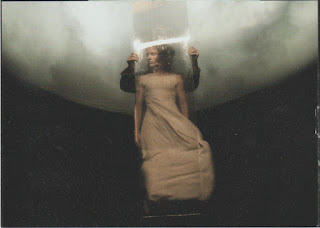
![]() |
| Still Life: Woman in the Wind |
The next scene was a woman behind a transparent flexible pane, downstage centre. (Aha, I began to think – a glass wall, if not a ceiling). But no. Men came down, stood behind her and shook the flexible pane to make her long flowing dress shake about as if in a wind. Each man moved her a little way upstage, and after a very long time when she reach fully upstage, she picked up the pane as the spotlight went off, and she went off. And that was that.
After this were several more scenes: a man carrying and dropping rocks (which really did seem heavy, or was it just a sound track that made them loud when they hit the floor?). Aha, I thought, here's good old Sisyphus. But he just came and went, leaving bits of rock all over the place. And that was that.
Up to now all the men had been dressed in suits, but next was a workman with a long-handled spade – which got used in other scenes from here on. This man shovelled his own feet in a deft manoeuvre to keep walking towards downstage, and behind him was a woman carrying rocks (a bit smaller than in the previous scene), which she dropped one by one until suddenly dropping them all at once, so he had to shovel them aside. Apparently he was very sexy, so she dropped his daks and underpants so we saw his bare backside. He leaned forward (facing upstage) while she climbed up (in bare feet) and balanced (she actually fell off first time – in the act, or not?) and so he carried her on his bare bum, oh so slowly, back upstage until they disappeared. And that was that.
That looked like the end of anything obviously to do with Sisyphus. For the next very long time people (back in suits, I think) found the ends of very long strips of gaff tape stuck to the wooden stage floor, which made fingers-down-the-blackboard type noises with deeper echoes because the floor was made of hollow rostra boxes, as they spent a very long time ripping all these strips from straight and circular lines, knocking away bits of plaster and rocks as they went. When that was finished, then that was that.
Then a man in a suit, with some help from another one, managed to balance on things like rather large bricks. He was good, but when that was done, that was that.
![]() |
| Still Life: Sunrise with Shovel |
But then the shovel got used to push up as far as it could reach into the lower surface of the translucent huge balloon-like structure which had been hanging all the time from the stage roof, with dry ice mist making it look like a cloud. When the bottom was pushed up, and a large circular Fresnel lamp lit up from upstage pointing just about horizontally at me in Row N, the whole filmy material floated, giving an impression very much like a sunset over water with a more orange light, and while the shovel man (in a suit, not a workman) and another sat down to watch on the stage (with their backs to us), the light changed and became a sunrise.
Visually, the effect was wonderful, but when it finished, that was that. Until out of upstage gloom came a fully set-for-a-sumptuous-lunch table, moving very slowly downstage especially because the bottom of each leg was placed on the top of a man’s head – no hands (except that some changed, like soccer players coming on from the bench, and hands were used to make the transition).
This table was carried off the stage onto the auditorium floor, at which point chairs appeared and all the cast sat down to eat. The audience was not invited – in fact we were completely ignored. So a number of people decided this was the end and started leaving the theatre. There was a little more action, but nothing significant, and so the audience decided it was time to clap. So the performers got up and left via the stage wings, lights went down, we clapped more and the cast came out for a conventional ‘curtain’.
And that was that.
In my later wondering, I went back to the program. It quotes Albert Camus referring to the Sisyphus myth, saying “The struggle itself towards the heights is enough to fill a man’s heart. One must imagine Sisyphus happy.”
Then I thought, remembering the broken paving in the streets of a very poor-looking Athens when I was last there, perhaps all those broken rocks and plaster walls are meant to represent the Greek economy. But then is the sumptuous lunch supposed to mean, like Camus’ Sisyphus, just be happy. Or was the lunch entirely cynical, saying it’s OK for those who can afford lunch, and don’t pay their income tax, but be damned to the rest of the Sysiphuses, men and women, struggling forever with their rocks, walls and gaff tape.
The program also refers to Dimitris Papaioannou as “Rooted firmly in the fine arts” and becoming “more widely known as the creator of the Athens 2004 Olympic Ceremonies”. So that’s that, then. I wonder.
© Frank McKone, Canberra
Subscribe to:
Posts (Atom)


