Friday, 31 August 2018

2018: The Harp in the South by Ruth Park, adapted by Kate Mulvaney

Charlie, Dolour (above), Rowena
Program Cover
The Harp in the South: Part One and Part Two, by Ruth Park, adapted for the stage by Kate Mulvaney.  Sydney Theatre Company at Roslyn Packer Theatre, August 16 – October 6, 2018.


Reviewed by Frank McKone
August 29

The time came when I knew I had to leave my green islands [New Zealand] and find a wider world, so I went to Australia and married D'Arcy Niland, a young short story writer. For a while we led a wandering life. I saw a little of this vast, magnificent land, and was captured for ever by its noble indifference to humankind. I felt that one day this continent would give a shrug and shake all the humans off into the sea. But it would still be its own self. That's what I call identity.
Text Copyright © 1988 Ruth Park, Photos © Niland Collection.
http://www.ruth-park.com.au/

Ruth Park
Sydney, 1940s
As an Evolutionary Marxist, a late teenager in 1959 with the ambition to write the great Australian novel (despite my very recent £10 Pom arrival), I attached myself briefly to the periphery of the Sydney Realist Writers’ Group, headed by the Communist, Judah Waten.  I was blissfully unaware that Ruth Park had already done what I never managed to do, when she published The Harp in the South a decade before, after it was judged Best Novel in the inaugural Sydney Morning Herald Competition in 1946.

I caught up by performing Lick Jimmy for Broken Hill Repertory Society in 1965. https://www.ausstage.edu.au/pages/event/101397 .  Directed by Kay McLachlan, the play was by “writer Ruth Park, adaptor Leslie Rees” but I haven’t been able to source a copy.  Ted Mosher, the Barrier Daily Truth reviewer, wrote under the headline Harp in the South plays well at Repertory “it is a play which will touch your heartstrings presenting as it does a pathetic-cum-humorous picture of the inhabitants of Sydney's poverty-stricken Surry Hills tenement district.”

12½ Plymouth Street, Surry Hills
Photo: Daniel Boud

Kate Mulvaney, in this massive 6 hour adaptation, has added an element of anger to Ruth Park’s novel, which she has Dolour express in a major damning speech about the treatment of women. 

It’s interesting to listen to Ruth Park http://education.abc.net.au/home#!/media/1454074/harp-in-the-south
saying “one of the quaintest criticisms was because I wrote about poor under-privileged people I was a communist and in the same mail … I was a capitalist … I was making money out of them.”  She goes on to describe her “absolute bewilderment” because she thought of her book as a “domestic comedy” – “a funny book”.

That’s how I remembered playing Lick Jimmy, who never spoke except for one line in Mandarin as he gave Roie a Christmas present.  The role was comic because he had no toilet in his next door fruit and vegetable shop.  Several times I would knock on the Darcy’s door with an anxious look, hurry through and out the back, reappearing a few minutes later with a satisfied expression, smiling sweetly on my way back next door.
 
This was the expression of warmth and community in this perhaps 2-hour play in 1965.   I never quite had that feeling while watching a quite fascinating complicated picaresque naturalistic narrative through Part One.  Some way into Part Two, which is staged as a more obviously symbolic drama, I cottoned on to a through-line concept which Mulvaney has used to give purpose to the story. 

In the novel, three elements come and go at times throughout.  The Darcy culture is centred on a romantic view of their ancient pre-Christian Irish heritage, distant in time and place.  In the present is the conflict between the rigid institutional injunctions and the socially inclusive ethics of the Catholic Church.  The third concern is the black-white divide in Australia. 

You may not be familiar with the old Irish figure of Death, who appears in the guise of someone real to take a real person ‘away’.  In Mulvaney’s play, this is the little boy Thady, Hugh and Margaret Darcy’s only son, who disappears aged six soon after they move to Surry Hills.  He reappears to ‘take away’ Hugh’s brother Jer, Margaret’s mother Eny, and his own sister Roie.  J M Synge’s Deirdre of the Sorrows is the Irish play which encapsulates the feeling, the inevitability and mystery of death which has clearly inspired Kate Mulvaney to open her play with Thady speaking to us.

For the Catholic matter, think of the story of how Australian teacher Mary McKillop became a saint and you’ll recognise Sister Theophilus, Sister Beatrix and Father Driscoll on stage here.

In the novel, Charlie Rothe – who marries Rowena and after her death finally lives on with his son Michael and her younger sister Dolour – has a great grandmother who he knows was Aboriginal.  In despair after Roie’s death, Charlie considers suicide but changes his mind after a chance meeting with an Elder.  In the novel, Ruth Park does not play up the mysterious nature of Aborigines in this encounter, though some of her characters do, at the same time as using the ‘n’ word.  Kate Mulvaney has given Angus McIntosh more to say to Charlie, in the role of an Elder teaching and giving traditional understanding to an uninitiated man, than in the novel.  Ruth Park had Charlie come to his own realisation simply as a result of Angus’ kind treatment of him in his distress.


Charlie and Roie's Wedding
Guy Simon and Rose Riley
Photo: Daniel Boud

So, has Kate Mulvaney done the right thing by her author, Ruth Park?  The Genesian Theatre, in their production some 15 years ago, called The Harp in the South ‘bitter-sweet’.  This Sydney Theatre Company production, though there is often laughter, especially in Part One, is far more bitter, while Park in the novel is surprisingly – and therefore powerfully – even-handed in presenting the motivations, feelings and understandings of her characters across the board, both of the perpetrators and receivers of bad behaviour.  Ruth Park’s calm objectivity shows the individual behaviour as the result social inequity.  In doing so, she exposed the worst of behaviour by men towards women, while her comedy keeps genuine love a real possibility.  Kate Mulvaney’s mood is a little less inviting, I feel. 

The production – as we have come to expect of STC, from the direction by Kip Williams; the stage, costumes, lighting and sound designs; and of course with such a wonderful 20-member cast playing at least 50 characters over three generations – is highly engaging throughout.  I was happy to see Part One at a 1:00 pm matinee and Part Two at 7:30 pm the same day, but since the style of Part Two is quite distinct, it would do no harm to have a day or two’s break between.


© Frank McKone, Canberra

Thursday, 30 August 2018

2018: The Misanthrope by Moliere, translated by Justin Fleming


The Misanthrope by Molière, a new version by Justin Fleming.  Bell Shakespeare in association with Griffin Theatre Company, Sydney Opera House Playhouse, August 28 – September 28, 2018.

Previewed by Frank McKone
August 28

I think I can say without reservation that
Jean-Baptiste Poquelin and Justin Fleming at
the game of couplet rhyming are equally exquisite –
so please make sure you pay them both a visit.

Their minds surely meet over four centuries fleet
In this stage production which is such a glorious treat
That even the very first preview had the audience on their feet.

Enough!, I say, but it is absolutely true that Fleming’s adaptation of Molière’s often vicious rhyming, satirising the pompous wealthy of his 17th Century day, works as well as ever for tearing strips off our modern Me, Me, Me middle class.

Even better – sex role reversal opens up the issues of individual integrity, purity and honesty, and the conflict of interest between reason and love, in a new way for a modern audience.  The old convention of the beautiful but a bit naïve young woman having to deal with two men both claiming to love her, but with very different motivations, is more than turned on its head when Alceste is now a woman, Cymbeline (Célimène) is a man – but so is Orton; and  Philinte (a polite and tactful man for Molière) becomes Philippa, whose object of romantic attentions is Éliante, still a woman now known as Eleanor, Cymbeline’s sister.  The puritanical prudish Arsenio, remains male, as up-himself as ever today as he was 400 years ago.

The clever idea in this production, I think, is that Eleanor is the Stage Manager – the most practical and unassuming person, working hard in a backstage setting that I’m sure Jean-Baptiste would instantly recognise, to get the dramatic cats herded.  This setting is a great original idea which opens up theatrical opportunities in wonderful, satirical and very funny ways.

The cast enjoyed the first run, including a couple of interesting improvisations, as much as we did and you will:

Alceste – Danielle Cormack        Arsenio – Simon Burke
Eleanor – Catherine Davies        Cymbeline – Ben Gerrard
Philippa – Rebecca Massey        Orton / Cleveland – Hamish Michael
Angus – Anthony Taufa

Director – Lee Lewis            Designer – Dan Potra
Lighting Designer – Matthew Marshall
Composers and Sound Designers – Max Lambert and Roger Lock
Voice Coach – Jess Chambers    Choreographer – Kelley Abbey


© Frank McKone, Canberra

Saturday, 25 August 2018

2018: Venus in Fur by David Ives


Venus in Fur by David Ives.  The Street Theatre, Canberra, August 22 – September 2, 2018.

Director – Caroline Stacey; Stage & Costume Design – Imogen Keen; Sound Design – Kyle Sheedy; Lighting Design – Verity Hampson; Accent Coach – Dianna Nixon; Movement Coach – Emma Strapps

Performed by Craig Alexander as Thomas Novachek, playwright/director; Joanna Richards as Vanda Jordan, aspiring actress

Reviewed by Frank McKone
August 25

In David Ives’ clever and intriguing play, Venus in Fur (singular), we see fictional Thomas Novachek as author/director of his (Novachek’s) adaptation for stage of Venus in Furs (German: Venus im Pelz - plural), an 1870 novella by the Austrian author Leopold von Sacher-Masoch. 

Good Reads at https://www.goodreads.com/book/show/427354.Venus_in_Furs describes the novella: 
'Venus in Furs' describes the obsessions of Severin von Kusiemski, a European nobleman who desires to be enslaved to a woman. Severin finds his ideal of voluptuous cruelty in the merciless Wanda von Dunajew. This is a passionate and powerful portrayal of one man's struggle to enlighten and instruct himself and others in the realm of desire. Published in 1870, the novel gained notoriety and a degree of immortality for its author when the word "masochism" - derived from his name - entered the vocabulary of psychiatry. This remains a classic literary statement on sexual submission and control.

Novachek waits in frustration, bombarded by magnificent frightening thunder and lightning, for his idea of a woman who can play Wanda von Dunajew.  He complains that in the old days a 24-year-old would have been married with five children with life experience enough to play the part – but nowadays 24 year-olds just chatter inanely in silly high-pitched voices like 12-year-olds.  Vanda Jordan clatters down the steel staircase to the only audition space Novachek can afford, a concrete basement, sounding exactly like the woman Novachek does not want.

You don’t need to have read Venus in Furs to understand Venus in Fur, though it might be interesting to do so; but I certainly do not recommend reading the summaries and study guides you can find online of Venus in Fur before seeing the play.  Much better to be surprised by the unexpected.  All I will say is that role reversal is a key element of the play’s exposure of male/female relations.

The acting by Joanna Richards and Craig Alexander, under Stacey’s direction, makes the complex transitions between their ‘real life’ roles and their roles as Severin von Kusiemski and Wanda von Dunajew look easy.  The coaching by Dianna Nixon and Emma Strapps has worked so well that we bit by bit are drawn into sensing the depth of the changing relationship which is the essence of the play – David Ives’ play, that is.

Though I find whistles, whoops and hollers an unpleasant form of applause which has become the modern fashion, I have to agree that this production is top quality from set, costume, sound and light design through to the acting, all showing a true integration of all the theatrical elements not always seen even in major company productions.

Craig Alexander (behind) and Joanna Richards
in Venus in Fur by David Ives

 Then there is the play itself.  Ives has written in the best of American tradition – Eugene O’Neill and Tennessee Williams come to mind – where stories from the past become deeply felt expressions of character and disturbing new ways of understanding the present.

Venus in Fur is small in scale compared with Mourning Becomes Electra, or Streetcar Named Desire, but it comes to grips with today’s central issue of the treatment of women.  When Joanna Richards, playing Vanda Jordan as Wanda von Dunajew, throws her line like a javelin in the face of  von Masoch / von Kusiemski/ Thomas Novachek / Craig Alexander, saying how as a woman actor in his play she is “denigrating herself”, the modern state of tension in the power-play of men and women suddenly becomes reality.  We even saw it played out this last week at the top level of government in this country.  Chaotic men still dominate, destroying the career of the woman who was probably their best bet to retain government.

But wait till you see how this play, written by a man, ends.  Maybe there’s a kind of hope after all.  Though as Shakespeare wrote “True love never did run smooth”, love doesn’t have to be quite as painful as von Masoch suggests – if men and women treat each other as true equals.

Craig Alexander and Joanna Richards
as Thomas Novachek and Vanda Jordan
in character as Severin von Kusiemski and Wanda von Dunajew
in Venus in Fur by David Ives
Photos: Street Theatre


 © Frank McKone, Canberra

2018: Mirusia - From The Heart Tour

Mirusia Louwerse
July 2017
Photo: Belinda McDowall
Mirusia – From the Heart Tour.  Mirusia Louwerse with Graeme Press (musical director and composer on piano), Leo Kram (violin) and backing singer Shannon Robinson.  At The Q, Queanbeyan Performing Arts Centre, August 25, 2018.

Reviewed by Frank McKone

At the end of a seemingly interminable week of vicious internecine political shenanigans at Parliament House in Canberra, feeling distinctly cynical, what a welcome surprise it was to find myself feeling warm and fuzzy, even a bit teary as Mirusia ended her second encore singing along with her upstanding audience “I am, you are, we are – Australian” on Saturday afternoon in our great little theatre, The Q, in Queanbeyan.

Mirusia’s joke was to thank us for making her feel more than a human being (‘humanbeyan’).  We made her feel a ‘Queenbeyan’.

Her concert of classical songs, music theatre and even the old folk song ‘Botany Bay’ focussed on heart and home.  Her theme is how, after ten years living in her parents’ home country, Holland, she remained homesick for Australia and the Brisbane of her birth and upbringing – finally succeeding in ‘importing her husband’ Youri who mans the sales desk in the foyer, where you are encouraged to buy the album of the show and donate to the Australian Children’s Music Foundation.

From the Heart is an unpretentious presentation of Mirusia’s journey from Brisbane, her success at the Queensland Conservatorium in Australia, where at the age of 21 she was announced as the youngest ever recipient of the prestigious Dame Joan Sutherland Opera Award, and her career touring the world for 10 years “as a featured soloist with the Johann Strauss Orchestra. This much loved orchestra is based in Maastricht, Netherlands and is led by the acclaimed violinist, André Rieu.”

Mirusia with André Rieu, 2016
Bringing Mirusia to The Q was a mark once again of the success of Stephen Pike and his team in providing a range of quality attractions to our region.  From the Heart indeed.

I have only two suggestions. 

I wondered if, especially in such a small theatre, whether the show might have been better un-miked.  Oddly enough, voices were rounded and clarity excellent when using the hand-held mikes, but this was not the case when Mirusia sang and spoke using only the ‘cheek’ clip-on mike.

I also felt Shannon Robinson, who sang very well, deserved to be introduced to the audience right at the beginning.  Even though it was great to hear her singing the Flower Duet with Mirusia later in the show, she looked left out of the group before that, even though we knew she was providing backing harmony.  In fact I would have liked at the beginning to have had a proper introduction to Shannon, Graeme Press and Leo Kram, with a little music played or sung by each.  In this way – in the Australian way – we would have felt more at home with a team of equals presenting the concert.


© Frank McKone, Canberra


Sunday, 19 August 2018

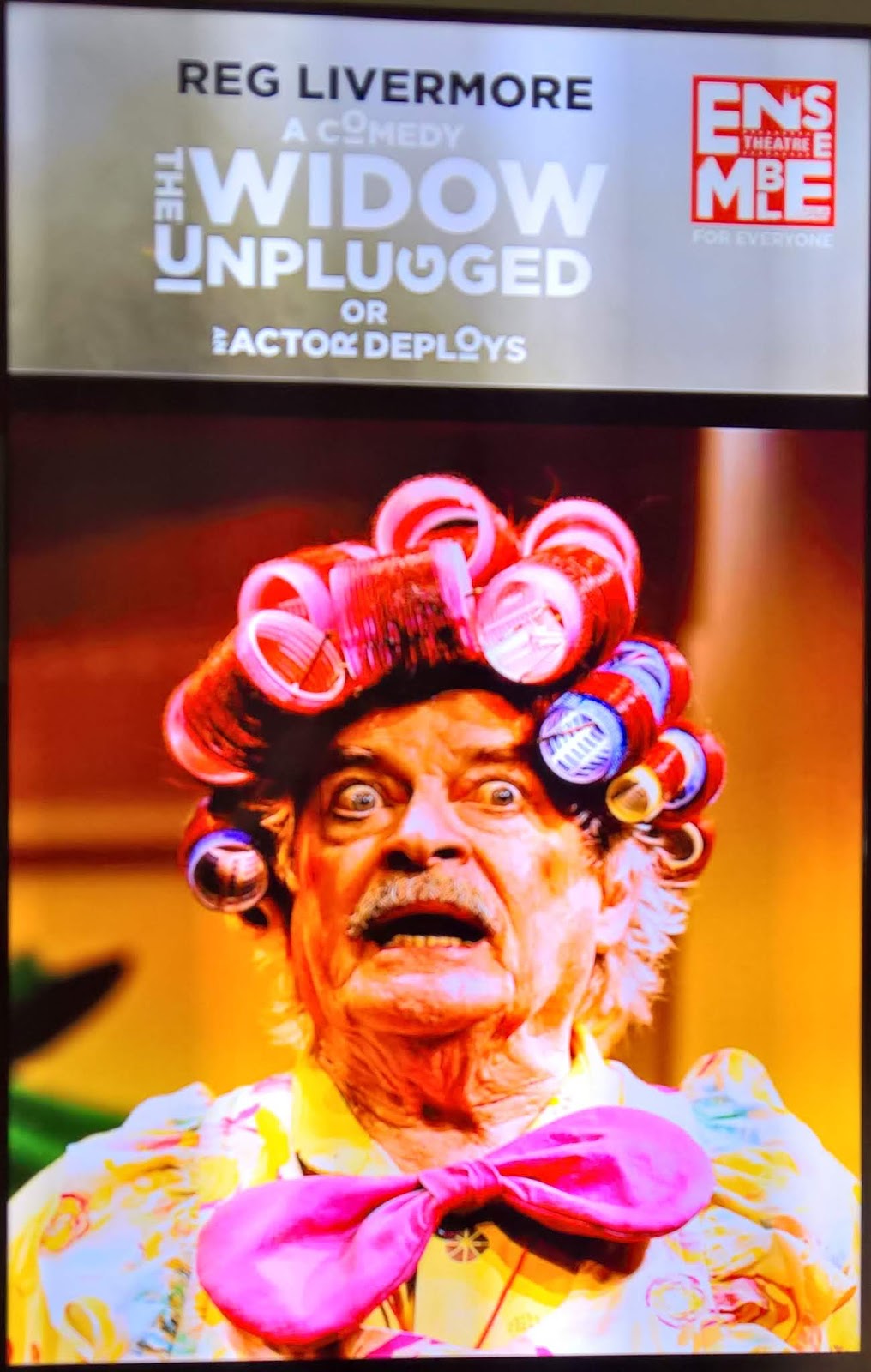
2018: The Widow Unplugged by Reg Livermore

The Widow Unplugged or An Actor Deploys written and performed by Reg Livermore.  Ensemble Theatre, Sydney, July 26 – September 1, 2018.

Director – Mark Kilmurry; Set and Costume Designer – Charles Davis; Lighting Designer – Christopher Page
Reviewed by Frank McKone
August 19

I reckon Arthur Kwick, janitor, employed by awfully wealthy Gina Rinestone, CEO of Time and Tide Nursing Home, not only to keep the place clean (no swearing) and proper (what, no drinking!!?) but to keep the “children” entertained, got a bit confused about 1969.  It seems from his published history that his alter ego Reginald Liveforevermore didn’t actually play Widow Twankey in the pantomime Aladdin that year, but acted in The Mikado in a revue devised by William Orr at the Doncaster Theatre Restaurant, Kensington, Sydney.

This news is important as you will find later, but in the meantime you will enjoy absolutely this ockergenarian vaudevillain, full to the goog as he is of malapropisms galorious.  Since most of the Sunday afternoon audience at The Ensemble were, like me, about as old as Kwick and his creator – approaching 80 – it didn’t seem odd to find ourselves enrolled as a bit past it, needing to have things explained.  Laugh?  You wouldn’t believe it!

Now in straight review mode, let me explain that Reg Livermore is certainly not past anything.  He is as spry, verbally and intellectually on the ball as he was as Alfred P Doolittle in Opera Australia’s terrific My Fair Lady when he was still only 78 last year (reviewed here August 31, 2017).  He didn’t tell us, as Arthur Kwick, how he had trained with Hayes Gordon as a founder member of The Ensemble Theatre-in-the-Round in the late 1950s.  Like Kwick, my memory can be a bit unreliable nowadays, but it’s quite likely I saw the real Reg in Tom Stoppard’s The Real Inspector Hound in 1969, perhaps when I took students to observe Hayes Gordon directing a rehearsal (though that may have been for The Effect of Gamma Rays on Man-In-The-Moon Marigolds by Paul Zindel in 1971, which Reg wasn’t in).

I may seem to be rambling a bit, but this is how Livermore’s play works – wandering through the memories – at least for the first 45 minutes.  Then after an interval (essential for a visit to the dunny by that time), we see Reg as Kwick, as the Widow Twankey.  I had forgotten, from my very young days in England, how Aladdin was supposed to be a middle-eastern story (by those people with that religion, says Kwick – what’s it called?  You know with the mosques – that’s right, the Mosquitoes).  But Aladdin’s mother, Widow Twankey, runs a Chinese laundry (including laundering money, says Kwick), and racist Chinese jokes abound.  How did this happen?  Go to Wikipedia as I did, and you find that Kwick’s characterisation is true to the tradition: 
https://en.wikipedia.org/wiki/Widow_Twankey .  So Reg has done his homework – but I just wondered if his acting in The Mikado in 1969 had got mixed into Kwick’s story of acting Widow Twankey in that year for J.C. Williamson.
http://www.reglivermore.com/history.html

The importance of Livermore’s show is how, behind the humour, there is a story of an insecure living.  Arthur Kwick has a sad ending, as at the last a nurse cheerfully settles him in his bed in the tiny attic room that Gina Rinestone has given him.  He works for no more than board-and-lodging, and we realise – with sympathy and appreciation for the entertainment he has given us – that his erratic storytelling means he is really just another of the “children”, whose only way out is “through the back door”.

On the serious side, here we see in action the theme of the current Platform Paper by Mark Williams called Falling Through the Gaps (Currency Press) about “Our Artists’ Health and Welfare” (see this blog August 10, 2018). As Williams notes, “At the welfare level, there are terrible dangers of falling through the gaps between psychic satisfaction and material security in their career path” and he mentions the fact that fame as an actor does not imply wealth or even health.  In Livermore’s play, Gina Rinestone (ie Australia’s wealthiest woman) is the opposite of Arthur Kwick, the dedicated actor sleeping on the streets after his men’s home burns down (not because they were smoking, he assures us). 

He talks his way into the janitor’s job (that’s the skill he has as an actor): though it’s only one step up from the vagrant’s home, and Gina won’t let him smoke, it’s the best security he can get – at the age of nearly 80.  Of course, it’s not my place to ask personal questions, but Reg Livermore’s Arthur Kwick ends up in the same place as Helen Mitchell, that is Dame Nellie Melba, who died in poverty.

Let’s just hope that Reg will live for quite a while yet, even though Liveforevermore is just my little joke.  He has an AO award already, and now deserves to be gonged a Living Treasure.


Left:
Dan Leno
as Widow Twankey
Theatre Royal
Drury Lane
London 1896
Photo: Alfred Ellis

Right:
Reg Livermore as Arthur Kwick as Widow Twankey


© Frank McKone, Canberra

Friday, 17 August 2018

2018: Circus Oz - Model Citizens


Circus Oz – Model Citizens, at Canberra Theatre Centre, August 17-18, 2018.

Reviewed by Frank McKone
August 17

“Circus Oz explodes back onto stage, audaciously unpacking the myths of modern Australia in their latest high octane circus show Model Citizens, the first creation fuelled by new Artistic Director Rob Tannion.

Model Citizens seamlessly blends the risk and beauty of breathtaking physical improbability with theatricality, choreography and Circus Oz’s distinct brand of Australian humour.”


There’s always a risk in pumping up the promotion that expectations might not be met.  This time around, Circus Oz needs more dramaturgy to create a clear storyline to unpack the "myths of Modern Australia" and a lot more originality in choreographic design to reach the heights of distinct Australian humour for which the company was famous from its beginning.

I suppose it is unfair or at least unfortunate for the young, and very competent, performers today to be judged by this particular critic who was lucky enough to see that wildly satirical and sometimes quite gruesome 1978 performance.  The title Model Citizens would seem to open up possibilities, but apart from a meaty song about diversity – “but not in my backyard” – and another about loving one’s Weber (which has probably mainly served to increase that brand’s sales), the humour was mildly funny and the message sometimes a bit too obvious and other times just lost in the physical improbability.

The set design of a nondescript kind of diagonal wall with an inconsequential turret at each end was hard to interpret.  A prison wall perhaps, but the message never came through.  It kept the very busy two-person orchestra partially hidden, and it seemed to be used only to give the fire-breather (who was rather frightening to the very young children near me) an access to the high wire – or rather high horizontal rope ladder – which was cleverly used to make human trapezes.

Perhaps, considering the very high proportion of very young popcorn munchers in the audience (who dismally failed the opening instructions, including to always clean up your mess – which did suggest more biting satire to come); perhaps it was OK to keep the intellectual level simple.  Of course the show was enjoyable, what with a kelpie chasing sheep all over the paddock (that is, where we were sitting), the gymnastic skills good (though I have seen better), and live musical accompaniment very effective.

So, entertaining in an ordinary sort of circus way, but not quite the explosive, audacious, and improbably absurd Circus Oz I have come to know and love.

Photos by Rob Blackburn


© Frank McKone, Canberra

Thursday, 16 August 2018

2018: Calamity Jane - Hayes Theatre Co


Calamity Jane adapted by Ronald Hanmer and Phil Park, from the stage play by Charles K. Freeman, after Warner Bros. film written by James O’Hanlon.  Lyrics by Paul Francis Webster.  Music by Sammy Fain.

Presented by One Eyed Man Productions in association with Neglected Musicals & Hayes Theatre Co.  At Canberra Theatre Playhouse, August 16-19, 2018.

Director – Richard Carroll; Musical Director – Nigel Ubrihien; Choreographer – Cameron Mitchell; Production Designer – Lauren Peters; Lighting Designer – Trent Suidgeest; Sound designer and Operator – Camden Young; Wig Designer – Lauren Proitti


Tony Taylor as Henry Miller, Nigel Ubrihien on piano
Hayes Theatre Co: Calamity Jane 2018
Photo: Jeff Busby


Reviewed by Frank (Francis) McKone
August 16

With the intelligence and wit that would make a David Pope cartoon proud, Hayes Theatre’s Calamity Jane makes America Great Again, even outshining the original 1963 Broadway production (which you can still see on the eighth wonder of the modern world, Youtube, at https://www.youtube.com/watch?v=snpqpLmOa4o ).  Carol Burnett’s Calamity was a comic performance par excellence; yet Virginia Gay, as directed by Richard Carroll takes us to a different level of interpretation.

Anthony Gooley, Sheridan Harbridge, Virginia Gay, Rob Johnson, Laura Bunting
Hayes Theatre Co: Calamity Jane 2018
Photo: John McRae


In 1963 Calamity was undoubtedly a woman challenging the norms of women’s behaviour, gun-toting on stage, while immediately and publicly making up to and making out with Lt. Danny Gilmartin (Matthew Pearce 2018) at first contact.  And it’s true that her speech demanding that Katie Brown be given the chance to prove herself – “do it your own way” – was a convention-breaking message in the transition to new feminism from the 1950s’ ‘little woman’.  Culminating in her threat to put her fist down Wild Bill Hickock’s throat and peel him like a banana, Burnett was more than funny: her audience cheered in 1963. Did Doris Day match this in the original 1953 movie?

The next scene, A Woman’s Touch, gives us a clue to the Hayes Theatre approach.  Is it possible that Calamity is Trans – sexual, gender – or maybe L or at least Bi?  In 1963 a woman’s touch meant a comic transition for Calamity as Katie Brown dresses her prettily as a conventional woman (spot-on performance by Laura Bunting 2018).  In 2018, there are hints of a ‘touch’ of a different kind, as if Virginia Gay is playing a friendly joke upon her surprisingly appropriate real name.

Of course, in the end Calamity’s being unsure of her sexuality is resolved into a straight scene of three plainly male-female marriages, in the tradition of romantic comedy going back to Shakespeare’s parallel Much Ado About Nothing. Think of Benedick as Wild Bill Hickock: the men’s names are telling – try saying them out loud with emphasis on the last syllable (and a great performance by Anthony Gooley) and Beatrice as Calamity (a fascinating complex characterisation by Gay).

Foreground: Anthony Gooley, Virgina Gay, Laura Bunting, Matthew Pearce
Background: Nigel Ubrihien, Tony Taylor, Rob Johnson, Sheridan Harbridge
in Hayes Theatre Co: Calamity Jane 2018
Photo: John McRae


Then, the other clever aspect of this production, which I guess couldn’t have been done on old Broadway, was Richard Carroll and Lauren Peters’ involvement of the audience.  It was fun to have a few tables on stage in the Golden Garter Saloon, but the really clever bits were the references to Canberra as if it were Deadwood, and today’s politics squeezed in, including Donald Trump’s famous claim.

When we really thought an irate audience member was attempting to get in late, knocking furiously on a door near us, with an attendant firmly explaining no-one would be let in until the next song-and-dance number (which we supposed would cover the disturbance of his entry), the door was finally burst open to the horror of all on stage, to reveal Rob Johnson as a wonderful Francis (not Frances) Fryer, just off his stage coach and determined to persuade Henry Miller (a strong performance by Tony Taylor) to let him perform, and finally to marry his ‘niece’ Susan (an excellent performance by Sheridan Harbridge, who also played Adelaide Adams in Chicago and who was never going to perform in, shudder, Deadwood). 

And, more fool us, we were even found ourselves standing for a full house ovation! 

Except, of course, the quality of the acting, singing and dancing deserved it.  Hayes Theatre’s Calamity Jane is entertainment plus.  An essential part of the plus is musical director Nigel Ubrihien, with a terrific ragtime style on piano (better, I think, than the big-band production on Broadway – more ‘right’ for Deadwood’s Golden Garter, and a much more personal feel for this small-cast production).

More subtle in design and characterisaton, with not a shot fired on stage, this Calamity Jane is definitely not to be missed.


Virginia Gay as Calamity Jane


© Frank McKone, Canberra

Friday, 10 August 2018

2018: Mark Williams: Falling Through the Gaps - Platform Papers No 56

Falling Through the Gaps: Our artists’ health and welfare by Mark R.W. Williams.  Platform Paper No 56, Currency House, Sydney, August 2018.

Commentary by Frank McKone

“Many giants stand on the shoulders of pygmies” is a comic insight well worthy of a lawyer who has spent his life on and off stage as much as in courts.  He acknowledges his wife, Fiona Gruber, for her “insights going back to a cast list for The School for Scandal in the 1770s containing RB Sheridan’s notes”. Sheridan wrote “scratch Groves”.  The Groves not chosen was an ancestor of  “the last of the Groves”, Gruber’s late uncle Donald, while earlier in the line was Fred Groves “who worked for Fred Karno’s circus and developed the silly walk that Charles Chaplin took over when Fred Groves left the company”.

“To the Groves family: you aren’t forgotten.”

The sense of humour is infectious but in Maslow’s hierarchy of needs “if self-actualisation sits at the top, and making and working with great works of art brings one towards it, some seekers will always struggle up to grasp it before they have a firm footing….So, keeping the prize firmly in view, let’s have a look at the base of Maslow’s pyramid for workers in the performing arts.  At the welfare level, there are terrible dangers of falling through the gaps between psychic satisfaction and material security in their career path.”

And so his Chapter 6 “From problems to solutions” begins:

From my own observations of the Australian and, to lesser extent, English performing arts scene, anyone of my generation who expected to have a career in the performing arts needed to start with the price of a house.  That’s right, start with it.

Williams’ purpose is not to wallow in stories of  performers living in poverty, drawn into dangerous use of alcohol or other drugs, or even committing suicide; nor of the difficulties of short-term and unpredictable employment, the need to move – often around the world – to follow the work, and the effects of these on family and personal mental stability.  He does make the point that the public’s perception of well-known performers as doing well for themselves is often out of touch with the reality that a big payout for one event (or even several events over years) which makes their name does not create what he calls a “longtail” income, or set them up with a comfortable retirement.

He does mention Helen Mitchell aka Nellie Melba as a case in point, though, and it is instructive to read the details of the provisions and lack of provisions for people working in the theatre industry, and the facts and figures about incomes and superannuation balances in comparison to other industries.

Williams’ purpose is to lay out practical structural steps “to fix the problems with which we find ourselves today”.  In brief:

 Industry superannuation funds trust deeds to make particular provisions for emergency and charitable support;
 Commercial funds to build in elements of social responsibility to support their members and the wider community;
 Government to consider a better salary sacrifice system for individuals in relatively good times of well-paid work to make additional contributions to their super via the PAYG system;
 Levy (say 5 cents) per ticket sold in Australia to live performance to fund super supplement for performers;
 Greater training and funding for dealing with health and mental health in the performing arts;
 Performing arts education institutions to teach realistically about the downside of being a creative performer, the protocols of good performance and the economics of the industry;
 Industry unions and producers to encourage whole-of-life support by companies.
 Benevolent funds to be inclusive…and avoid divisions of employment between ‘legitimate’ theatre, the media, variety and cabaret, circus, backstage and front-of-house.

I found Williams’ description of the situation and past history which has led to how the Australian industry operates made me think wider than employment in the arts.  He mentions in passing the similarities with what has begun to be called the ‘gig economy’, in which people are contracted for all sorts of jobs (the ‘gig’ – a word borrowed from the pop music industry, I think), without the protections and benefits of being ‘employees’.

This leads me to take seriously the moves already well underway in Europe towards a new system of supporting whole-of-life survival in the new life of flexible work and continuously changing technology.

The concept of Universal Basic Income, which is being trialled in Finland and elsewhere including Canada right now, may be well worth a visit.  There’s an interesting run-down of what’s happening (as of April 26, 2018) at https://www.wired.co.uk/article/finland-universal-basic-income-results-trial-cancelled

If you would like a more substantial discussion of Universal Basic Income (UBI), I invite you to look at the RSA article
https://www.thersa.org/discover/publications-and-articles/rsa-blogs/2018/02/pathways-towards-economic-security-and-universal-basic-income-new-rsa-report?id=utm_medium=newsletter/fellowship/260218

[The Royal Society for the Encouragement of Arts, Manufactures and Commerce (RSA) is a still active 17th Century London-based, British organisation committed to finding practical solutions to social challenges.  Disclosure: I am a Fellow of the RSA ANZ]

For a fun finish, read “I hated maths at school. It came back to bite me later.” by Danny Katz (Canberra Times, 10 August 2018).  He turns the Binomial Theorem into the Buy-no-meal Theorem and Differential Calculus into Depressional Calculus, and – consistent perhaps with Mark Williams’ arts education suggestion – demands that “ArtsMaths should become a proper subject, compulsory for all poncey gits, massive wankers and arty dickweeds” like him.
https://www.smh.com.au/lifestyle/life-and-relationships/i-hated-maths-at-school-it-came-back-to-bite-me-later-20180809-p4zwij.html


© Frank McKone, Canberra

Thursday, 26 July 2018

2018: Dark Emu by Bangarra Dance Theatre

Dark Emu.  Bangarra Dance Theatre at Canberra Theatre Centre, July 26 – July 28, 2018.

Artistic Director – Stephen Page; Costume Designer – Jennifer Irwin; Lighting Designer – Sian James-Holland; Cultural Consultant – Yuin/Biripi Nation Woman, Lynne Thomas; Set Designer – Jacob Nash; Dramaturg – Alana Valentine; Composer – Steve Francis; Language Consultant – Yuin knowledge holder, Warren Foster.

Choreographers: Stephen Page, Daniel Riley, Yolande Brown, and the dancers of Bangarra Dance Theatre.

Reviewed by Frank McKone
July 26


To say Bangarra’s Dark Emu is just wonderful is not enough.  I felt a great sense of wonder growing from the first appearance of the people – our First People – heads and then lifted arms, hands exploring space, whole bodies stretching, twisting, turning in a new land.

By the end it was a great wonder, expressed in glorious, powerfully appreciative applause from the full house, for the ingenuity, determination and resilience in the people’s survival – throughout the ages long before as well as since 1770.


In this beautifully abstracted dance-drama, the enclosure of the people by invaders’ fences and cultural tie-downs is just the latest brief time of struggle compared with the aeons of learning to manage growth in this land of fire and flood.

The people win through as they always have.  In the final image, a reprise, we return to the land of the beginning.  The dancers leave the scene, heads high.  The wonder of their living is complete.  This is their land still, and ever will be.
___________________________________________________________________________

After how I felt and what I thought, there’s much more to be said about this production.  I am not formally qualified to judge dance technique in any detail, but I saw here a unified style clearly deeply engaged in traditional dance forms yet developed into highly emotive modern dance.  That in itself dramatically represents the theme of the work.

The energy of the drama is driven by extraordinary surround sound, tremendous visuals (the fire scene was frightening while unavoidably beautiful) – the whole combined with the most original costuming of the dancers becoming a great example of the effective integration of technology in the work, moving us along through 16 scenes in 70 minutes.

The modern qualities (and top-class quality) of the staging enhances the point of the story – First Peoples belong to the ancient past yet live essentially in our world today – still exploring new ways to express their continuing culture.

There is the wonder indeed, working from the study done by Bunurong/Tasmanian Bruce Pascoe in his book – essential reading – Dark Emu, Black Seeds: Agriculture or Accident? (Magabala Books, 2014).  This work – both the book and the dance-drama – changes all our understanding of rhe past towards a better future.  More than wonderful – just outstanding.


 Photos by Daniel Boud

© Frank McKone, Canberra

Sunday, 15 July 2018

2018: Bliss by Peter Carey, adapted for stage by Tom Wright

Toby Truslove as Harry Joy
in Bliss
Photography by Pia Johnson

Bliss by Peter Carey.  Adapted for the stage by Tom Wright.  Belvoir & Malthouse Theatre at Belvoir Street Theatre, Sydney, June 9 – July 15, 2018.

Reviewed by Frank McKone
July 14

Cast: Marco Chiappi (Alex Duvall and others); Mark Coles Smith (Joel Davis and others);  Will McDonald  (David Joy and others); Amber McMahon (Bettina Joy and others);  Charlotte Nicdao (Lucy Joy and others);   Susan Prior (Alice Dalton and others); Anna Samson (Honey Barbara and others);  Toby Truslove (Harry Joy)

Bliss is an unreal play.  If you are my age, which is about the same age as Peter Carey, who was about the same as Harry Joy was when Peter Carey published his first and I think best novel in 1981, then you know what I mean when I say the novel, and even more this stage adaptation is ‘unreal’.  A bit later in time (‘unreal’ was first recorded in 1965) Harry Joy’s daughter Lucy might have said ‘gas’.

Nowadays, ‘cool’ doesn’t cut it  This show is full on.  I can’t say, don’t miss it – because you already have in Sydney.  And in Melbourne too (May 4 – June 2).  What a bummer!

Charlotte Nicdao as Lucy Joy, Anna Samson as Honey Barbara, Toby Truslove as Harry Joy
in Bliss

So, why would you want to see a show about a weird kind of 1970’s adman, sort of naïve about making money (reminds me of the 2007 Mad Men tv series set in the 1960s).  But Harry Joy dies three times, by my count. 

Nearly, when he has his heart attack and wakes up in what he thinks is hell – that is his old life.  More metaphorically when his wife Bettina (now the kids are grown up) turns out to be better at running a business than he had ever been, and drags him back into advertising.  That’s when the image of Honey Barbara draws him away to the rainforest.

And finally for real, when the gum tree he had planted in his blissful forest retreat drops a branch on him in old age while he works in his garden.

It’s all about Australia, you see.  Or perhaps you don’t – yet.  It’s certainly all about Peter Carey, who escaped from a 20 year career in advertising  (and mainly short story writing) until his The Fat Man in History got him noticed (1974) and Bliss made him a celebrity.  So why since 1990 has he lived in New York?  Not the seductive rainforest like Harry Joy?

I guess this is the Australian bit.  Harry Joy’s retreat to the world of nature is actually unreal.  His being recognised by Honey Barbara at the climactic point in the play as essentially honest in his naif kind of way, and so she loves him for genuinely being himself – this is the quality of being Australian.  Even though the gum tree, being equally itself, drops a branch and kills you.

And as for the work of adapting the novel by Tom Wright, directing by Matthew Lutton, designing by Marg Howell (Set & Costume), Paul Jackson (Lighting), Stefan Gregory (Composer and Sound), and all the cast – it is exactly this Australian quality that makes this production unreal. It has life, energy and honesty.  And, for us, even though we know about widow-maker gum trees, we leave the theatre on a high note.

The story is about truth in art.  This production of Bliss is truly art.

Charlotte Nicdao as Lucy Joy, Amber McMahon as Bettina Joy, Anna Samson as Honey Barbara
in Bliss

© Frank McKone, Canberra


2018: The Man in the Attic by Timothy Daly


The Man in the Attic by Timothy Daly.  Shalom & Moira Blumenthal Productions at Eternity Theatre, Darlinghurst, Sydney July 4-22 2018.

Reviewed by Frank McKone
July 14

Director – Moira Blumenthal; Set & Costume Designer – Hugh O’Connor; Lighting Designer – Emma Lockhart-Wilson; Sound Designer – Tegan Nichols;

Cast:  Barry French – The Jew; Danielle King – The Wife; Gus Murray – The Husband; Colleen Cook – The Neighbour


Shalom Theatre, in conjunction with Moira Blumenthal Productions, stages a professional production each year, “telling universal stories which reflect the history, culture and identity of Jewish life.” 

Timothy Daly has written “I first came across the story of The Man in the Attic over a decade ago, in a book of German radio plays, which made the briefest of references to a newspaper clipping of the trial of a couple who were accused of keeping a Jewish man ignorant of the fact that World War II had ended…. I needed access to the records of the actual court case. (The un-named couple were apparently taken to court over the deception.) All attempts to locate the transcript failed, not least because it took place in a rural area whose court appeared no longer to exist.”

So “in the absence of the full historical record, some of the play had to be re-imagined and even re-invented. As a simple example, to this day, I do not know the name of the Unknown Jew who is the hero of my play. But, in a strange way, it did not matter.”

The Man in the Attic, then, indeed reflects “the history, culture and identity of Jewish life”, but is a story of much wider significance.  In the German tradition, for example, the story of why the anti-Semitic husband kept the man in his attic, despite the risk – in order to make money on the illegal black market in the chaos of 1945 – was a parallel to the fictional story that Bertolt Brecht had written in 1939, Mutter Courage und ihre Kinder, set in the Thirty Years’ War of the 17th Century. 

And, I imagine, in the current chaos of refugees doing their best to escape – often with the worst results in detention centres around the world, not to mention boatloads drowned – there are many making money on the side.  We might see The Wife who rescued the man hiding in the woods, in this play, as a ‘bleeding heart’ – as Peter Dutton, Minister for Border Security would say – but her Husband turns out to be Dutton’s other bete noir: a ‘people smuggler’ of a particularly nasty kind.  He uses sex with the Party woman next door who might reveal his business to authorities, and finally kills her when he can steal her ill-gotten gold – for the money and also to permanently protect his business.

The Wife, of course, has to go along with her husband and even compromise herself by telling lies to the The Jew, since the reason she found him in the first place was she was searching for wild fruit in the forest when she had no money and the shops, even if she could have paid, had been bombed by the Allies.  Even after Hitler’s death (which the German radio announced as a glorious sacrifice) and the Americans appeared with pictures of the Holocaust, these villagers had to keep the expert watchmaker in their attic working.

What actually happened in real life is not clear, but Timothy Daly finally allows The Wife’s conscience to get the better of her, and she releases The Jew while her Husband is away ‘on business’.  The play does not suggest how The Jew might have got on even when freed.  I can only add a personal touch.  I am named after my uncle who was captured early in the War, but who fortunately returned to England in 1945.  He walked from Poland to Holland to get home, but would never say anything about what he saw on the way.

So, though I cannot say that Daly’s scriptwriting is of Brechtian quality, the set design, costuming, lighting and especially sound are effectively done, and the acting and directing competent.  The result is a production which should be seen because it reveals how terrible are the effects of big power play in human society on the lives of ordinary people.


© Frank McKone, Canberra

Wednesday, 4 July 2018

2018: Switzerland by Joanna Murray-Smith

Switzerland by Joanna Murray-Smith.  Pigeonhole Theatre at Canberra Theatre Centre, Courtyard Studio, July 3-14, 2018.

Director – Jordan Best; Designer – Michael Sparks; Lighting Designer – Cynthia Jolley Rogers; Props – Yanina Clifton; Composer – Matthew Webster.

Performed by

Karen Vickery – Patricia Highsmith
Lachlan Ruffy – Edward Ridgeway

Reviewed by Frank McKone
July 4

Karen Vickery and Lachlan Ruffy
as Patricia Highsmith and Edward Ridgeway
in Switzerland by Joanna Murray-Smith
Photo: David James McCarthy
Joanna Murray-Smith has written a quite remarkable play.  Not only does Switzerland play cleverly and wittingly with the genre of murder mystery, the form for which Patrica Highsmith is famous when creating the character Ripley in The Talented Mr Ripley (1955), and, of course, the form which made Agatha Christie compulsory reading in my mother’s generation.

In this play, Murray-Smith has created two characters – one based on Patricia Highsmith (1921 – 1995) and the other presumably entirely fictional Edward Ridgeway, supposedly sent from Highsmith’s New York publisher to her retreat in Switzerland to persuade her to write one more Mr Ripley novel before she dies.

Pigeonhole’s direction, design and casting are all up to the standard well-established since their original offering (Playhouse Creatures by April de Angelis, reviewed on this blog March 2016) – with the added intensity of a demanding confrontational two-act two-hander.  Our attention never wavered, watching Karen Vickery’s aggression and Lachlan Ruffy’s determination.

Two aspects of this play interested me - Murray-Smith’s inventive twist of the murder mystery convention and her interpretation of the psychology of Patrica Highsmith.  The central twist is that Edward Ridgeway, in standing up to Highsmith’s contumely, morphs into the character she had created.  He becomes Mr Ripley and murders his creator.  So she dies before writing the last Mr Ripley novel, after all.  Or did the real Highsmith complete the work, Ripley Under Water (published 1991), and then was metaphorically murdered when she died in 1995?

It is Murray-Smith’s interpretation of what this means that fascinates me.  At this point I have not read all the research material that I assume Murray-Smith has (you can start at https://www.biography.com/people/patricia-highsmith-121715 ), but I wonder why Murray-Smith’s Highsmith insists on her lesbian sexuality, and for the right of women to be equal and independent against society’s patriarchal forces, yet at the end of the play appears to have fallen for Edward Ridgeway / Mr Ripley – and he for her – making their encounter apparently essentially sexual rather than professionally platonic, in an all-encompassing kiss.  After which, as she turns away in contemplation of the experience, he kills her with her favourite knife, which he had given her, taken down from the display of guns, swords and knives which cover the wall of her writing space.  (The other play you might like to consider at this point is Le Leçon by Eugene Ionesco).

Is she simply thanking Ripley / Ridgeway for her writing success?  Is she denying her lesbian nature?  Are we to take this as a political statement in support of sexual difference and the right to individuality; or are we to think Murray-Smith sees Highsmith as psychologically disturbed – that her writing and creating fictional characters is/was more real than reality?

Could it even mean that Murray-Smith herself is concerned about her own psychological state as a writer?  Or that all creatives live in “a world of their own”, as Murray-Smith’s Patricia Highsmith says she does?

And does this make Switzerland and its author something unusual and even “great” in Australian writing? 

I leave that consideration for my readers, but in my view Joanna Murray-Smith wittingly challenges patriarchal society in Switzerland.


© Frank McKone, Canberra


Thursday, 28 June 2018

2018: The Curious Incident of the Dog in the Night-Time


The Curious Incident of the Dog in the Night-Time adapted by Simon Stephens, based on the novel by Mark Haddon.  National Theatre of Great Britain at Canberra Theatre Centre, June 27 – July 1, 2018. 

Reviewed by Frank McKone
June 27

If I describe this highly energised show as “children’s theatre for adults” I may upset most of the very large and equally highly appreciative audience on opening night.  I might perhaps ameliorate their response a little if I called the show “adult theatre-in-education”. 

I would probably make things worse for myself if I objected to the gratingly commercialised approach to the publicity, including the business of selling “official merchandise” derived from telling an ultimately heart-warming story of a child savant who as an impossible child splits his parents apart but equally impossibly brings them back to working together on his behalf.  Here’s what you can buy in the foyer:


But let me explain.  The drama is plot-centred, based upon setting up anticipation, points of potential achievement, episodes of likely disaster, climaxing in a major success and leaving us with a grand sense of hope for the future. This is the story of Christopher Boone, who can only tell the literal truth, succeeds in discovering who killed his neighbour’s dog, and scores 100% in a matriculation-level advanced maths test and expects to become a scientist – in other words, essentially a children’s story. 

Joshua Jenkins, on stage throughout each hour-long act – and even after curtain call to demonstrate the algebraic equation which describes Pythagoras’ square on the hypotenuse theorem – maintains an exhausting pace in physical movement, let alone in the abrupt changes in Christopher’s responses to a world which overloads his senses.  He does an admirable job, as indeed do the whole cast, but in truth (like Christopher I can only tell the truth) the plot is the thing, not any complexity of character. 

The style, appropriate to the task, presents us with a quite amazing picture book: we want to turn the pages.  We feel for Christopher and his Mum (Emma Beattie) and Dad (Stuart Laing), and even for the dead dog with the garden fork stuck in it.  We want to cheer Christopher on. We laugh and are happy for him when the train leaves Swindon before the policeman can get Christopher off (which would have been to face his father at the police station). We are afraid for his life when he jumps into the underground train track to rescue his pet rat.  We are amazed he manages to navigate the London Tube as chance voices give him incomprehensible clues.  And I was stunned when his mother and her current partner happen entirely by chance upon Christopher in a street presumably not too far from the address he has memorised – from the letters he secretly found in his father’s room, which proved his mother was not dead from a heart attack, as his father had told him, but alive in London.

So the acting is physical and close to cartoon in style – and very well done at that – while the set design is visually, audibly and technically dramatic, including especially Christopher’s putting together, bit by bit throughout the performance, a toy electric train set covering the whole stage.  It lights up and starts the train running as the play ends – highly symbolic of Christopher’s journey.

There is plenty to think about from an adult point of view, even though the design, in technique, is what the best of theatre-in-education teams would do – if they had the money.  A good comparison would be with Australia’s Shake & Stir Company, for example in their stage interpretation of  Emily Bronte’s Wuthering Heights (reviewed on this blog March 9, 2016). 

The inability of Christopher’s mother to cope with a son who cannot recognise ordinary emotional clues, let alone respond to them except by extraordinary but purely literal logical comment, and her finding solace in a neighbour’s husband, is sad.  The response of Christopher’s father in violently rejecting his wife, killing the neighbour’s dog, telling his son that his wife has died (including a lengthy fiction about her time in hospital and her death), and hiding her letters addressed to Christopher from London, is an awful indictment of human vindictiveness.  This is an adult tale of the human condition.

Yet, because the core of the play is the plot and the characters cannot be fully developed, I found it hard to believe how Christopher’s mother could return to Swindon so easily – though it was true that she continued to live apart from her husband and, I suppose, kept herself at a distance from married intimacy just enough to support her son’s continuing need for help.  The play did show his father’s attempt to regain his son’s acceptance – this was a symbolic gentle hand-touching – and Christopher’s rejection of the contact.  I haven’t read the novel and at this point I’m therefore only considering Simon Stephens’ play. 

There are certainly adult concerns and issues here, but the happy ending as Christopher receives his result – which he accepts without excitement since he had no doubts about his having completed the exam perfectly – leaves me unsatisfied.  His teacher (Julie Hale), a great example of compassionate professionalism, is overcome by Christopher’s success, as is his mother, and even his father sincerely tells Christopher how proud he is.  But the play fails the adult education question I have: what chance does this extreme Asperger Syndrome character really have of coping when he is frantic under the normal bombardment of noise and movement which is part of other peoples’ ordinary lives; when he is obsessive to the extreme that his mother has to clean his toilet before he can use it after any stranger; and when he quickly turns to aggressive acts like hitting and even trying to stab someone – admittedly his mother’s London manfriend who is clearly obnoxious.

This play doesn’t offer any hope to us adults, except for the everlasting patience of the teacher – who, of course, even so, must remain at a professional distance and refuse Christopher’s request to live with her in her house.

So, I conclude that this production of The Curious Incident of the Dog in Night-Time is an interesting example of theatre-in-education which raises questions for adult consideration – but leaves us with no easy answers or even suggestions.  That’s why I find the promotion of the production – done in much the same format as for the recent royal wedding – is superficial commercialism, which I find grating, when the issues of how we can improve the lives of people born with such differences as Asperger’s Syndrome are deeply difficult, and require great respect from the rest of us.

Joshua Jenkins and Emma Beattie
in The Curious Incident of the Dog in the Night-Time

Director – Marianne Elliott; Designer – Bunnie Christie; Lighting Designer – Paule Constable; Video Designer – Finn Ross; Movement Directors – Scott Graham and Steven Hoggett (Frantic Assembly); Music – Adrian Sutton; Sound Designer – Ian Dickinson (Autograph)


© Frank McKone, Canberra


Monday, 18 June 2018

2018: Saint Joan by George Bernad Shaw

Sarah Snook as Joan
in Saint Joan by George Bernard Shaw
Photo: Brett Boardman
Saint Joan by George Bernard Shaw.  Sydney Theatre Company at Roslyn Packer Theatre, June 5 – 30, 2018.

Reviewed by Frank McKone

I first acknowledge George Bernard Shaw.  At 16, my adult life began with my reading his 1924 play Saint Joan and his Intelligent Woman’s Guide to Socialism and Capitalism.  This phase took me from the fifties to the sixties, to Bob Dylan’s words about The Times They Are A-changing: “I had to play this song on the same night that President Kennedy died.”

Now in 2018, at a similar age Shaw was when he was awarded the Nobel Prize for literature in 1925, I humbly acknowledge Imara Savage and Sarah Snook for showing me the right Saint Joan for our times, true to Shaw and the direction of change – even in the face of those who would take us backwards to the fifties or worse.

This production of Saint Joan must surely travel the world.  Not merely because it has such clarity of purpose and theatrical intensity, but because people need to understand the ethics of civilisation – if you like, of the Western tradition.

Sarah, Imara and writer Emme Hoy have done what I had never imagined could be done: they have made Shaw’s work even more powerful than he could have known.  As Imara has written in her Director’s Note: “Shaw, like Joan, was a thoroughly modern individual, a rebel and an agitator.  It is in this spirit that we have approached the work.  And whilst failure is always a possibility, an unambitious Saint Joan is really no Saint Joan at all.”

They have trimmed and refocussed the original script because times have indeed a-changed.  Shaw’s audience, shortly after the mass destruction of World War I, needed to have Joan, seeking support early in her career, introduced to them via some seemingly inconsequential comedy at Robert de Baudricourt’s expense: “No eggs!  No eggs!  Thousand thunders, man, what do you mean by no eggs?”  His steward explains:  “Sir: it is not my fault.  It is the act of God.”

Today’s audience, after World Wars I and II and the current threat of a breakdown in world order, wants humour of a different kind – direct and pointed.  And so we begin today with the meeting in Scene IV of Richard de Beauchamp Earl of Warwick and Bishop Cauchon of Beauvais.  Apart from asides like “We were not fairly beaten, my lord.  No Englishman is ever fairly beaten”, the issue of Joan’s success – “Charles is to be crowned at Rheims, practically by the young woman from Lorraine; and – I must not deceive you, nor flatter your hopes – we cannot prevent it...” as Warwick lays the political cards out:  “It would, I presume, be the duty of your reverend lordship to denounce her to the Inquisition, and have her burnt for that offence” of being a sorceress.

This is Shaw with no leavening of the horror of Joan’s situation.  This the Shaw whose every word is telling, whether it makes us laugh or cringe in its irony.  Nothing of Shaw’s writing is lost, while some is added so that we come to know and understand Joan’s voices.  We know from the beginning of this production that we are in the hands of a great playwright.  Sarah’s Joan becomes more than a mere theatrical symbol as she realises how she has been fooled into signing a confession which will lead to a life worse than death.  Sarah’s performance is nothing short of miraculous.

Focus in simplicity of costume, set design, lighting and sound is the keynote to this production.  Wherever it goes, this design must go with it.  See it very soon if you can, or seek out Sydney Theatre Company’s Saint Joan wherever in the world you may find it.


Director – Imara Savage
Additional Writers – Imara Savage, Sarah Snook, Emme Hoy

Set Designer – David Fleischner; Costume Designer – Renee Mulder; Lighting Designer – Nick Schlieper; Composer & Sound Designer – Max Lyandvert

Gareth Davies – Dauphin / King / Assessor / George
John Gaden – Inquisitor / Archbishop
Brandon McClelland – General / Executioner
Sean O’Shea – Priest
Socratis Otto – Officer / Prosecutor
Sarah Snook – Joan
Anthony Taufa – Brother / Bluebeard / Julian
David Whitney – Earl / Captain
William Zappa – Bishop


© Frank McKone, Canberra