Saturday, 5 May 2018

2018: ‘So That You Might Know Each Other’ - Exhibition at NMA

‘So That You Might Know Each Other’ – Faith and Culture in Islam.  Exhibition at the National Museum of Australia, April 20 – July 22, 2018.  Free Entry.

Reviewed by Frank McKone
May 6

Museum people love to tell you how many ‘objects’ they have in a collection.  For this exhibition, I prefer the French word ‘objets’, as in objets d’art.  ‘So That You Might Know Each Other’ is certainly not about exhibitionism.  The items on display are from the daily lives of people, from the many ordinary to the occasional wealthy, shaped and decorated in beautiful ways.


 Is that what you expected from the rest of the title, ‘Faith and Culture in Islam’?  Perhaps not.  There is as much to learn from the story of this exhibition as there is to see in the exhibition.  Senior curator Carol Cooper’s quietly effervescent enthusiasm shines through.  An overhead spotlight projects an outline of the map of the world from Italy in Europe to China in the Far East, and round the corner to Australia in the South.

It all began with the Roman Catholic Pope Pius XI in 1925 and Fr Nicola Mapelli nearly a century later.  Let me explain.

I think of the NMA as a dynamic museum, not stuffed with objects from the past for people to stare at, but always mounting changing exhibits which illuminate not only the past, but the present too, with implications for the future.  Songlines – Tracking the Seven Sisters is a terrific example (reviewed here 17 November, 2017).

The story of ‘So That You Might Know Each Other’ begins in a museum set up in the Vatican by an Italian pope, Ambrogio Damiano Achille Ratti, perhaps looking forward to the present Pope (who hails from South America).  Pius XI took the meaning of ‘catholic’ to suggest the church should collect in a museum – now known as the Anima Mundi – items which would show the philosophy of being ‘universal in extent – involving all’ (Macquarie Dictionary). 

As I see it, there could be two motivations for this decision.  Translated as ‘the soul of the world’ it might be seen as Roman religious colonialism.  But I suspect that Pius XI also thought of bringing to the Vatican, which in those days was an insular organisation, the ‘life’ of the world to make his administrators and Italian Catholics aware of the variety of other peoples’ beliefs and practices.  It is this interpretation which I’m sure Fr Mapelli, and the Director of Vatican Museums, Barbara Jatta, are working from.  It makes the translation something more like ‘Welcome to the World’.

Though I, personally, don’t subscribe to any religious belief, I see in their work the human rights and understanding value in a cooperative venture with the Sharja Museums Authority of the essentially Muslim society in the United Arab Emirates.  I don’t doubt that Jorge Mario Bergoglio, who was elected the 266th pope of the Roman Catholic Church in March 2013, becoming Pope Francis, and the first pope from the Americas, fully supports cross-cultural cooperation.  His choice of the saint’s name ‘Francis’ is obviously significant, and bodes well for human rights.

On the other side of the hand-shaking is a human rights interpretation of the essential Islamic text, the Q’ran.  Though I, again personally, have concerns about the parts of text that seem to be divisive, encouraging fighting in defence against believers’ enemies, there are two quotes which underpin this exhibition.

In Chapter 57, Iron, after the early prophets Noah and Abraham, “We sent other apostles, and after these Jesus son of Mary.  We gave him the Gospel and put compassion and mercy in the hearts of his followers.” (trans. N J Dawood, Penguin 1956)

The other includes the title of the exhibition: "O Mankind, We created you from a single pair of a male and a female and made you into nations and tribes, so that you may know one another. Verily the most honored of you in the sight of God is he who is the most righteous of you" (Chapter 49, The Chambers).  This translation is from an excellent paper by Abdul Malik Mujahid, delivered at the International Council of Christians and Jews (ICCJ) Conference, Istanbul June 23, 2010.
http://www.iccj.org/redaktion/upload_pdf/201011262022430.Mujahid_keynote.PDF

In this paper, Abdul Malik Mujahid explains:

In this brief verse, Islamic scholars have been able to draw several fundamental Islamic principles which are reaffirmed elsewhere in the Quran and the Prophet’s teachings:

 God addresses all of humanity, not only the Muslims. 

 God says that He created us from one man and one woman, thus making us all
brothers and sisters. 

 The verse invalidates the claims of superiority due to one’s birth by stating that all
are born through a similar process, i.e. from a male and female. 

 God is the One who made human beings as part of tribes and nations as a means
of identifying and differentiating. This is not meant to be a source of superiority
or inferiority, nor as a contributing component of tribalism, caste systems,
nationalisms, colonialism or racism.

 The only measure of greatness among human beings is at the individual level, not
on a national or group level, based on the characteristic called “Taqwa” in Arabic.
This word means God-consciousness.

 This singular criterion of preference, Taqwa, however, is not quite measurable by
other human beings since it deals with the inner self. Therefore, human beings
must leave even this criterion to God to decide rather than using it to judge each
other. At the same time though, this principle does not mean that we are unable to
differentiate between right and wrong behavior, nor does it prevent us from acting
against wrong actions. Rather, it discourages the human tendency to ‘sit in
judgment’ of others.


And so, as you explore the extensive exhibition at the National Museum of Australia,  you will see objects from a camel’s saddle, a desk calendar, a lectern, an embroidered wedding shawl, among “over 100 precious 18th to 20th Century objects from over twenty countries” illustrating “the evolution of Islam across the globe and celebrates diverse Muslim societies from the Middle East, through to Africa and India, China and South East Asia” – and including objects and photos of Muslims in Australia, from early contacts with Indonesia several hundred years ago to those who came in substantial numbers from 1860.

Though the catalogue might seem expensive at $30, it is a wonderful record of the exhibition to keep, not only for the excellent quality of the photos of the objects, but especially for the detailed historical and cultural information in the text.

We can be justifiably proud of the humanity expressed in the meeting of the minds of Fr Nicola Mapelli, Ulrike Al-Khamis and Carol Cooper in bringing together the best of the collections in the Vatican Anima Mundi Museum, the Sharjah Museum of Islamic Civilization and our own National Museum of Australia.  As Dr Barbara Jatta writes: “As I followed the preparation of this exhibition, I was sincerely struck by the beauty and sophistication of the Islamic world – I saw firsthand the refined productions of people living across a vast area stretching from Africa to Australia.”

For Australians now as much as for Pope Pius XI in 1925, such appreciation of others’ beliefs and cultures is essential for a better future around the world.  This exhibition is not to be missed.


 © Frank McKone, Canberra


Thursday, 3 May 2018

2018: Glorious! by Peter Quilter


Glorious! by Peter Quilter.  Christine Harris & HIT Productions at The Q, Queanbeyan Performing Arts Centre, May 3-5, 2018.

Director – Denny Lawrence; Set, Costume and Lighting Designers – Jacob Battista and Sophie Woodward

Cast:
Diana McLean as Florence Foster Jenkins; Alister Kingsley as Cosme McMoon; Kaarin Fairfax as Dorothy / Maria / Mrs Verrinder-Gedge

Reviewed by Frank McKone
Thursday May 3

What a glorious week for a reviewer it’s been!  Populist champagne-popping selfie theatre at The Spiegeltent (Blanc de Blanc, April 27); esoteric literary deep and meaningful theatre on grassy turf on the stage at Canberra Theatre Centre Playhouse (The Aspirations of Daise Morrow, May 1); and now warm empathetic humour theatre at The Q.  Glorious!, billed as hilarious comedy, in this production comes over as a sympathetic study of the relationship between Florence Foster Jenkins – the world’s worst opera singer – and her pianist, Cosme McMoon.

Many times I have praised The Q for its intimate community atmosphere.  On this occasion sympathetic feelings had rapidly spread through the staff on Monday for Joshua Sanders, the regular Cosme McMoon.  Artistic director Stephen Pike told them of Joshua’s sudden hospitalisation and that the show must be cancelled on its opening night on Wednesday.  By Thursday, at the new opening, we heard good news that he is recovering.

As we entered the theatre, sympathy abounded then for the cast, after, I believe, being able to have only four hours’ rehearsal with Alister Kingsley – book in hand – and retired  co-director of Canberra Academy of Music and Related Arts (CAMRA), Colin Forbes. 

The youthful Alister – looking perfect for Cosme, and coming with a Bachelor of Fine Arts (Music Theatre) at the Victorian College of the Arts (VCA) – was able very cleverly to smoothly pass over his playing of the piano, on stage, on to Colin – one-time Australian Opera repetiteur – playing off stage for the more extended and demanding pieces.  Diana McLean, singing gloriously and amazingly, slightly off-key with Florence Foster Jenkins’ erratic timing, never missed a beat.  Our concern for Joshua and for the cast and director Denny Lawrence – who had explained the situation to the audience from the stage before the action began – was soon overtaken by admiration for the skills of these performers.

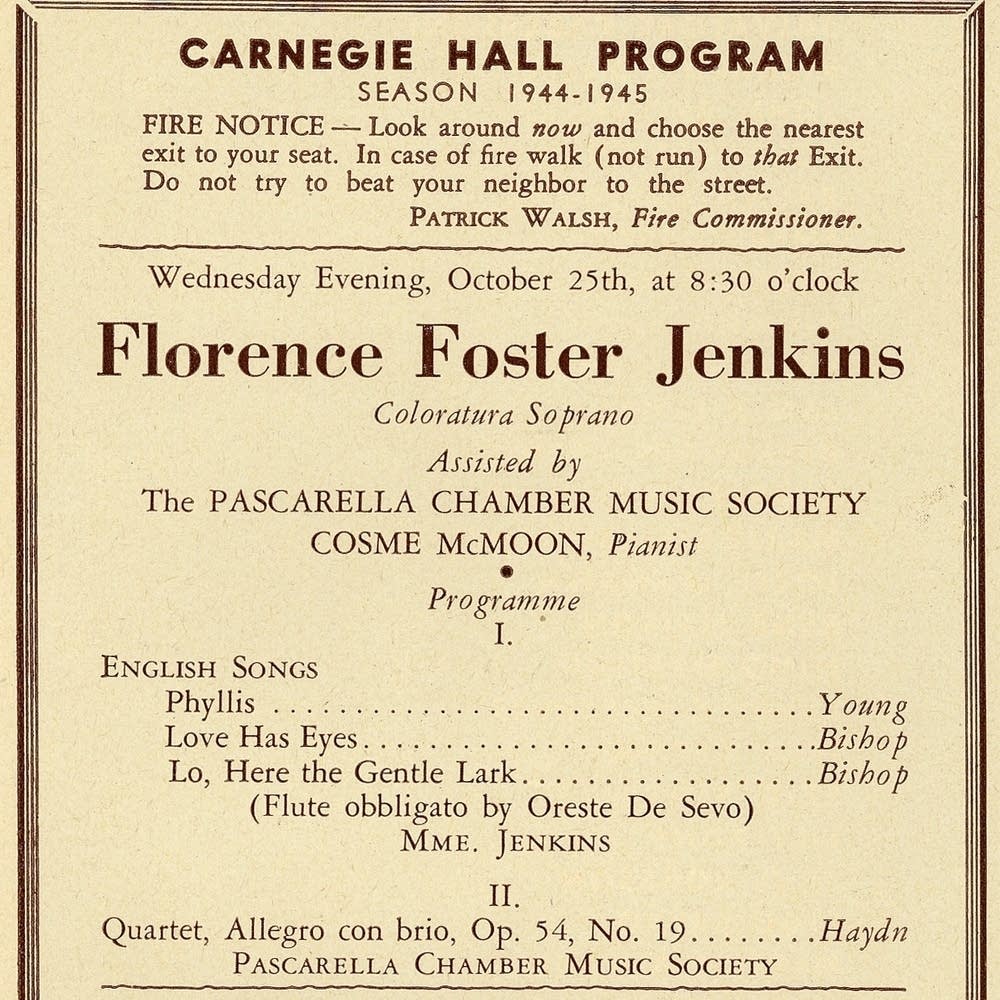
Florence Foster Jenkins – she seemed always to insist on her full title as if she were royalty – was excruciatingly funny, but gradually, despite her assumption that her inherited wealth entitled her to impose herself on the world as she saw fit, we found ourselves appreciating, along with Cosme, that her lack of self-awareness was beyond her control.  Where early on we thought he would only play for her because she had the money to pay him (three times what the restaurant offered), when it came to the incredible idea of her performing at Carnegie Hall, it was not just a chance for him to play there, but represented a grand risk and chance for fulfilment for her.

This is the same risk that all artists take – indeed, these very performers on stage before us in this production – no matter how ‘good’ we may judge them to be.  Though this is “The hilarious true story of Florence Foster Jenkins”, we end up not laughing at her, but alongside her, with empathy for her determination while objectively observing her failings. 

I guess this was not the case for a large proportion of the 3000 people who cheered her on in the Carnegie Hall in 1944, even though she vetted as 'my friends'.  As Carnegie Hall Museum Director and Archivist, Gino Francesconi, has said: "One of the most wonderful things about Carnegie Hall is the continuum of what Andrew Carnegie said at the laying of the cornerstone in 1890, which was, 'All causes may here find a place; we hope they're good causes, but it's not for us to judge'."
 [ https://www.classicalmpr.org/story/2016/08/12/florence-foster-jenkins-a-curious-concert-at-carnegie-hall- ]

Peter Quilter, I guess, may have had the spirit of Carnegie in mind in writing this play – and I guess the feeling, watching Glorious! and the many and varied shows presented by Stephen Pike, is something like the same for The Q.  The audience last night, I’m sure, were highly appreciative – including, of course, not only of the highly developed character of Diana McLean’s Mrs Jenkins, but especially of Kaarin Fairfax’s wonderful transitions from feisty Mexican Maria, vicious critic Mrs Verrinder-Gedge and naive disciple Dorothy.  These comic foils gave us a proper perspective, and helped us to recognise the truth in Alister King’s playing of Cosme.

Our concern for the absent Joshua and sympathy for director Denny Lawrence’s plight were certainly expressed in our applause, as well as our praise for design and directing well done.  What a genuinely nice piece of theatre to finish my week.


 © Frank McKone, Canberra


Wednesday, 2 May 2018

2018: The Aspirations of Daise Morrow - Brink Productions adaptation of Patrick White


The Aspirations of Daise Morrow – a stage adaptation of the short story Down at the Dump by Patrick White in the collection The Burnt Ones, 1964.

Brink Productions, presented by Far and Away Productions with Canberra International Music Festival at Canberra Theatre Centre, May 1-5, 2018.

Reviewed by Frank McKone
May 1

To the genres ‘art-song’ and ‘art-cinema’ we can now add ‘art-theatre’.  To fully appreciate this concentrated small-scale 80 minute work, you should be familar with Patrick White’s story of two families, Morrow and Whalley, from the right side and the wrong side of the street respectively, on the occasion of the funeral of Mrs Daisy Morrow, sister to Mrs Myrtle Morrow, in the Sarsaparilla cemetery which abuts the Sarsaparilla dump.

On the ‘right’ side, consider White’s writing.  “The procession from Barranugli back to Sarsaparilla was hardly what you would have called a procession: the Reverend Brickle, the Hogben’s Holden, Horrie’s Holden, following the smaller of Jackson’s hearses.  In the circumstances they were doing things cheap – there was no reason for splashing it around.  At Sarsaparilla Mr Gill joined in, sitting high in that old Chev.  It would have been practical, Councillor Hogben sighed, to join the hearse at Sarsaparilla.  Old Gill was only there on account of Daise being his customer for years.  A grocer lacking in enterprise.  Daise had stuck to him, she said, because she liked him.  Well, if that was what you put first, but where did it get you?”

On the ‘wrong’ side, how about this?  “The fact that Whalleys ran a [Ford] Customline as well puzzled more unreasonable minds.  Drawn up amongst the paspalum in front of the Whalleys’ shack, it looked stolen, and almost was – the third payment overdue.  But would slither with ease a little longer to Barranugli, and snooze outside the Northern Hotel.  Lum could have stood all day to admire their own two-tone car.  Or would stretch out inside, his fingers at work on plastic flesh.”

14-year-old Lum, short for William (ie Willum in baby talk) made sure he was called Bill at school.  14-year-old “Meg Hogben and Lummy Whalley did not notice each other even when they looked”.

These snippets ask you to wonder who is thinking aloud?  Some bits seem to be the words of an objective observer; others are Councillor Hogben, about Old Gill or Daise; others by a mixture of observer and Lum, about the Ford Customline.  The whole story is told in this oddly elliptical manner.  I can’t tell from the published program who – but surely including director Chris Drummond – understood the potential for physically presenting the characters on stage, speaking the dialogue White gives them, and the thoughts they have about themselves and others, as well as observations as if from outside the action.

The effect is quite remarkable because it give us all these different angles of perception of the one event – a funeral.  Not only do we shift from character to character, but we shift in time as characters’ memories are stirred. 

Because we are placed on stage, in a circle in quite widely spaced rows, we become part of the theatrical effect, as characters move between and around us and we react to their physical presence – and importantly react emotionally.  Daise’s oration, rising from her own grave, spoken by the actor who also plays Meg, represents the experienced dead passing on a living essence into the young.  Mystical it may be, but this is a powerful point, in the original story and in this performance.

But the ‘art-theatre’ is not all about words.  Music composed and played by the Zephyr Quartet far more than accompanies the text.  The moods created in sound are essential to our reactions and understanding of the story, offering us a sense of the universality of these ordinary lives which, I found, added an extra depth to my reading of the story.  The music literally brought the text and action alive, in keeping with Daise Morrow’s ‘aspirations’.

For me, some aspects of the staging made following the text and action more difficult than it might have been elsewhere, while the music worked a treat.

Acoustics was the main concern.  Friends seated in the inner circle had little trouble hearing the dialogue, while in the outer circles speech not directed towards us was often lost.  This was because the large stage on which we were seated was not designed to enhance voices which could disappear into the wings, the flies, towards backstage or into the auditorum.  At the same time the stage floor, covered in a carpet apparently of living turf, absorbed sound like a sponge. 

Since I had not read the story beforehand, I missed a lot of the detail and was really only able to pick up on the main threads and moods. One answer could have been to mic the actors with surrounding speakers.  Since the piece is really a kind of art installation rather than the normal conventional form of acting out a linear story, issues like where the voice was coming from would not be a problem.  But clarity and details of the words spoken are essential elements, as you realise when you read Patrick White’s densely packed writing.

The casting and the acting were superb.  Rather than playing all the roles with individual actors, the essence of the work was focussed by casting only an Older Man (Paul Blackwell whose Myrtle Hogben was brilliant, alongside Wal Whalley), the Older Woman (Genevieve Picot, essentially as a wonderful Mrs Whalley, who made an authorative observant narrator), a Younger Man (James Smith who did both an excellent Lummy and a tremendously sad Ossie Coogan, as well many other parts) and finally perhaps the most terrific performance by Lucy Lehmann of the poetic Meg Hogben and her Aunt Daisy, in life and death. 

Costume changes, additions and subtractions distinguished the changing characters with a sense of flair; all smoothly done from props corners around the acting space.

Quality was the core element in this work – a model for the new genre of art-theatre.


© Frank McKone, Canberra

Sunday, 29 April 2018

2018: Art, Politics, Money: Revisiting Australia’s Cultural Policy by David Throsby

Art, Politics, Money: Revisiting Australia’s Cultural Policy by David Throsby.  Currency House: Platform Papers No 55,  May, 2018.

Commentary by Frank McKone

In 2006 David Throsby wrote Platform Papers No 7: Does Australia Need a Cultural Policy?  After 12 years of a terrifying but fascinating political history, he concludes we should begin again. 

He suggests our starting point should be the ‘definitional proposition’ from the Labour policy document Creative Australia which came to nought in 2013 when the Liberal/Nationals Coalition under Tony Abbott defeated Labour’s Kevin Rudd.  The proposition reads:

 Australian culture is the embodiment of the distinctive values, traditions and beliefs that make being Australian in the 21st Century unique – democratic, diverse, adaptive and grounded in one of the world’s oldest living civilisations.

Throsby believes that this ‘can be seen to rise above Party politics’, and ‘is likely to be generally accepted, regardless of political leaning.”  He is concerned as probably we all are that ‘a wide-ranging rumination on our culture and its values at this present time is most unlikely to appeal to the Prime Minister or his Cabinet, given the cultural conflicts that keep re-surfacing within the Coalition’s own ranks, the Government’s apparent lack of interest in the area, and its preoccupation with issues they would see as having higher priority’.

But he does put up some practical suggestions for immediate application by a Labour Minister for the Arts after the next election, which must take place by May 2019.  I suggest his ideas should be taken up by The Arts Party, which has recently established a new formal structure with the objective of sending at least one member to the Senate next year.  We need a voice in the Parliament whichever party forms Government.

As Throsby puts it: The Minister for the Arts “will have his own ideas of
what might be included, but here are some suggestions for components for a new arts policy package, derived from discussion in this paper:

• A recalibration and expansion of the
artist-in-residence programs in schools;

• A forum or series of forums on arts funding,
perhaps including a broad discussion of the
role of peer assessment in evaluating grant
applications;

• In conjunction with the Cultural Ministers’
Statistics Working Group, persuade the ABS to
re-establish the National Centre for Culture and
Recreation Statistics;

• A program to increase funding for art centres
in remote communities to enable expansion in
their support for Aboriginal and Torres Strait
Islander arts in all areas of art practice;

• Re-establishment of the Cultural Industries
Innovation Centre;

• Set up a feasibility study to consider the
establishment of a Heritage Lottery Fund.”

A little explanation, in reverse order:

The “Heritage Lottery Fund” is based on the UK National Lottery, funding to which – as an example – the Royal Shakespeare Company has access through Arts Council England.  Throsby recalls, in support of this idea, the success of the Opera House Lottery which helped fund the construction of the Sydney Opera House back in the day.

“The Australian Government’s Creative Industries Innovation Centre (CIIC) was a wonderful organisation that worked with over 1,500 creative enterprises from 2009 to 2014. They provided one-on-one support, and facilitated research reports including Valuing Australia’s Creative Industries, which showed that the creative industries made a direct contribution to GDP of $32.8 billion in 2011/12, more than the contribution made by many traditional industries.” https://www.creativeplusbusiness.com/ciic-resources/

Aboriginal and Torres Strait Islander arts centres are now a feature of many communities across Australia. They are already supported to some extent by the Federal Government but need more money and more security of funding to develop fully.  The rationale is that art is central to those communities’ social cohesion and ongoing stability, to the benefit of the whole Australian society.

Throsby writes: “Progress in implementing any policy needs to be tracked over time, and this requires data. In the cultural arena, the axing by the Federal Government of the National Centre for Culture and Recreation Statistics (NCCRS) of the Australian Bureau of Statistics (ABS) in 2014 dealt a blow to the steady supply of data about arts and culture from the Centre that had contributed so strongly to supporting policy-making in the field.” (Page 57)

Throsby notes that the Australia Council has thankfully survived through all the political exigencies, including some shenanigans, since its inception as an independent statutory authority through the Australia Council Act 1975.  There are other models internationally for the evaluation of grant applications which he believes we should examine, especially because of confusions over the years about concepts like ‘quality’, ‘excellence’, ‘diversity’, and issues like inclusion, small to medium organisations, heritage, individual practitioners, ‘major’ performing companies.

An expansion of the artists-in-residence program in schools is a straightforward action a new minister could take immediately, as part of much broader policy development about the central role of arts in education. 

“There are many lessons to be drawn from the sad meandering tale that represents the progress, if it can be called that, of Australian cultural policy over the last ten years that we have charted in these pages.  Some of these lessons are encouraging – for example, as Australians we have shown that we can indeed countenance a coherent national cultural policy if the mood so takes us.  Some of the lessons are profoundly discouraging, such as the sense that good policy is fragile, it can be replaced by bad policy, and in the end does anyone really care?”, writes David Throsby.

Throsby’s paper is a clarion call for political action, and maybe there are signs of hope.  The Arts Party did remarkably well in the last election while it was still in a very early fledgling state.  It is now ready for a major campaign for 2019.

And equally remarkably, “Gonski’s radical review” was the front page Fairfax headline as I write (Canberra Times, Monday April 30, 2018). 

“Prime Minister Malcolm Turnbull will push for a radical overhaul of the Australian curriculum after endorsing a blueprint by his businessman friend David Gonski to fix the lagging school system.  The Gonski 2.0 plan will transform the school system to assess and reward personal progress, not just standard academic benchmarks.  It challenges the Commonwealth, states and territories to ditch their ‘industrial model of schooling’ in favour of a more modern and individual approach.” (by Michael Koziol)

This raises the possibility of applying the very model of student centred learning and personal development which arose from Currency House’s Platform Papers No 54 Young People and the Arts: An Agenda for Change by Sue Giles, which I reviewed on this blog in March 2018, and developed with a detailed article on my blog at www.frankmckone2.blogspot.com . 

It’s time to take action, I believe.


SYDNEY: Launch of Art, Politics, Money: Revisiting Australia’s Cultural Policy –
David Throsby in conversation with MUP publisher and commentator Louise Adler

When: 6pm – 8pm, Tuesday 1 May 2018

Where: Dentons Seminar Room
Level 16, 77 Castlereagh Street, Sydney (between King/Market Streets)

All welcome. Book https://www.trybooking.com/VDYN or info@currencyhouse.org.au

Currency House’s Platform Paper No.55 is available for media on request and for
purchase on https://currencyhouse.org.au/node/255.

Media enquiries to Martin Portus at mportus@optusnet.com.au or 0401 360 806.


© Frank McKone, Canberra

Friday, 27 April 2018

2018: Blanc de Blanc by Strut & Fret


Blanc de Blanc.  Strut & Fret at The Spiegeltent, Civic Square, Canberra, April 26 (preview), April 27 – May 20, 2018.

Director – Scott Maidment; Musical Director – Steve Toulmin; Costume Designer – James Browne; Choreographer & Co-Creative Director – Kevin Maher; Lighting & Set Designer – Philip Gladwell

Performers: Tuedon Ariri; Hampus Jansson; J’aiMime; Jess Mews; Laura New; Milena Straczynski; Monsieur Romeo; Spencer Novich; Shun Sugimoto.

Program illustration - The cast of Blanc de Blanc in action

Reviewed by Frank McKone
April 27

New circus is now old, if not old hat – becoming established as it did in Australia with Circus Oz in 1978.  But perhaps the better comparison for Strut and Fret’s Blanc de Blanc might be the work of the French James Thierée, brought up in Le Cirque Imaginaire and Le Cirque Invisible and reviewed on this blog for his work Bright Abyss presented in the Sydney Festival, 19 January 2006.

Quoting myself, “Thierrée's directing made what might have been a series of circus-style acts into a work of strong dramatic structure which drew the audience into the lives of those on stage and reflected on our own experience - and gave hope that, working together, we may survive the abyss and find our way in some kind of harmony.”

There will be people in the audience last night who will object, saying but we only came for a fun night!  But I reply, in my curmudgeonly way (to steal a favourite word from the famous Canberra Times columnist, Ian Warden), that I wanted more.  The performers – especially Jess Mews whose hoop swinging was certainly the most amazingly complicated and skilful I have ever seen – were all terrific acrobats, dancers, mimes and contortionists, but the basic idea of turning the largest Spiegeltent in Australia into nothing but a bawdy champagne party was a bit limited dramatically, I thought.

Of course, I appreciated what was often a spoof of the up-itself French-Canadian Cirque du Soleil, but what does Blanc de Blanc really mean?

I can’t do better, I suggest, than quote wine merchants Berry Bros. & Rudd:

A classic Blanc de Blancs is restrained and elegant when young, yet with ageing it develops a mouth-coating brioche richness that overlays an intense expression of fruitiness.   Their Champagne by Le Mesnil, Grand Cru is described in this way: Le Mesnil is a cooperative located in one of Côte des Blancs’s greatest villages, Le Mesnil-sur-Oger. It produces Champagnes that are smooth and rich with fine acidity at the basic level; while the vintage wines offer a significant step up, with crisper, richer and fuller fruit that will develop a toasty finesse.

How could you seriously make fun of that, hey? The term Blanc de Blancs designates Champagnes made only from Chardonnay grapes.  If that had been explained in the show, I would have understood.  Surely middle-class Canberrans only ever drink chardonnay – never those awfully pretentious NZ sauvignons.  Though I notice that there’s a backsliding trend recently to the terrible Rhine rieslings, would you believe!

Well, the brioche richness certainly came in a highly original approach to the aerial work, in solo and duet, in and out of the water, but, while the ending inside and outside very surprising balloons and soap bubbles lightened the tone, the crowd taking selfies with the performers was not quite the ‘significant step up’ I would have preferred – certainly not ‘crisper, richer and fuller fruit that will develop a toasty finesse’.

On the other hand, perhaps this is not what the traditional Famous Spiegeltent is about – except that my first experience (of the then much smaller original ‘tent’) was at the Sydney Festival in 2007.  The show was La Clique, compered by Canberra’s very own Mikelangelo, backed live by his Black Sea Gentlemen band.  The episodes followed much the same format as Blanc de Blanc, the nudity of magician Ursula Martinez was much more sexually stimulating, the humour was not based on old-style stereotyping (including isn’t it great to just get drunk), the pure circus skills were nearly as good – and finally, the satire was funnier because it was better written and more biting.

But don’t let this curmudgeon put you off going along for the party, party, party atmosphere.  It was just fun, and after all – maybe – all you need is fun!

Post Partum

All I didn’t need was to stand in a very long queue for a very long time in what was an unusually merely cool evening, instead of Canberra’s usual freezing temperature by this time of year.  I suggest the 6.30 pm hour-long shows should start at 6 pm or even 5.30 pm, since we found ourselves waiting until the previous crowd departed and the venue was set up for the 8 pm show, which actually got under way maybe by about 8.20 pm.  This really wasn’t fun, and helped make the opening of the action a less effective audience warm-up than it could have been.

A small fraction of the queue at The Spiegeltent Canberra
waiting in the cool for Blanc de Blanc, April 27, 2018
Photo: Frank McKone


© Frank McKone, Canberra

Tuesday, 17 April 2018

2018: The Celtic Tenors - The Irish Songbook Tour

Matthew Gilsenan    James Nelson    Daryl Simpson
The Celtic Tenors – The Irish Songbook Tour.  Presented by Duet Entertainment and Sport at The Q, Queanbeyan Performing Arts Centre, April 17 / 18, 2018.

Performers:

Matthew Gilsenan    James Nelson    Daryl Simpson

Reviewed by Frank McKone
April 17

The strength of The Celtic Tenors’ performance is not so much in the quality of their singing – which ranges from high opera to pure folk – but in the sense of community they quickly establish with their audience.  They found the level just right for Queanbeyan’s The Q, the locals and the busful from Ulladulla, Moruya and Batemans Bay, silver-hairs among the golden harmonies.  It was not long before everyone was singing the chorus parts – from yodelling in John Denver’s Calypso to aaahing in Nessun Dorma.

In two 50-minute segments, 21 songs from bawdy Irish humour in Finnegan’s Wake (nothing to do with James Joyce!), to sad songs critical of the sending of young men to war (especially Eric Bogle’s All the Fine Young Men) and even of the transportation to Botany Bay of the young Irish farmer, for stealing bread to feed his wife and family in the potato famine (The Fields of Athenry which was written in the 1970s by Pete St. John).

A social conscience is a central concern in The Celtic Tenors’ songbook, about the plight of the homeless or about the crucial role played by carers for those ageing with dementia.  Yet the show is leavened with a sense of humour, often improvised in direct fun with us, and songs of homecoming like Song for Ireland (by English folksingers June and Phil Colclough).

After the expected Nessun Dorma by Puccini to conclude the show, when the audience demanded an encore, came a wonderful highlight – the traditional Danny Boy sung a capella without microphones. 

I’m not so sure about the presenters’ expertise in sport, but Duet certainly provided excellent entertainment, which continues at The Q for one more night before moving on to Tasmania at the Theatre Royal, Hobart, on Saturday April 21, and in Victoria in Traralgon April 22 and Frankston on the 24th to complete their first tour of Australia.

My only disappointment was that though we were told the name of the terrific young pianist / musical director, my silver-haired aural memory is not up to scratch.  I have not been able to find out who he is – he deserves acknowledgement as much as the singers in my view.  Nor could I find details of the technical team, whose lighting and especially sound mixing was equally excellent.


© Frank McKone, Canberra

Friday, 13 April 2018

2018: Antony and Cleopatra - Bell Shakespeare


Antony and Cleopatra by William Shakespeare.  Bell Shakespeare at Canberra Theatre Centre Playhouse, April 12 –21, 2018.

Reviewed by Frank McKone
April 13

Director – Peter Evans; Designer – Anna Cordingley; Lighting Designer – Benjamin Cisterne; Composer & Sound Designer – Max Lyandvert; Movement and Fight Director – Nigel Poulton; Voice Coach – Jess Chambers

Cast:
Cleopatra – Catherine McClements; Antony – Johnny Carr
Charmian – Zindzi Okenyo; Alexas – Janine Watson
Enobarbus – Ray Chong Nee; Menas / Philo – Joseph Del Re
Octavius – Gareth Reeves; Lepidus / Clown – Jo Turner
Pompey / Scarrus – Lucy Goleby
Octavia / Soothsayer / Eros – Ursula Mills
Agrippa / Demetrius – Steve Rodgers


All of Shakespeare’s plays, even the comedies, question the nature of absolute rule.  Unsurprisingly, considering the likelihood of execution in the reigns of autocrats Queen Elizabeth I and James I, he set his plays in the past and in other places.  Even his history plays were in the past “which is another country”.  So Shakespeare made his plays metaphors or allegories: an astute move as writer and (I guess) director of theatre which upper and lower classes felt to be relevant to their times – and from which he did well financially and in social status, as a tour of Stratford upon Avon reveals. 

As Bell Shakespeare hangs upon the great man’s coat-tails, and has become, like Shakespeare in London – the capital city of his day – an accepted central element of our culture (we can count Sydney and Canberra as our combined capital, I think), how does this production of Antony and Cleopatra stack up?

I’ll start with costumes.  Read the Globe Theatre Costumes site http://www.bardstage.org/globe-theatre-costumes.htm and you will notice two points: Shakespeare’s actors were probably not dressed in ancient Roman or Egyptian clothes, but were certainly dressed in materials and colours which immediately told the audience the social status of each character.  Queen Elizabeth made this clear in her Sumptuary Law of 1574 ( The Statutes of Apparel ) [which] contained the following clause:

" Note also that the meaning of this order is not to prohibit a servant from wearing any cognizance of his master, or henchmen, heralds, pursuivants at arms; runners at jousts, tourneys, or such martial feats, and such as wear apparel given them by the Queen, and such as shall have license from the Queen for the same."

Shakespeare’s theatre companies were given that licence from the Queen so the actors could wear clothes on stage of a class different from those they had to wear in the street.

So should Anna Cordingley have dressed her actors in her idea of Roman and Egyptian clothes, to make it clear the play is set in that place in the past?  Or should she have gone for what Shakespeare’s actors would have worn – but without an audience today understanding the meanings of Queen Elizabeth’s laws of apparel?  Was it enough, then, to dress the characters in some kind of recognisably millenium-babies’ style for modern 18-year-olds to get the metaphorical meaning of the play?

As a pre-baby-boomer, from a time when couture could more easily define social status, I found oligarchs and soldiers in narrow-leg suits a bit hard to swallow (and their identities hard to follow); while a dressed-down with messy hair Cleopatra and Charmian as some kind of Spiegeltent performer (they’ll be here on April 26 in Civic Square) didn’t seem to me to support what Peter Evans wrote (in the Conversation published in the program):

Of Antony and Cleopatra’s relationship: “They use the biggest images and are often entertaining each other and themselves with these poetic gestures.  It’s what makes this play and their love very adult.”

And having actors draped in various unlikely forms over modern lounge room furniture, in costume but not apparently in character, in scenes their characters were not part of, didn’t seem to match the director’s other words:

“Shakespeare’s historically based plays are about powerful people in back rooms, making decisions that will affect the world....where the stage could be an oval office or a hotel that gets taken over for a political campaign – they’re waiting spaces, they’re meeting spaces...[the actors] won’t always be their characters, but they’ll be witnesses....”

It was the style of movement and the poses, in a setting that never had the sense of an oval office or grandiose hotel, that seemed out of place to me.  The penultimate scene, where the whole cast pop-danced to a pop-song before the too-long ending (which I think was Shakespeare’s fault), was so out of place that there was a general feeling of “What is this?”  The couple behind me, throughout the genuinely sad scene of Enobarbus dying in a ditch rather than follow either side in a crazy war, and even through the final defeat and brave suicides of Cleopatra and her maids, continually crackled their Malteser packets.

Well, Peter Evans did say “When the audience watches this production, I’m hoping there’s a sense of delight in how outrageous these people are.  The audacity, the charisma, and the language of the play is big and exciting.”  Like the crackles of the lolly packets.

Seriously though, I think this production has sincerely tried to deal with this difficult play but has not been able to integrate the elements which Shakespeare set up as a real challenge: Can we accept that power brokers seeking autocratic power can genuinely fall in love with each other?  Can we have empathy for such people when they lose in that competition because of that love?

For today, for example, should we feel sorry for US President Donald Trump having to fend off criticism of his apparent friendship with Russian President Vladimir Putin, because of his marriage to Melania who was born in Slovenia (then part of communist Yugoslavia).  Did Putin use this situation to hack Hillary Clinton’s emails and so support Trump’s election?  Is Putin now engineering a war over Syria to put Trump down?

Just remember, one of the countries in the contest between the children of Julius Caesar (Octavius and Octavia Caesar) and Pompey the Great (Pompey the Younger, played here as Pompey’s Daughter) – a conflict which dragged in the older generation’s Mark Antony and Cleopatra – was Syria! 

Pompey the Younger was murdered in Egypt in 45 BCE.  Mark Antony married Octavius’ sister Octavia in 40 BCE  (don’t forget the dates go backwards).  Mark Antony and Cleopatra committed suicide in 31 BCE.  Should we feel sorry for them?

I’m inclined to think that Shakespeare wasn’t sure what he thought about this.  The play may have been written about the same time or a year or two either side of King Lear (1605).  I’m sure Shakespeare felt empathetic towards Lear when he (Lear) realised how his demand for power had undermined his love for his youngest daughter, Cordelia.  Antony and Cleopatra’s love reversed the situation – their demand for love undermined their power.

Though Peter Evans and Anna Cordingley tried to bring out the power side of the story, by projecting the dates of the wars on the scrim between scenes, these made no real impact on us in relation to the love story.  I feel that I would, for a modern audience, trim Shakespeare’s script down to focus better on the main elements of the story, with less of the “big and exciting” language (which worked in Shakespeare’s day), to simplify the issue of power and love – even make it more domestic than political on the huge scale of Shakespeare’s original.  Just as Shakespeare himself did in King Lear.


© Frank McKone, Canberra

Monday, 9 April 2018

2018: The Sound of Waiting by Mary Anne Butler


The Sound of Waiting by Mary Anne Butler.  Darlinghurst Theatre Company at Eternity Theatre, Sydney, March 31 – April 22, 2018.

Director – Suzanne Pereira; Video Artist and Screen Designer – Samuel James; Composer and Sound Designer – Tegan Nicholls; Lighting Designer – Christopher Page

Cast:
Reza Momenzada as Hamed Mokri; Gabrielle Scawthorn as The Angel of Death

Reviewed by Frank McKone
April 8


The Sound of Waiting is more like performance poetry than a conventional drama.  There are two voices in a tone poem: the father, Hamed, “who escapes his war-torn country to seek a future of hope and possibility for his young daughter” and an Angel of Death who becomes “Hamed’s antagonist; the Angel’s job being to eliminate Hamed en route, as per instructed by The Host – who has ordered the Angels of Death to eliminate every displaced person on the planet” (Mary Anne Butler in her Playwright’s Note).

I can imagine this work as a purely sound recording by Tegan Nicholls, which I think would work very well.  On stage it becomes imagist theatre.  Centre stage is a small low ‘island’.  It is surrounded by a circle of see-through netting hung from on high on a track, with an opening in front, so that the Angel or Hamed can speak in front of the curtain, or can open the curtain to left or right or both ways at once, and take up positions at floor level inside the curtain area, or on the island. 

On the netting simple images are projected, such as water drops moving upwards as Hamed’s boat sinks.  White feathers float down and catch on the netting towards the end.  These images are abstract, creating just enough reference to the story Hamed tells – of the bomb which kills his wife and son, of the soldier who accepts their counterfeit documents to escape their country, of their flight in a decrepit aircraft, of the overcrowded boat with an unreliable engine, of the storm, the sinking and their drowning.  The Angel succeeds in her mission, though even she at times admits to empathetic feelings for this determined father and hapless child.

The work becomes emblematic, representing the hypocrisy of power players in the world who speak of achieving great things while causing so many to become refugees and then claiming to save lives by turning back the boats.

The Sound of Waiting is an interesting and worthwhile example of Darlinghurst Theatre Company’s aim to “value freedom of expression, the discussion of ideas, different points of view and dialogue.  We seek out work and provocations that explore, discuss and engage with contemporary Australia and topical issues.  It is this ‘democracy of ideas’ that drives our company...”


© Frank McKone, Canberra

2018: The Children by Lucy Kirkwood


The Children by Lucy Kirkwood.  Sydney Theatre Company and Melbourne Theatre Company at Sydney Opera House Drama Theatre, March 29 – May 19, 2018.

Director – Sarah Goodes; Designer – Elizabeth Gadsby; Lighting Designer – Paul Jackson; Composer and Sound Designer – Steve Francis; Voice and Dialect Coach – Geraldine Cook-Dafner

Cast:
Sarah Peirse – Rose; Pamela Rabe – Hazel; William Zappa – Robin

Reviewed by Frank McKone
April 9


Though the performances, set, sound, and lighting designs were all up to the expected standard for these major theatre companies, I found the playwriting left me unsatisfied. 

Despite STC’s artistic director Kip Williams writing “...Lucy talks about her struggle to find an emotionally resonant way to write about climate change.  She clearly found it”, I think she has tried to put too much into this two-hour long (without interval) three-hander. 

The first issue is that the meltdown of the nuclear power plant – because these retired nuclear engineers when they were in their 20s did not plan for a tsunami on the east coast of Britain to flood the reactor’s pumping system – could not have been caused by climate change. 

Nor was the real case in Japan on which this story is obviously based.  The ring of fire that Japan sits on is caused by geological plate movements quite independent of our last 200 years’ increase in global warming.  In her play, Kirkwood has a local earthquake which shakes Robin and Hazel’s house near the reactor and which then causes a tsunami which floods the house and the reactor.  In the geology of Japan this scenario is possible as happened at Fukushima, but not in Britain.  See https://www.geolsoc.org.uk/Plate-Tectonics/Chap4-Plate-Tectonics-of-the-UK.

Even if it had been possible, it would have had nothing to do with climate change.  No wonder Lucy was struggling.

However, accepting the scenario as a fiction for the sake of writing about how even middle-class scientists have personal sexual relationships which mess up their lives when placed under ethical tension in their later years, the play still doesn’t ring true.  The dilemma, which is hardly a matter of much fun, takes up the idea that they should be cleaning up the nuclear reactor rather than younger people, because the radiation will inevitably cause cancer and early death. 

Rose has organised a team of other old workers and needs the expertise of Hazel and Robin, arguing that young people should not be employed because they have their whole adult life ahead of them, while she, Robin and Hazel have their relationships and children behind them, with only their unnecessary old age to go.  If their lives are shortened by radiation, that is better than sacrificing the young – especially considering that the three of them helped cause the problem in the first place.

It’s a clinical proposition which I suppose Lucy Kirkwood imagines a scientist might make.  But the more than 30-year-long story of Rose’s previous relationship with Robin, his marriage to Hazel instead, engineered by Hazel to thwart Rose (she claims), and the children Robin has with Hazel while Rose has none because she only ever wanted children with Robin, becomes the main focus of our attention for two hours.

The only relevance to the issue of climate change is that Rose has kept on smoking, while Hazel insists on ‘doing the right thing’ – like picking up other people’s rubbish as well as their own when she and Robin go camping.  Otherwise the real story is about Rose’s obsession with Robin, to which he apparently may have responded at times during his married life; and Rose’s self-imposed single state, now at the age of 65.

The end is a cop-out.  In my view, Kirkwood could see after two hours that there is no end to the situation.  So after a point about halfway through – a kind of interval, perhaps – when the three of them break out into dancing together as they did 40 years previously, at the end Hazel gets out her yoga mat and starts the salute to the sun, and Rose (the smoker) joins in.  Robin seems to accept that things have settled, despite his agreement to leave with Rose for the power plant, without Hazel’s decision clear – and this is to force independence on their 38 year old daughter, Lauren, who is constantly on the phone never having properly grown up.  I’m sorry, but I seemed to have lost the plot – was it about the children, or the grown-ups, or the dangers of nuclear power?  And what ever happened to climate change?

Kip Williams writes “People have said this is Lucy Kirkwood’s best play yet, and some have gone further to say that this might be the play of decade.”  I don’t think so.  I reviewed Kip Williams’ production of Kirkwood’s Chimerica (March 11, 2017) and thoroughly agree that is a major work.  I think the change to a concentrated domestic setting has not worked for Kirkwood as well as her handling of the extensive political setting ranging from Beijing to New York in Chimerica.

And, as a contrast, I would be inclined to say that the other recent domestic writing with broader implications produced by Sydney Theatre Company – Black is the New White – suggests that Nakkiah Lui is the playwright with “the play of the decade”.


Pamela Rabe (Hazel), William Zappa (Robin) and Sarah Peirse (Rose)
The dance sequence in The Children by Lucy Kirkwood
Photo: Jeff Busby


© Frank McKone, Canberra

Saturday, 7 April 2018

2018: Sami in Paradise - Belvoir


Sami in Paradise.  Based on The Suicide by Nikolai Erdman, adapted by Eamon Flack and the Company.  Belvoir at Belvoir St Theatre Upstairs, Sydney, April 1 – 29, 2018. 

Director – Eamon Flack; Set and Costume Designer – Dale Ferguson; Lighting Designer – Verity Hampson; Musical Direction, Sound Designer and Composer – Jethro Woodward, with Musicians: Mahan Ghobardi (percussion) and Hamed Sadeghi (strings); Movement Director – Nigel Poulton; Dialect Coach – Amy Hume

Reviewed by Frank McKone
April 7

Cast:
Paula Arundell – Fima / Fairuz; Fayssal Bazzi – Abu Walid; Nancy Denis – Adnan / Sanda; Charlie Garber – Charlie Gerber; Victoria Haralabidou – Maria; Marta Kaczmarek – Gita; Mandela Mathia – Owke; Arky Michael – Father Arky; Yalin Ozucelik – Sami; Hazem Shammas – Hazem; Vaishnavi Suryaprakesh – Vaish / Boy / Waiter

Thematically sincere, though theatrically a mess, Sami in Paradise has tried to use a Russian comedy from 1928 – about the incompetent confusion which was the Bolshevik Revolution of 1917 – to say something about the impossibility of living in a refugee camp in modern times. 

The central figure, Sami, concludes he must kill himself, but he must justify his death as being for the good of all humankind.  The Chekovian philosophical angst is very Russian – which in 1928 made excellent comedy, I’m sure (until Stalin made sure the great directors Meyerhold and Stanislavski abandoned their productions, and Erdman was exiled to Siberia in 1933). 

But despite the obvious enthusiasm of the Company in their research, where everywhere “we found quotations, people, events which bore an uncanny similarity to lines, characters and situations in the play” and made them ask “Why would life as a refugee bear such a resemblance to life in Stalin’s Russia?”, their conclusion that “Perhaps [it is] because both regimes seek to treat people as a problem to be solved” has not led to an effective satiric comedy, which might stir Peter Dutton to send Belvoir to Siberia.

Theatrically, I guess I have to sheet the failure home to the adapter / director Eamon Flack. 

Comedy can range from frantic farce through inconsequential humour all the way to bitter black satire.  This largely group-devised show has bits of all these entering and exiting all over the shop.  Though we get the basic idea that it’s funny to see absurd behaviour which mostly does not seem to have any understandable motivation, and on the other hand there is a kind of anxious laughter in the tension of watching Sami trying to persuade himself to shoot himself (in the mouth?… through the temple?…through the heart?…oh, which side is my heart, left or right?…), the ‘plot’ fizzles away in the end.  Would it have been more funny, humorous, satirical if he had succeeded in killing himself?  Was it satirical, humorous or merely funny as he appeared and disappeared in and out of his coffin?

I really couldn’t tell by the end how this play told us anything new, or funny, about being a refugee.  Until, after the first round of applause, we were asked, very and sincerely seriously, to donate money to an organisation that helps refugeees to find ways to support themselves as independent agents.  Even though during the play, one of the most telling sections of potential satire criticised do-gooder NGOs for satisfying their own needs for doing good on a continuing basis, rather than actually solving the refugee problem at its political core.

Seeing Sami in Paradise made me see that the modern refugee problem is not the right material for comedy, despite the apparent parallels with a Russian play from 90 years ago.


© Frank McKone, Canberra

2018: The Resistible Rise of Arturo Ui by Bertolt Brecht

Hugo Weaving as Arturo Ui
in The Resistible Rise of Arturo Ui
Program cover photo supplied


The Resistible Rise of Arturo Ui by Bertolt Brecht, translated by Tom Wright.  Sydney Theatre Company and UBS at Roslyn Packer Theatre, Sydney, March 21 - April 28, 2018.

Director – Kip Williams; Set Designer – Robert Cousins; Costume Designer – Marg Horwell; Lighting Designer – Nick Schlieper; Composer and Sound Designer – Stefan Gregory; Cinematographer – Justine Kerrigan; Fight Director – Nigel Poulton; Assistant Director – Alastair Clark; Voice and Text Coach – Charmian Gradwell

Reviewed by Frank McKone
April 9

If you ever thought Bertolt Brecht was getting a bit passé, even somewhat historic, Kip Williams and especially his translator Tom Wright, in this production of The Resistible Rise of Arturo Ui will shake you out of your 21st Century middle-class complacency.  You can’t escape the terrifying epilogue speech, done here by the risen-from-the-dead figure of the honest but forcibly-compromised politician Dogsborough, spoken with such depth of feeling by one of our greatest veteran actors, Peter Carroll.

In the socialiststories.com translation, [ http://www.socialiststories.com/writers/bertolt-brecht/ ] a sign appears after the final demagogue speech by Ui, saying “On 11 March 1938 Hitler marches into Austria.  An election under the Nazi terror results in a 98% vote for Hitler”. The epilogue reads:

Therefore learn how to see and not to gape.
To act instead of talking all day long.
The world was almost won by such an ape!
The nations put him where his kind belong.
But don’t rejoice too soon at your escape –
The womb he crawled from still is going strong.

Tom Wright’s uncompromising translation ends after similar couplets:

The bitch that bore Arturo Ui is still in heat.

Throughout this script, more transformed rather than merely translated, Ui is made to represent all the political thugs who threaten and actually kill all who oppose the essential lie of their offer of ‘protection’.  It’s a protection racket, of course.  Hitler used the ancient ploy by creating fear in Germans’ minds of economic disaster, loss of nationhood status, and finally scapegoating Jews, Gypsies and homosexuals.  Of course, in his play Brecht used the mafia controlled cauliflower trade in Chicago as his parallel to the rise of Hitler.

Tom Wright has brought Brecht up to date by turning Brecht’s particular into our general situation, from the worst cases like the treatment of the Rohingas in Myanmar, to our own politicians’ just announced Gang of 20 setting us up to fear infinitely rising electricity prices unless our government subsidises new coal mines and builds new coal-burning power stations, instead of encouraging renewable resources for power production. 

Wright’s text makes you think of these things by subtly incorporating references into the speeches written by Brecht – and in doing so, supported by exactly the production style that Brecht was seeking, Wright has injected life back into Brecht, however jaded we may have thought he had become.  The middle-class audience in the aptly corporately-sponsored named Roslyn Packer Theatre were amused by the line in Arturo’s election victory speech, beginning “We will decide …..”, as John Howard’s ghost appeared in our memories, stirred by Hugo Weaving’s powerful populism.  Laughter was stopped in its tracks by our recognition of the truth in Peter Carroll’s final line.

Then there was an almost revolutionary feeling in the explosion of applause for a play so well done and of such social import.  The Monash Forum had better take notice – but they will surely keep their eyes neatly blinded, and probably accuse the Sydney Theatre Company of being ‘lefties’ as if that sort of insult is all that’s needed to shut the conversation down.

True to Brechtian principles, every element of the staging of his play is open for our inspection, with the wonderful addition of cleverly designed live video.  Just to list cinematographer Justine Kerrigan in the credits is not enough.  The skills of her team – camera operators Philip Charles and Daniel Boules, video supervisor Dave Bergman and mixer Jason Jones – bring their parts as performers in the play up to the standard of this team of best Australian actors in the cast.  Hugo Weaving, deservedly, is the publicity front-runner for a quite extraordinary bravura performance, while everyone else in their many roles equal his strength of characterisation and contact with the audience – at long range and in close-up.

This has to be the very best production of this master-work that I can imagine, proving the place of Brecht as the Shakespeare of the 20th Century, just as relevant today and, I suspect, for the next four centuries as Shakespeare has been since his death four centuries ago.

The question for the future is, How Resistible is the Rise of Arturo Ui?  Will we just keep talking all day?  Or if we take action, how do we do that without starting World War III?


Cast: (alphabetical order)

Mitchell Butel – Clark / Theatre Director / Court Appointed Physician
Peter Carroll – Dogsborough
Tony Cogin – Ignatius Dullfleet / Maulbeer / Hook / 1st Millstreamian
Ivan Donato – Giri / Young Dogsborough
Anita Hegh – Betty Dullfleet / Carruthers / Deller / Defence Attorney
Brent Hill – Ragg / Gaffles / Gazillo / Prosecutor / Short Man / Priest
Colin Moody – Roma
Monica Sayers – Dockdaisy / Counsel / 2nd Millstreamian
Hugo Weaving – Arturo Ui
Charles Wu – Inna / Schussel / Mullet / Waiter
Ursula Yovich – Givola / Magistrate


© Frank McKone, Canberra

Wednesday, 28 March 2018

2018: Black is the New White by Nakkiah Lui


Black is the New White by Nakkiah Lui.  Sydney Theatre Company at Canberra Theatre Centre Playhouse, March 28 – 31, 2018.

(This production premiered at Roslyn Packer Theatre, Sydney on March 1, 2018.  The original production premiered at Wharf 1 Theatre on May 10, 2017.)

Director – Paige Rattray; Designer – Renée Mulder; Lighting Designer – Ben Hughes; Composer and Sound Designer – Steve Toulmin; Voice and Text Coach – Charmian Gradwell.

Cast:
Ray Gibson – Tony Briggs; Narrator – Luke Carroll; Marie Smith – Vanessa Downing; Dennison Smith – Geoff Morrell; Joan Gibson – Melodie Reynolds-Diarra; Charlotte Gibson – Shari Sebbens; Francis Smith – Tom Stokes; Rose Jones – Nakkiah Lui (replacing Miranda Tapsell for the Canberra season); Sonny Jones – Anthony Taufa

Reviewed by Frank McKone
March 28

There is a special sense of coming together in this new form of comedy of manners.  It is both a romantic comedy, but also a questioning comedy.  What does it mean to be ‘black’ or ‘white’?  Lui’s highly sophisticated writing says it’s very funny.  Standing ovation kind of funny.  Seriously exciting kind of theatre.

Looking at Black is the New White from the white side, as I inevitably must, I see a picture which reminds me of when I was a £10 invading Pom some 60 years ago.  I was fascinated then by my culture’s 18th Century cartoonery and social commentary pictures.  William Hogarth comes to mind.

             An Election Entertainment featuring the anti-Gregorian calendar banner "Give us our Eleven Days", 1755

I came to understand that to see the whole picture, I had to accept equally all the diverse characters in Hogarth’s typically crowded scenes – from the grotesque to the ‘normal’; from the low class to the high.


L-R: Anthony Taufa, Vanessa Downing, Luke Carroll (above), Shari Sebbens,
Geoff Morrell, Melodie Reynolds-Diarra, Tony Briggs, Miranda Tapsell, Tom Stokes
in Black is the New White by Nakkiah Lui

Joan Gibson's Christmas speech
Photo: Prudence Upton

Nakkiah Lui’s picture of today’s middle class in Sydney – black, white and Tongan – is as humorous a view as Hogarth’s and brings me up to date.  Though I was an unwitting invader at the age of 14, I feel better about being here now, thanks to the many Aboriginal playwrights and performers whose work I’ve seen (and some reviewed here and at ( www.ccc-canberracriticscircle.blogspot.com ) from the days of the National Black Theatre in Redfern which I attended in 1973, through  Jimmy Chi's 1990 musical Bran Nue Dae and many others, to Nakkiah Lui. 

The first work of hers I reviewed, Kill the Messenger (February 20, 2015) was beyond impressive.  Black is the New White thoroughly establishes her place among our great writers on the Australian stage.  She makes the crossover between cultures understandable and acceptable.  Lui is an enormously generous writer.

The quality of the production of the play goes without saying, after last year’s success at Wharf 1, though I would have liked to have seen Miranda Tapsell (not to disparage the author’s performance here in Canberra).  I first noted Tapsell’s acting while she was still at NIDA, in Dallas Winmar’s Yibiyung ten years ago, with Wesley Enoch directing, and later in Louis Nowra’s Radiance, directed by Leah Purcell, and would love to have seen her here in such a different role.  Tapsell’s story alone shows where Indigenous theatre is travelling.

Luke Carroll, Miranda Tapsell, Anthony Taufa
Photo: Hon Boey

In this rehearsal picture, you see not only Miranda Tapsell (Rose) and Anthony Taufa (Sonny), but an important figure in the background, Luke Carroll as The Narrator.  From her Indigenous culture, Lui has clearly drawn upon the storytelling tradition in this dynamic character, but also on the idea – regarded as new when Tennessee Williams wrote The Glass Menagerie last century – of a member of the family standing aside from the action to explain to us outsiders what is really going on inside.

While Tom tells much of his own story in The Glass Menagerie, director Paige Rattray writes of Black is the New White, in answer to the question  “What can the narrator be and what can’t it be for it to work well here”,  The improvisations were useful.  We pushed that character to see how far he could be involved in the world of the other characters.  We found a few little moments of overlap, but it’s actually much better if he is outside the reality, observing.  He’s more connected to the audience than he is to the characters.

I found The Narrator especially important in two ways.  The first is as a simple device for changing scenes as one bit of the story ends and another begins.  But this character knows all the little details of the family members’ behaviours, do’s and don’ts, wishes and real intentions.  He is absolutely Aboriginal, though so well dressed in ‘white’ suits.  He moves as if dancing (including with a front-row audience member!) and talks with a glint of humour in his eye.

I found myself imagining The Narrator as a kind of ghost-figure, but the opposite of a Kadaitcha (the harbinger of death).  This Narrator is the epitome of life, both romantic and questioning – but never with rancour.  Observing, yes – but to me, at least, he is much more, connecting the audience to the characters.

If there’s a parallel in my culture, it must be in the independent clownish philosophers in Shakespeare’s plays, but never with the cynicism of a Jacques.  It’s at this level that I place Nakkiah Lui’s art.

Director Paige Rattray with playwright Nakkiah Lui during rehearsal
Photo: Hon Boey


© Frank McKone, Canberra

Saturday, 24 March 2018

2018: The Stevenson Experience: Spot the Difference

James and Benjamin Stevenson
The Stevenson Experience: Spot the Difference, created and performed by Benjamin and James Stevenson.  At The Street Theatre 1, Canberra, Saturday March 24, 2018.

Reviewed by Frank McKone

Ben and James Stevenson in
The Stevenson Experience


Now that I’ve stopped laughing, this is serious.  Despite one review a year ago of their earlier show Identical as Anything (“Their songs are catchy enough, but the content of their comedy is overly puerile and questionable..." by Joe Dolan, The Music.com.au), the Stevenson Twins, in their new show this year, Spot The Difference, still have catchy songs and puerile jokes – but that’s the point of their comedy.

How puerile indeed is so much of what purports to be ‘social’ on the internet.  The audience, mostly about the same age or a bit younger than the 28 the boys claimed to be, seated around time-worn me, got all the details of the jokes – many of which I missed – because they recognised the teenage-bitch quality in themselves.  In my maturity, I’m not on Facebook, Twitter or Instagram, and the Stevensons have made be glad I’m not.

Of course, I recognised myself in the Stevenson parents’ text messages and emails.  Like them I like to be precise and careful about what I write, as well as making the occasional Dad and even Grandad apocryphal joke, though I hope I’m not quite as gormless as their father seems to be.

So what makes their show worth going to?  The serious answer, considering Benjamin’s insistence throughout the show that he is an intellectual and it's all about Art, would be the Menaechmi by the ancient Roman playwright Plautus.  In that play the twins are separated when young when their father takes Menaechmus to another country on business.  After their father dies, their grandfather, with the other twin in the original country, renames Sosicles ‘Menaechmus’.  As adults in a third country, chaos (ie comedy) reigns as people can’t tell the difference between the two Menaechmi.

The Stevensons have not been separated, so their experience is about their growing up together – looking alike to the degree that Ben took James’ driving test, so James had a driver’s licence for ID purposes with Ben’s photo on it; and so had to use Ben’s photo for his passport.  But, he discovered, German face recognition software saw the difference – with chaotic comic consequences, on a par with Plautus’s plot.

So what I like about The Stevenson Experience but not
is that it has something of a play about it, more than standard stand-up comedy. 

The twins play characters in a story which reflects on the lives of young people in the internet age in contrast to the past.  Time becomes a philosophical question, since James was born 30 minutes before his brother Ben.  They live in Sydney, but James insists that Ben is really in Adelaide (where the Central Australian time difference is 30 minutes behind Eastern Australian time). 

Of course, this sort of argument is puerile (literally from the Latin meaning ‘childish’), but the silly argument is funny because it is silly – yet it has implications for Ben’s feelings of being put down by James (especially because Adelaide is seen as a less than exciting city compared to Sydney, and we Australians all get the joke). 

Fortunately, as in Menaechmi when the identical twins finally meet, the Stevenson twins clearly get along – they couldn’t possibly write and improvise so well together otherwise, and the comedy has a happy ending, which deserves all our applause.

Benjamin Stevenson and James Stevenson
© Frank McKone, Canberra