Showing posts sorted by relevance for query My Fair Lady. Sort by date Show all posts

Thursday, 31 August 2017

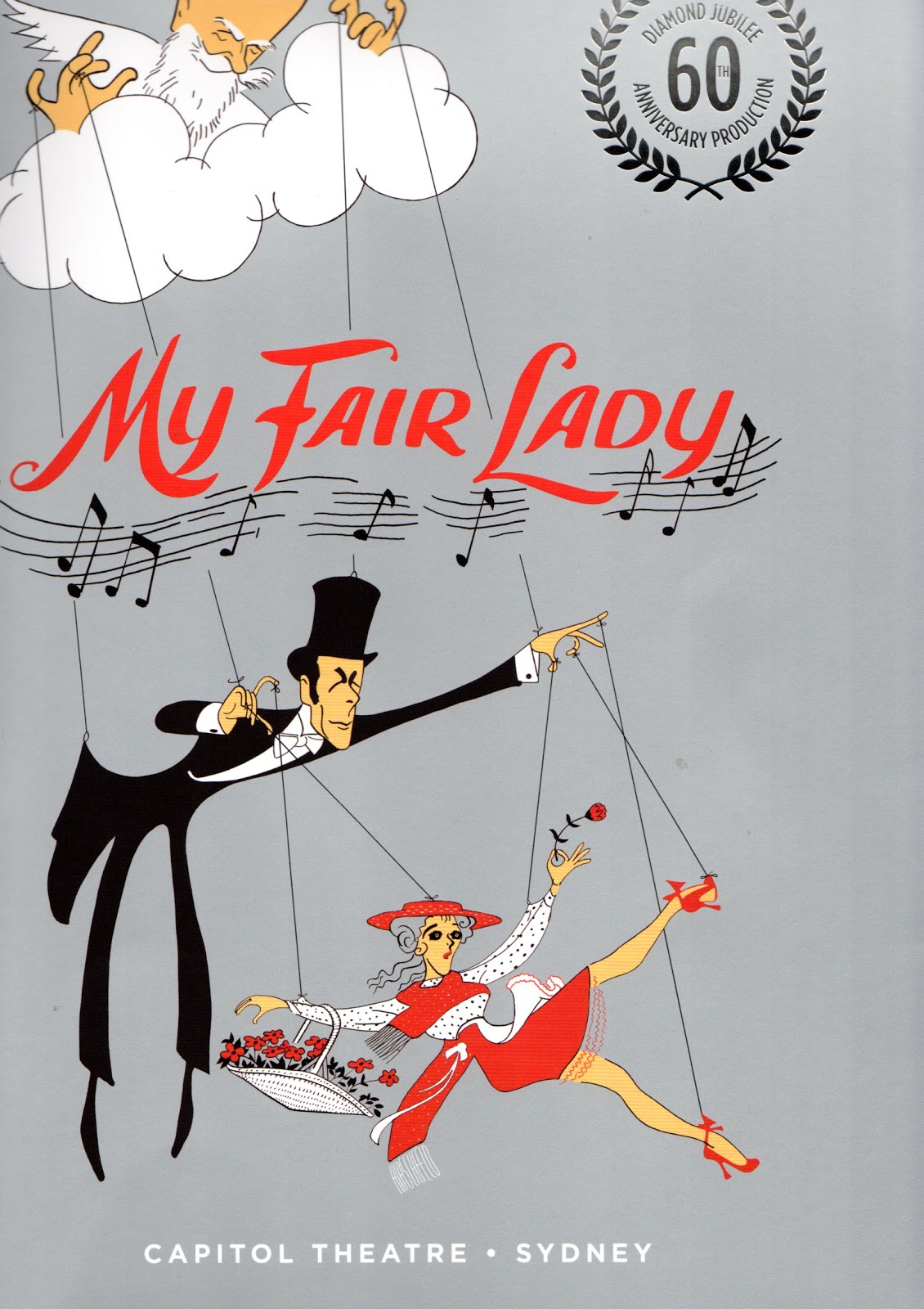
2017: My Fair Lady - Opera Australia


My Fair Lady adapted from George Bernard Shaw’s play and Gabriel Pascal’s motion picture Pygmalion.  Book and Lyrics by Alan Jay Lerner; Music by Frederick Loewe

Presented by Opera Australia and John Frost with Elizabeth Williams, Benjamin Lowy and Adrian Salpeter, Jean Arnold, Beckett Swede, Just for Laughs Theatricals and Glass Half Full Productions at Capitol Theatre, Sydney August 24 – October 14, 2017,

Director – Julie Andrews; Set Design – Oliver Smith; Lighting Design – Richard Pilbrow; Costume Design – Cecil Beaton, and Recreation – John David Ridge; Sound Design – Michael Waters; Make-Up Design – Rick Sharp, and Wig and Hair Design – John Isaacs.

Musical Supervisor – Guy Simpson and Musical Director – Laura Tipoki with 23-piece orchestra: Associate Concertmaster, Leader – Huy Nguyen Bui; Deputy Concertmaster, Leader – Katherine Lukey.


Anna O'Byrne as Eliza Doolittle and Reg Livermore as Alfred P Doolittle

Cast

Professor Higgins – Charles Edwards; Eliza Doolittle – Anna O’Byrne;
Alfred P Doolittle – Reg Livermore; Mrs Higgins – Robyn Nevin;
Colonel Pickering – Tony Llewellyn-Jones; Mrs Pearce – Deirdre Rubenstein
Freddy Eynsford-Hill – Joel Parnis; Mrs Eynsford-Hill – Julia McRae
Zoltan Kaparthy – Glen Hogstrom; Mrs Hopkins – Octavia Barron Martin

Butler – Michael Hart; Servants – Josh Gates, Kate Maree Hoolihan, Vanessa Rosewarne, Greta Sherriff, Sophie Viskich

‘Loverly’ Cockneys – Daniel Belle, Mark Doggett, Mat Heyward, Glen Hogstrom

Others in Ensemble: Justin Anderson, Deborah Caddy, Elisa Colla, Rodney Dobson,Tom Handley, Georgina Hopson, Erin James, Hollie James, James Lee, Allyce Martins, Holly Meegan, Scott Morris, Meredith O’Reilly, Joshua Robson, David Sirianni, Paul Whiteley, Katherine Wiles, Don Winsor
Photos by Jeff Busby
Above L: Deirdre Rubenstein as Mrs Pearce
Above R: Tony Llewellyn-Jones as Colonel Pickering
Below: Anna O'Byrne as Eliza and Charles Edwards as Prof Higgins


Reviewed by Frank McKone
August 30

First things first: Opera Australia’s Capitol Theatre production of My Fair Lady is brilliantly well done. 

Credit, of course, first goes to George Bernard Shaw for refusing to allow his 1914 play Pygmalion to be turned into a ‘light opera’. As Shaw told Austro-Hungarian composer Franz Lehar, “A Pygmalion operetta is quite out of the question … Pygmalion is my most steady source of income: it saved me from ruin during the war, and still brings in a substantial penny every week.” Having been burned before, Shaw swore he’d never “allow a comic opera to supplant it.”  [ 15 Loverly Facts About My Fair Lady by Mark Mancini at http://mentalfloss.com/article/76684/15-loverly-facts-about-my-fair-lady ]  The burning referred to Oscar Strauss’s 1908 too popular operetta The Chocolate Soldier adapted from Shaw’s 1894 play Arms and the Man.

Second, you have to admire Alan Jay Lerner for finding the right musician, Frederick Loewe, and both of them for not being afraid of Shaw’s dialogue-based in-depth characterisation, and for writing lyrics and music that strengthened especially Eliza, Professor Higgins and Alfred P Doolittle.

Anna O’Byrne, Charles Edwards and Reg Livermore were supernovas among all the other stars, including a wonderful Mrs Higgins from Robyn Nevin.  For some audiences, opera is more about sumptuous sets, costumes and singing than thoroughly good acting.  The standing ovation at Wednesday’s largely seniors matinee happened because it all came together: busloads of oldies were as excited as perhaps we (I’m one of them) are rather less often than we used to be, as the beautiful star-filled ceiling of the old Capitol Theatre faded before the stars on stage.

And indeed the sets on that grand revolve were stunning, like the costumes, make-up and props – while the orchestra under Guy Simpson played all the ‘highs and lows’ just right.  Christopher Gatelli’s choreography ranged from tremendous athleticism to the wonderfully ironic statue-like imagery of the Ascot horse race, accompanied by 3-dimensional sound.  Julie Andrews’ directing never missed a beat both in the musical and acting sense.

I could have danced all night, except that I wasn’t on a bus.  I was driving, stuck near the airport, as reported by Keely McDonough, The Daily Telegraph, August 30, 2017 7:06 pm: ... Traffic remains very sluggish on the M5 East in Sydney’s south west after an earlier crash [at 4.30pm just after the My Fair Lady matinee finished] involving a car, a truck and a motorcycle...caused a monster traffic jam with all westbound lanes blocked and traffic backed up for 10km.

So, after thinking about why I prefer not to live in Sydney, I had time to wonder about the ending of My Fair Lady.  I’ve reviewed productions of Pygmalion three times in the past twenty years, and never had doubts about Eliza’s future at the end of the play. 

MRS HIGGINS.  The carriage is waiting, Eliza.  Are you ready?
LIZA.  Quite.  Is the Professor coming?
MRS HIGGINS.  Certainly not.  He cant behave himself in church.  He makes remarks out loud all the time on the clergyman’s pronunciation.
LIZA.  Then I shall not see you again,  Professor.  Goodbye.

Does she mean what she says? Higgins orders “by the way, Eliza, order a ham and a Stilton cheese, will you?” and “a pair of reindeer gloves number eights” and a tie.  “You can choose the colour.”

Shaw’s stage instruction is [His cheerful, careless, vigorous voice shews that he is incorrigible].

LIZA. [disdainfully] bluntly tells Higgins “Number eights are too small for you....You have three new ties....Colonel Pickering prefers double Gloucester to Stilton; and you don’t notice the difference.  I telephoned Mrs Pearce this morning not to forget the ham.  What you are to do without me I cannot imagine.  [She sweeps out].

When his mother suggests Eliza is fond of Colonel Pickering, Higgins ends the play:
“Pickering!  Nonsense: she’s going to marry Freddy.  Ha ha!  Freddy!!  Ha ha ha ha ha!!!!!  [He roars with laughter as the play ends].

So why, in My Fair Lady, does Eliza reappear, standing quietly watching until Higgins turns and realises she is there?  This is definitely not Shaw’s ending.

I think there must have been considerable discussion for this Australian Opera production because Charles Edwards played the Higgins character exactly, maybe even more forcefully true to Shaw’s characterisation of this impossibly insensitive self-centred man. 

Just before the lights dimmed on that final image, Edwards turned his face away, towards the audience, and put his head down – to do what?  Hide Higgins' embarrassment, when he had never been embarrassed before?  Hide his tears, as he realised he has lost her forever?  As a kind of joke, pretending to be a little boy?

According to one of the many things written about the making of My Fair Lady, Rogers and Hammerstein gave up on the project when asked by Gabriel Pascal (with whom Shaw had collaborated for the 1938 Pygmalion film), because there was no obvious love interest.  I suspect Lerner and Loewe were pressured to have Eliza come back to Higgins to satisfy that sentimental demand – the exact opposite of Shaw’s view of such a relationship, as he explains in great and often humorous detail in a postscript following the text of the film version (published by Penguin in 1941):

“Eliza has no use for the foolish romantic tradition that all women love to be mastered, if not actually bullied and beaten....  No doubt there are slavish women as well as slavish men; and women, like men, [who] admire those that are stronger than themselves.  But to admire a strong person and to live under that strong person’s thumb are two different things....”

Though Higgins has said, when Eliza says “Yes, you turn round and make up to me now that I’m not afraid of you, and can do without you”, that “I like you like this...now youre a tower of strength: a consort battleship”, we must recognise Shaw’s perceptiveness.  This Higgins is the example of the despot Shaw quotes in the postscript: ‘When you go to women,’ says Nietzsche ‘take your whip with you.’

Considering Anna O’Byrne’s terrific feisty Eliza and Charles Edward’s completely intransigent Higgins, his head down at the end can mean no more than her reappearing will make his life hell if she stays.  Just read the rest of the postscript to Pygmalion, and you’ll see what I mean.

But dont (that’s Shaw’s spelling) refuse to see My Fair Lady on the grounds of some feminist principles.  Opera Australia have got it right as near as right can be.


Anna O'Byrne as Eliza Doolittle
Charles Edwards as Professor Higgins


Anna O'Byrne as Eliza Doolittle and Robyn Nevin as Mrs Higgins


© Frank McKone, Canberra

Friday, 27 May 2022

2022: Pygmalion by George Bernard Shaw - Tempo Theatre


Pygmalion by George Bernard Shaw.  Tempo Theatre at Belconnen Community Centre Theatre, May 27 – June 4, 2022.

Reviewed by Frank McKone
May 27

Creatives Team:
Director – Rachel Hogan
Lighting Design – Neville Pye; Sound Design – Angus Eckstein
Set Design – Rachel Hogan
Costumes – Rachel Hogan, Sandy Cassidy and Cast

Characters in Order of Appearance:
Suffragettes – Philippa Russell-Brown, Kathryn Holopainen
Clara Eynsford-Hill – Eilis French; Mrs Eynsford-Hill – Crystal Mahon
A Lady of the Night – Kah-mun Wong
Freddy Eynsford-Hill – Lucas Edmunds
Eliza Doolittle – Meaghan Stewart; ‘Kershaw’ Pickering – Thomas Cullen
Henry Higgins – Adam Salter; Mrs Pearce – Joan White
Alfred Doolittle – Peter Fock; Mrs Higgins – Elaine Noon;
Maid – Kathryn Holopainen

________________________________________________________________________________
Tempo Theatre sought out Rachel Hogan to direct, asking for a ‘light’ choice.

Considering what Bernard Shaw himself wrote in 1941, you may wonder about Tempo’s agreeing to do Pygmalion: I wish to boast that Pygmalion has been an extremely successful play, both on stage and screen, all over Europe and North America as well as at home.  It is so intensely and deliberately didactic, and its subject is esteemed so dry, that I delight in throwing it at the heads of the wiseacres who repeat the parrot cry that art should never be didactic.  It goes to prove my contention that great art can never be anything else.
[ Preface to Pygmalion, Penguin ]

You may have wondered, too, why Shaw gave it such an awful name, Pygmalion, instead of the oh-so attractive title My Fair Lady.  That Lerner and Loewe musical was staged in 1956, six years after Shaw died; and was made into the famous movie in 1964.  I have always felt that Shaw would have felt ambivalent about the ending of My Fair Lady, where Rex Harrison’s Professor Higgins  is almost avuncular and Julie Andrews’ Eliza reappears as if still wanting him after all, as he sits sadly hearing her recorded voice.

(I have written on this issue previously in my review of the Opera Australia production at https://frankmckone2.blogspot.com/search?q=My+Fair+Lady)

The famous British director Trevor Nunn had no doubts in his 2001 article in The Guardian, Poor Professor Higgins! In George Bernard Shaw's original play, Eliza and Henry don't even get it together. No wonder My Fair Lady is miles better than Pygmalion….But the real achievement of Lerner's adaptation is his insight that the story requires not one, not two, but three personal journeys. Doolittle is changed into a respectable member of the reviled middle classes; Eliza is changed into an new woman once her "guttersnipe" habits are expunged; but the third metamorphosis is of Professor Higgins, who is transformed finally and movingly from a man unable to express his feelings into a more complete emotional human being. Pygmalion is a collection of very brilliant theatrical and comic ideas, but My Fair Lady quite simply is a masterpiece.
[ https://www.theguardian.com/culture/2001/mar/14/artsfeatures.georgebernardshaw ]

Along with Rachel Hogan, and her excellent cast, including at least two drama teachers, I don’t agree with Trevor Nunn.  Rachel's production is lightly done, with a finesse that is entirely true to the original Shaw play, which he called – ironically – a ‘romantic’ comedy.   

If you want schmaltzy romance, choose My Fair Lady.  If you want the truth, go see Tempo’s Pygmalion, laugh at Adam Salter’s Henry Higgins (because you can’t laugh with him), and enjoy Meaghan Stewart’s irrepressible Eliza – and especially feel with her that tremendous sense of relief that in her determination to be her own person she has found a way to escape her arrogant, even violent, Pygmalion: the sculptor who stupidly falls in ‘love’ (i.e. lust) with his own creation.  Pig-malion, I would call Professor Henry Higgins.

“Tempo Theatre Inc. is a non-profit community theatre organisation proudly serving the Canberra region. We produce and promote live theatre, foster social interaction between people interested in theatre, and promote theatre skills development.”
[ https://tempotheatre.org.au/main/welcome.html ]

Tempo Theatre has served us very well indeed.

Now to the production itself.  

As a Londoner myself, whose grandfather was a true Cockney – born within the sound of Bow Bells (and whose grandmother was Welsh, like Eliza’s according to the phonetics professor) – I was impressed especially with the accuracy of the accents, though I did find the harshness of Peter Fock’s ‘undeserving poor’ voice in his first scene a little hard to follow.  He, and even Meaghan Stewart when in the gutter in the opening scene, could slow the pace to bring out more of the ‘knowing’ quality of the language – which Meaghan captured so beautifully in the ‘not bloody likely’ scene.  Cockney expression, often what I knew as a child as ‘chi-acking’, makes fun of the person being spoken to, while also being an in-joke that the listener – if a true denizen of Tottenham Court Road – appreciates.  (How Shaw, an Irishman, came to understand Cockney so well always amazed me.)

The details of the characterisations was the next element that made this production impressive.  The trick in Bernard Shaw’s writing is to play just enough ‘over-the-top’ in an expressionist style to bring out the subtlety of the comedy (this is Shaw being didactic) at the same time as formulating naturalistic characters which draw upon the audience’s empathetic feelings.  I call this acting both outwards and inwards at the same time.  It makes Shaw’s dialogue special.  Shakespeare did it so well using verse.  Shaw can be harder to fathom: many directors think his dialogue is boring!

Everyone in Hogan’s cast cottoned on wonderfully to Shaw’s intention, placing their character in their social class with just the right personality.  

I was pleased especially to see Elaine Noon’s Mrs Higgins take control of her scenes with the two childish ‘boys’ Henry and Kershaw Pickering; and a similar strength in Joan White’s Mrs Pearce – yet with the recognition of her place as a servant dependent for her income on her employer, the often irascible and childish Professor.  The change in Alfred Doolittle when he comes into the money – but with middle class morality obligations – is easily over-played too far.  Stanley Holloway could get away with this in the romantic My Fair Lady; but Peter Fock got it right as it should be for Pygmalion.  The Eynsford-Hill family also all kept that balance.  We could see them as a real family of individuals without the satire of their class taking over their scenes.

Playing Colonel Pickering as a younger character than is usually done, worked very well.  Thomas Cullen had the class behind him that placed him in Henry Higgins’ environment, while his less imposing figure yet with worldly experience made him able to play more equally with Eliza – allowing the scene in which she explains how important it was for her when he had called her ‘Miss Doolittle’ to have a greater impact for us, in our times where the issues of how men treat women, at all ages and levels of society even within our democratic Parliament, have become exposed so much more openly than in 1914.  Presenting Philippa Russel-Brown and Kathryn Holopainen as suffragettes with Votes for Women signs at Covent Garden made its political point clear – very suitable for Bernard Shaw’s didacticism.

Finally the details of the development in the characters of Eliza Doolittle and Professor Higgins and their fraught relationship were played out by Meaghan Stewart and Adam Salter with the exact balance needed between the acting outward and acting inward that makes this production a thoroughly satisfying success.

And I must conclude by saying that the staging and set design was thoughtfully done, keeping in mind Shaw’s stage instructions yet working very well in the limited space available on the Belconnen Community Centre’s stage.  And the thunder and lightning which begins the play were appropriately realistic.

Only being able to offer a one-week run is perhaps inevitable for an amateur company, but I must say the standard of this production makes me wish it could go on longer.


© Frank McKone, Canberra

Friday, 14 September 2018

2018: What Matters? Talking Value in Australian Culture


What Matters? Talking Value in Australian Culture by Julian Meyrick, Robert Phiddian and Tully Barnett.  Monash University Publishing, Melbourne 2018.

Reviewed by Frank McKone


What Matters?, a product of Laboratory Adelaide in an ARC-funded Linkage project based at Flinders University,  is an academic work of inestimable value to critics in the arts.  To explain why requires me, to be consistent with the book’s approach, to provide you with an anecdote, titled

The Parable of Being Fair to My Lady

In 1956, a teenager named Frank, already enamoured of the work of George Bernard Shaw, heard Julie Andrews singing Eliza Doolittle on his newly acquired original Broadway cast LP and fell in love again – with both the performer and the character.  He even learned to play all the tunes on his Hohner chromatic harmonica in the manner of Larry Adler.

Though My Fair Lady was a commercial success and has continued to be so to this very day, Frank had a niggling feeling through all those years.  Did Julie Andrews, he worried, feel satisfied with Eliza Doolittle’s ending?  He knew, of course, that Bernard Shaw sent Eliza off at the end of Pygmalion to run her own life in her own way regardless of Henry Higgins’ self-centred feelings – in fact, maybe because of them.  But in My Fair Lady, Eliza returns to her ‘creator’ as if at least to say sorry, or even to live with him.  Maybe she might do no more than manage his affairs and put his slippers out for him.  But surely Shaw’s point in using the ancient tale of Pygmalion was to expose male chauvinism and emphasise women’s independence and human rights.

Some 50 years later, young Frank finally got see Sydney Theatre Company’s Pygmalion on stage (reviewed here February 4, 2012) and was pleased to see that Peter Evans understood Shaw’s intentions, using clever video at the end.  But Julie Andrews still niggled – until just last year when I had the chance to review Julie Andrews’ directing of My Fair Lady “adapted from George Bernard Shaw’s play and Gabriel Pascal’s motion picture Pygmalion”.  What would this mean?

Reviewing on August 30, 2017, I was fairly sure Julie Andrews had been niggled too, because she found a way of satisfying commercial sentimentality by having Eliza re-appear, but with a nodding recognition in Shaw’s direction.  I wrote:

Just before the lights dimmed on that final image, Charles Edwards turned his face away, towards the audience, and put his head down – to do what?  Hide Higgins’ embarrassment, when he had never been embarrassed before?  Hide his tears, as he realised he has lost her forever?  As a kind of joke, pretending to be a little boy?
I followed this observation with considerable discussion, rather in the manner of Shaw in his prologues.
_____________________________________________________________________________
And the point of the parable?

To quote Meyrick et al: “For now, what matters is that the ambition to turn all that we do and have into ‘an asset’ of one kind or another is extremely contentious.…it places all phenomena on a plane of theoretical equivalence.  A native forest could be valued ‘the same as’ a local golf course, or a family friend ‘the same as’ a family home…Actuaries and insurance brokers regularly put a price on objects, persons and relations we would regard as irreplaceable but which are treated as things that can be weighed and measured in standardised units, and thus compared.”

Since My Fair Lady has surely made far more money than Pygmalion, and is therefore a much greater ‘asset’, should I – as a critic – treat them as ‘equal’, or one as better than the other artistically?  Is it fair of me to say that Julie Andrews seems to know what Shaw meant, but sold him out just a bit to keep the show popular?

This is the sort of question What Matters? raises, about my role as a critic through to the role of politicians as funders of the arts. 

Let’s take the use of numbers to decide on funding:

“Used where context is understood, and subject to robust interrogation, numbers can be worth the trouble.  However they can also be a distraction from more important but less measurable purposes, and:
1. They provide little security from external blows, because funding decisions are always political and not really based on the sorts of evidence they claim to want.
2. They quickly generate internal targets that work to the metrics and not to reality, so they distort internal practice.
3. If they escape into the public realm, they become targets and rankings in next to no time.
4. And the targets have to be exceeded every year because growth is the constant expectation.”

And let’s consider the effects of ‘digital disruption’, where technology is applied to these numbers:

“Open access may make the inequalities in society we have not yet resolved more extreme.  There’s no app for that.  The age of FAANG brings with it challenges that evaluation strategies must learn to deal with.  As Julianne Schultz points out:
   
    “we are seeing a massive redistribution of wealth from the cultural sector, where meaning is created, to the technology sector, which has figured out how to market, distribute, reach and make money out of it in ways the cultural industries never imagined possible.”

Reminds me of the good old days when there was no budget for Drama, but the Principal insisted the Drama teacher put on a musical each year because it made the school look good.

You may have noticed in these couple of quotes that What Matters? reads differently from what you may expect of an academic publication.  This is where parables come in.  Instead of standard academic format and style, the authors interpolate short stories between sections of factual statement and argument.  They even justify this approach by pointing out how successful Jesus of Nazareth has been, for some 2000 years, by telling creative stories which demonstrate his rational argument.

“There is considerable overlap between academic researchers’ use of case studies and our conception of parables of value. Any competent case study will have a parabolic dimension to it, as it must tell a story exemplifying a wider set of relations or conditions.  Such an approach is not an exercise in make-believe, but a discipline of framing evidence meaningfully and holistically so readers get a sense of what is at stake in human terms without being in a particular situation themselves…. Jesus set an impressive standard in the Gospels that few organisations today can equal. Parables should draw their meaning from the context around them, and not spend much time in scene-setting. They need to be graspable in a couple of minutes, and might reasonably be given strict word limits in official assessment.”

For example, “David Marr tells the story of White and the critic Geoffrey Dutton meeting in Sydney on 24 August 1960” in which we learn how to interpret the numbers, such as audience subscription bookings and single ticket bookings, and the reception of Patrick White as a playwright (and even his decisions about whether to write plays or not) over the decades after 1960.  “The reception of White’s plays in the 1960s was not ‘wrong’. Perhaps the high position we now give them will be seen as ‘wrong’ in 50 years’ time.”

This is quite a lengthy instructive parable, but a fascinating reflection on a creative writer’s career, showing how fine detailed interpretation of numbers recorded by box offices make a nonsense of politically puerile use of simple numbers, like attendances, to inform funding decisions by government on a nation-wide basis.

I’ll leave you to read the parable of the Farnarkulator, so named, of course, in memory of the comic genius, John Clarke.

So, if numbers are problematical, where do we go instead – or at least, as well, since numbers carefully and fully understood can sometimes be useful?  Here is where we critics come in:

“The aim here, it is important to remember, is not to agree about culture, but to get better at disagreeing about it. All participants, professionals and ‘mere’ citizens must learn to talk better as enthusiastic and well-informed amateurs: as non-experts. To bridge the personal and the political, culture talk needs a robust pluralism of positions and tones.  This requires language skills as arduously acquired and profound as any expert talk.”

So now words become What Matters – like ‘excellence’ (ref George Brandis) and its replacement ‘innovation and participation’ (ref his replacement Mitch Fifield).  In the parable Buzzword Bingo, about bureaucratic language, Don Watson’s book Death Sentence is quoted:

“No doubt in the place from which these words came they
were judged competent. But they are not competent in the
world at large. They are not competent as language. They
represent an example of what Orwell calls anaesthetic
writing. You cannot read it without losing some level of
consciousness. You come to, and read it again, and still your
brain will not reveal the meaning – will not even try. You
are getting sleepy again."

“Watson points out the problem, and we all laugh. But the objects of ridicule refuse to melt away.”

Thus we reach textbox 7: A Guide to Writing about Value to be used when presenting your case for funding, when words is all you have, because (ref Beatles) words, like love, is all you need.

1. Good writing skills are not peripheral to the provision of evidence: they are the key to it.
2. Because writing is part of making a case, it should not be entirely outsourced.
3. Write to communicate not to obfuscate.
4. Be specific.
5. Carefully attend to the story you are telling.
6. Keep bullshit to a minimum.
7. Be truthful.
8. Be credible.
9. Read as carefully as you write.

“This list sounds like no more than useful health advice (eat well, exercise regularly, get plenty of sleep). Yet in Laboratory Adelaide’s view, communicating well about the value of culture is overwhelmingly a matter of clarity and honesty.”

And so we come to Narratives of Value; Reporting of Value including the Charter of Cultural Reporting: Six Principles of Meaningful Communication; and Conclusion.

“Over the four years of Laboratory Adelaide’s life we have followed debates about value wherever these have led us. We have talked to artists, academics, economists, CEOs, consultants, statisticians and artists again. Our conclusion is that government policy has reached a strange moment when quantitative measures have achieved dominant power over the least quantifiable area of human endeavour – culture.”

The Conclusion is made up of four Thoughts, with accompanying textboxes and parables – the story of Laboratory Adelaide’s life.  For me, as a critic, What Matters? Talking Value in Australian Culture places what I write in context in a much more down-to-earth way than any of my previous studies of the nature and purpose of criticism.  Maybe I’m the only one who needs it, but I recommend What Matters? to any practitioner in the arts, remembering that ““The aim here, it is important to remember, is not to agree about culture, but to get better at disagreeing about it.”


The Three of Us


© Frank McKone, Canberra

Sunday, 24 July 2022

2022: An Eye for Talent by John Clark


Cover design: Katy Wall
 

An Eye for Talent – A life at NIDA by John Clark.  Coach House Books, Currency Press, Sydney, 2022.  
Foreword by editor Nick Parsons. www.currency.com.au  
Contact: enquiries@currency.com.au

Reviewed by Frank McKone

We critics indulge in our feelings in response to what actors do to entertain us, but how much do we understand about how great actors – so many of whom have been trained at NIDA – create our sense of satisfaction, gain our appreciation and our applause for their work?

John Clark served on the staff of the newly established National Institute of Dramatic Art from 1960 until 1969 when he was appointed director, a position he held until his retirement at the end of 2004.  This record of his forty-four year life at NIDA explains why the way actors are taught there has made NIDA recognised as arguably the best drama school in the world.  This is not boasting like Bottom in A Midsummer Night’s Dream.  It’s because NIDA actors are taught how to think their way into creating the feelings we respond to.

I never went to NIDA.  After all, surely my only sensible choice in 1958 was the prestigious University of Sydney; definitely not that upstart technical college now called the University of New South Wales.  Yet, by some kind of osmosis, my thoughts on drama turned out to be much more in tune with what Robert Quentin had in mind as the just-appointed director of a school for actors at UNSW, which became NIDA, than with the only drama activity at Sydney, where the Sydney University Drama Society (SUDS) were focussed on presenting melodramas.  There was no undergraduate course in drama, so I took up politics with the Labour Club instead.

My reviews since retiring from teaching, published here, show my long-abiding interest in George Bernard Shaw from my teenage days and my Masters thesis (1972).  Now John Clark reveals an amazing link to Shaw, Pygmalion and the My Fair Lady movie I saw in 1958, on Page 207-8.  Clark had earlier explained that his approach had long been opposed to the American Method actor training, where actors were to focus their characterisation work on their own experience of feelings.  He had them research their character, and that character’s social and even political world, and then to focus on thinking about how that character would behave – and in this way create that character’s feelings which are communicated to the audience.

This means that the actor-in-training, though learning skills of voice and movement, does not then ‘obey’ her teacher/director but through research and thinking becomes an independent creator of the character.  The teacher is successful when the student no longer needs direction.  Here is Clark’s example:


Acting remained the central course. It set out to teach young artists how to transform their voice, their body, their emotional life and their thinking according to the demands of the character they were playing and the play’s imaginary world – exactly what Professor Henry Higgins tries to achieve in George Bernard Shaw’s Pygmalion. Shaw knew what acting was all about; a performer himself, he also taught acting at the London Royal Academy of Dramatic Art and bequeathed the rights to his best-known play to his old school. The difference between the ending of the play and the ending of the musical adaptation is striking.


My Fair Lady ends with a blazing row between teacher and student.  Eliza storms out, but not for long. She returns to Professor Higgins and the implication is they will marry and live happily ever after. The play ends differently. Eliza says to Higgins, ‘You can’t take away the knowledge you gave me … ! I’ll go and be a teacher … what you taught me … phonetics’. Higgins is thrilled. This is exactly what he wanted to hear. ‘Five minutes ago, you were like a millstone around my neck.  Now you are a tower of strength.’


Throughout An Eye for Talent, as we find out about what happened to NIDA from its Tin Shed days to Clark’s retirement when “Astonishingly, less than 50 years from its inception, NIDA was included in the International Theatre Institute’s list of the ten best theatre schools in the world”, you will find stories and comments on the process of theatre work which will surely make connections for you – whether as performer, audience member, as teacher, or even as reviewer.

Two Canberra connections, for example, are Karen Vickery, very prominent currently at The Hub, and Ken Healey, one time reviewer for The Canberra Times.  Both were graduates who later taught Theatre History and General Studies at NIDA in John Clark’s time.  

Ken reviewed me – before he taught at NIDA.  He observed one of my group improvisation classes at Hawker College and gave me the title “The Invisible Man” because, once the action was set up and underway, I had disappeared behind the curtain to watch without interfering in the drama being created by the students.  For me, a Professor Henry Higgins moment.

Though I had not gone to NIDA I had been to World Education Fellowship summer schools in movement and improvisation with the indomitable Margaret Barr in my early years of teaching (English, of course, before Drama became a separate subject). Clark writes


Margaret Barr reminded me of Bertolt Brecht’s Mother Courage, charging through life with a single-minded, ruthless determination to survive…. What mattered to her was the human body and its capacity for supple, expressive and dynamically energetic movement.  She despised prettiness, elegance, lightness and grace. The body had weight and substance and, unlike in classical ballet, the floor was the actor’s best friend. Her morning exercises would have exhausted the Australian rugby football team. Miss Barr also taught Improvisation: acting exercises without a script that encouraged young actors to create directly from their own experience; to think, imagine and feel from the heart, rather than ‘having plays thrust upon them’, presumably by directors and teachers of Theatre History [ie John Clark at that time]. So much of what she taught was fundamental to good acting: truthfulness, honesty, simplicity and clarity. She detested pretence, emotional demonstration and generalized acting. Everything the actor did had to come from an inner impulse: what she called ‘the inward motivation of the outward gesture’.

Apart from personal lucky links of this kind, An Eye for Talent is hugely informative about the experiences, backgrounds and future lives of hundreds of the actors, production students and directors who ‘got into NIDA’ – so often against the wishes of their parents, as Clark recalls:

Perth-born Jason Chan wanted to become an actor after leaving school, but his parents were opposed, so he studied medicine and became a doctor like his father. Only then, having fulfilled his parents’ wishes, did he audition successfully for NIDA, paying his way by doing locums each weekend. His first acting job was in Spain with Playhouse Disney presenting children’s television programs for Asia. He then became the Green Power Ranger and now has his own film production company in Singapore.

Stories like this provide us with an understanding of the changing times not just in Australian theatre but in Australia, from White Australia to Multicultural Australia, and at last to the increasing acceptance and appreciation of Indigenous Australia.

The 14th Chapter is titled with a quote from Twelfth Night: Foolery Doth Walk About The Orb.  Like all good drama the through-line has to reach some kind of climactic point.  Clark had announced his intended departure as Director some years before 2004 to allow for finding a suitable replacement, but he remained a Member of the NIDA company.  What can only be called the NIDA Tragedy of Governance following his retirement is dramatic reading indeed.

Of course, the drama e non finita.  A takeover of the Board by business and academic interests, rather than experienced theatre practitioners operating as an arts-centred organisation, may be working to a dénoument after catastrophe, as NIDA reported on 4th May 2020:


NIDA has been ranked in the top 5 of The Hollywood Reporter’s world’s best drama schools for an undergraduate degree. The Reporter’s international ranking of acting schools places NIDA in the top echelons, along with Carnegie Mellon and New York’s Juilliard School.

The Hollywood Reporter canvassed alumni, instructors and top theatre and Hollywood pros to arrive at its list. The stringent ranking took into account management and staff, guest mentors and visiting artists, recent graduates’ notable film, TV and theatre credits, and buildings and facilities.

For The Hollywood Reporter, NIDA was proud to list its achievements. These include Director of Acting, John Bashford, the former Head of Acting and Vice Principal at London Academy of Music and Dramatic Art (LAMDA). Iconic Australian actor Sigrid Thornton and NIDA alumnus and Sydney Theatre Company Artistic Director, Kip Williams have been appointed to NIDA’s Board of Directors to help shape the future of the institute.


Hope is eternal, and so is my fascination with John Clark’s story not merely of having an eye for talent, but for giving NIDA the life it, and the theatre world, deserved.  It is important also to understand the remarkable professional relationship Clark had throughout with his General Manager, Elizabeth Butcher.  During the period of crisis a figure of doom stated that a company cannot be run by two bosses.  However true that may be for a private business, for an arts institution based on the educational principle of learning through group cooperation, because that kind of teamwork produces the best art, the cooperative leadership over four decades by Clark and Butcher is an outstanding example of good in the world.

And finally, Clark demonstrates this approach in the creation of the book itself, when he writes in Acknowledgements:

"Many thanks, too, to Nick Parsons [son of Currency Press founder, Katharine Brisbane, and NIDA Graduate] whose extensive edits were probably made in revenge for my bold cuts and re-arrangement of scenes in at least two of his plays. I have to admit, Nick’s advice has invariably been spot on."

An Eye for Talent – A life at NIDA is essential reading for any theatre critic – and isn’t that everyone?


John Clark


 © Frank McKone, Canberra

Wednesday, 22 June 2011

2011: Turns by Reg Livermore

Turns by Reg Livermore, with Nancye Hayes and piano accompaniment by Vincent Colagiuri.  Christine Dunstan Productions directed by Tom Healey at Canberra Playhouse, June 21-25 2011.

Reviewed by Frank McKone

The story of Turns – a pantomime with a twist – is entirely fictional.  Gladys Moncrieff, Australia’s ‘Queen of Song’ is claimed to be the mother of Nancye Hayes’ character, Marjorie Joy.  Marjorie’s son, Alistair Moncrieff, claims his mother shot Gladys on stage as she opened wide to sing high C.  In case you want to know, the real Gladys Moncrieff had no children and died in hospital in 1976 at the age of 83, having retired from the stage with her husband Tom Moore to the Isle of Capri in 1968.

Livermore’s author’s note says ‘Turns is a broad reflection on show business, matters of identity, of family and dependency, of the memory, and the commonality of an experience that lies ahead for most of us.’  This refers, presumably, not to death, since that lies ahead for all of us, but to dementia – although European studies show incident rates of 2.5 per 1000 at age 65, growing to 85.6 per 1000 at age 90.  In other words most of us will not suffer from dementia, but 95 year old Marjorie Joy certainly does, and I begin to suspect that her son Alistair (who I suppose is about the same age as me and Reg Livermore) is headed in the same direction. 

I should calm any fears by noting that on stage and at the pre-show talk hosted by Helen Musa on June 21, neither Reg (72) nor Nancye (67) showed the slightest signs of any forms of dementia that I could detect – but of course that may merely reflect my own shortcomings now I am 70.  What I do know is that there is no way I could hoof, sing, mime, speak, shout, and hold an audience with anything like the verve and discipline of these two.  Or remember my lines.  So I’ll stick to criticism, thank you very much.

I guess what Livermore, as author, has shown is that not only is theatre all a matter of illusion, but that life itself is largely illusory.  When we see Alistair attempting to cope with caring for his impossible mother, he appears to be normal.  He feels duty bound even while her behaviour is frustrating.  We find her funny even as we sympathise with him. 

When Alistair speaks to us after his mother’s death, we begin by assuming that he is normal, but the twist is that he reveals to us his own need for illusion to sustain a sense of personal integrity.  Like his mother, he must use dress-ups as a way to create a life for himself.  We are back in the world of theatre, where fiction can be made to seem real, even including a story about the death of Gladys Moncrieff.

What does it all mean?  Well, I suggest that Hayes and Livermore, who have both been named among Australia’s Top 100 Entertainers of the 20th Century, in the musical theatre tradition, can be seen as the children of Gladys Moncrieff.  Hayes’ career began as a dancer in the JC Williamson 1961 production of My Fair Lady, while Livermore’s got under way at the Phillip Street Theatre in 1957.  I had arrived in Australia in 1955 and was certainly made well aware of the Queen of Song – though I have to admit that my 1957 highlight was Eugene O’Neill’s Long Day’s Journey Into Night, sitting up in the Gods at the Elizabethan Theatre in Newtown.  Gladys Moncrieff was a pleasant radio voice for me, but one who didn’t often make it among AE Floyd’s Music Lovers’ Hour on the ABC each week.  Maybe even then I was too pretentious for my own good.

So I guess I have to conclude that although Turns and Reg Livermore as a writer can’t match O’Neill and Long Day’s Journey, this is an entertainment with something more than mere enjoyment – a ‘broad reflection on show business’ as the author has claimed.

© Frank McKone, Canberra

Sunday, 19 August 2018

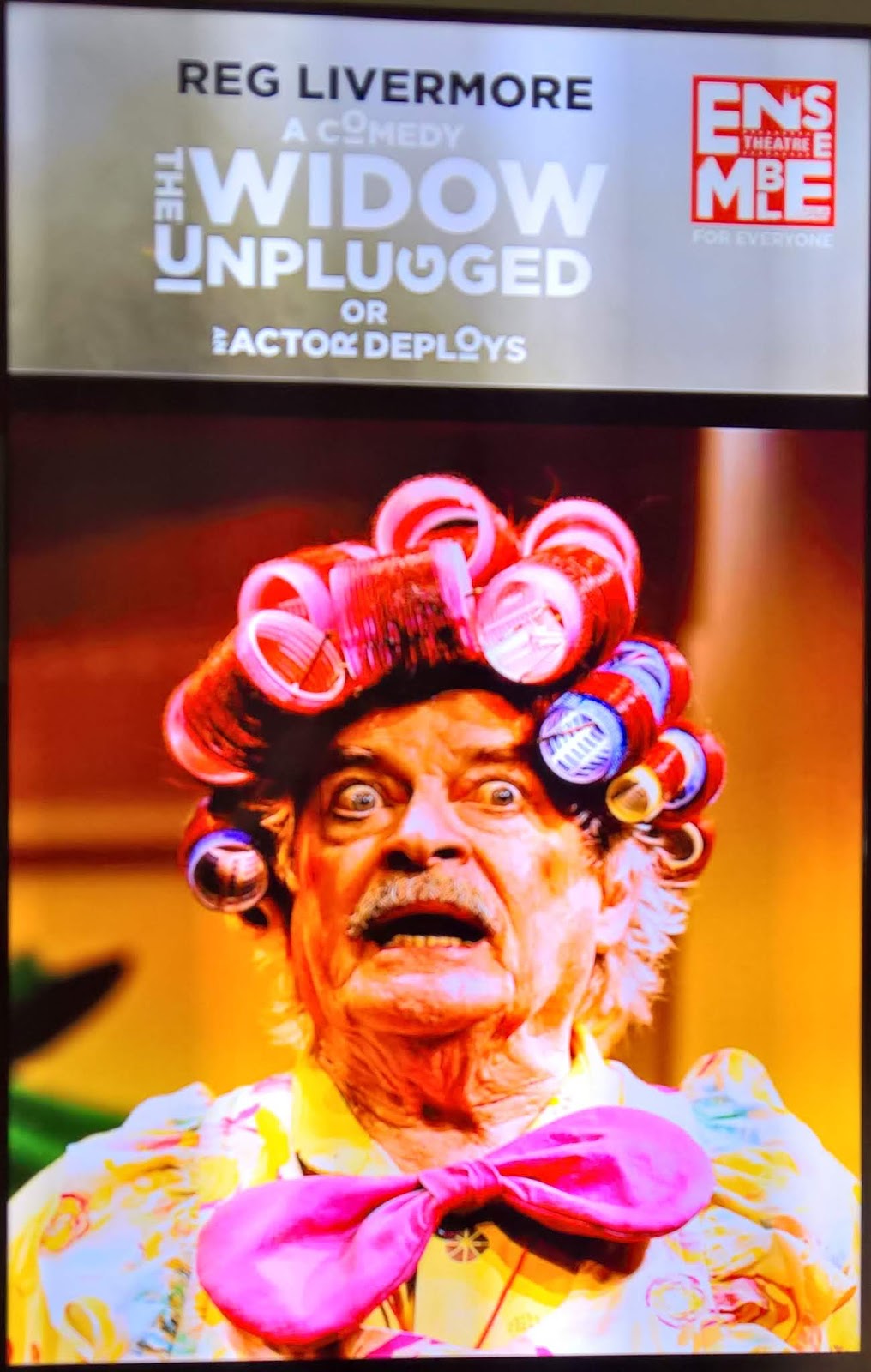
2018: The Widow Unplugged by Reg Livermore

The Widow Unplugged or An Actor Deploys written and performed by Reg Livermore.  Ensemble Theatre, Sydney, July 26 – September 1, 2018.

Director – Mark Kilmurry; Set and Costume Designer – Charles Davis; Lighting Designer – Christopher Page
Reviewed by Frank McKone
August 19

I reckon Arthur Kwick, janitor, employed by awfully wealthy Gina Rinestone, CEO of Time and Tide Nursing Home, not only to keep the place clean (no swearing) and proper (what, no drinking!!?) but to keep the “children” entertained, got a bit confused about 1969.  It seems from his published history that his alter ego Reginald Liveforevermore didn’t actually play Widow Twankey in the pantomime Aladdin that year, but acted in The Mikado in a revue devised by William Orr at the Doncaster Theatre Restaurant, Kensington, Sydney.

This news is important as you will find later, but in the meantime you will enjoy absolutely this ockergenarian vaudevillain, full to the goog as he is of malapropisms galorious.  Since most of the Sunday afternoon audience at The Ensemble were, like me, about as old as Kwick and his creator – approaching 80 – it didn’t seem odd to find ourselves enrolled as a bit past it, needing to have things explained.  Laugh?  You wouldn’t believe it!

Now in straight review mode, let me explain that Reg Livermore is certainly not past anything.  He is as spry, verbally and intellectually on the ball as he was as Alfred P Doolittle in Opera Australia’s terrific My Fair Lady when he was still only 78 last year (reviewed here August 31, 2017).  He didn’t tell us, as Arthur Kwick, how he had trained with Hayes Gordon as a founder member of The Ensemble Theatre-in-the-Round in the late 1950s.  Like Kwick, my memory can be a bit unreliable nowadays, but it’s quite likely I saw the real Reg in Tom Stoppard’s The Real Inspector Hound in 1969, perhaps when I took students to observe Hayes Gordon directing a rehearsal (though that may have been for The Effect of Gamma Rays on Man-In-The-Moon Marigolds by Paul Zindel in 1971, which Reg wasn’t in).

I may seem to be rambling a bit, but this is how Livermore’s play works – wandering through the memories – at least for the first 45 minutes.  Then after an interval (essential for a visit to the dunny by that time), we see Reg as Kwick, as the Widow Twankey.  I had forgotten, from my very young days in England, how Aladdin was supposed to be a middle-eastern story (by those people with that religion, says Kwick – what’s it called?  You know with the mosques – that’s right, the Mosquitoes).  But Aladdin’s mother, Widow Twankey, runs a Chinese laundry (including laundering money, says Kwick), and racist Chinese jokes abound.  How did this happen?  Go to Wikipedia as I did, and you find that Kwick’s characterisation is true to the tradition: 
https://en.wikipedia.org/wiki/Widow_Twankey .  So Reg has done his homework – but I just wondered if his acting in The Mikado in 1969 had got mixed into Kwick’s story of acting Widow Twankey in that year for J.C. Williamson.
http://www.reglivermore.com/history.html

The importance of Livermore’s show is how, behind the humour, there is a story of an insecure living.  Arthur Kwick has a sad ending, as at the last a nurse cheerfully settles him in his bed in the tiny attic room that Gina Rinestone has given him.  He works for no more than board-and-lodging, and we realise – with sympathy and appreciation for the entertainment he has given us – that his erratic storytelling means he is really just another of the “children”, whose only way out is “through the back door”.

On the serious side, here we see in action the theme of the current Platform Paper by Mark Williams called Falling Through the Gaps (Currency Press) about “Our Artists’ Health and Welfare” (see this blog August 10, 2018). As Williams notes, “At the welfare level, there are terrible dangers of falling through the gaps between psychic satisfaction and material security in their career path” and he mentions the fact that fame as an actor does not imply wealth or even health.  In Livermore’s play, Gina Rinestone (ie Australia’s wealthiest woman) is the opposite of Arthur Kwick, the dedicated actor sleeping on the streets after his men’s home burns down (not because they were smoking, he assures us). 

He talks his way into the janitor’s job (that’s the skill he has as an actor): though it’s only one step up from the vagrant’s home, and Gina won’t let him smoke, it’s the best security he can get – at the age of nearly 80.  Of course, it’s not my place to ask personal questions, but Reg Livermore’s Arthur Kwick ends up in the same place as Helen Mitchell, that is Dame Nellie Melba, who died in poverty.

Let’s just hope that Reg will live for quite a while yet, even though Liveforevermore is just my little joke.  He has an AO award already, and now deserves to be gonged a Living Treasure.


Left:
Dan Leno
as Widow Twankey
Theatre Royal
Drury Lane
London 1896
Photo: Alfred Ellis

Right:
Reg Livermore as Arthur Kwick as Widow Twankey


© Frank McKone, Canberra

Wednesday, 13 September 2017

2017: The Exotic Lives of Lola Montez by Jackie Smith


Lola Montez
painting by Joseph Karl Stieler, 1847
The Exotic Lives of Lola Montez by Jackie Smith.  Presented by Finucane & Smith at Tuggeranong Arts Centre, Canberra, Wednesday September 13, 2017.

An evening of gathering in the bar from 7.30 pm, attending the stage performance by Caroline Lee as Lola and Holly Durant as a Parisienne Dance Siren, followed by the post-show Lola Lounge from 9.30 pm.

Director – Moira Finucane; Composer – Darrin Verhagen & Ben Keene; Choreography – Moira Finucane & Holly Durant; Designed by Finucane & Smith with Keon Couture, Melbourne

Reviewed by Frank McKone

There are some very weird thoughts arising from Jackie Smith’s version of the true life of Lola Montez.  Did, for example, the Irishman George Bernard Shaw (I’ve just seen My Fair Lady) consciously or unconsciously name his Pygmalion heroine Eliza after Eliza Gilbert of County Sligo, the daughter of a very ordinary army officer, born in 1821, who became the extraordinary “Lola Montez”?  There’s real evidence parallel to Eliza Doolittle’s achievement in being recognised as a Hungarian princess in Eliza Gilbert’s love affair with King Ludwig of Bavaria, causing him to abdicate during the revolution of 1848.

How did Moira Finucane (whose name is the “reduced Anglicized form of Gaelic Ó Fionnmhacáin 'descendant of Fionnmhacán', from fionn 'fair' + the diminutive of mac 'son'”) come up with such extraordinary choreography?  Perhaps she and Holly Durant binge-watched YouTubes of Isadora Duncan (especially as danced by Vanessa Redgrave in the 1969 movie), picked up on the idea of Lola Montez’s Spider Dance (aka Tarantula, or Tarantella), and invented a manic fantasy version.

Manic seems to be the right word for Eliza Rosanna who told stories about her mother’s supposed Spanish origin when it is more likely that she was the illegitimate daughter of a wealthy Irish Member of Parliament; who gave herself Spanish Christian names Maria Dolores as well as the stage name Lola Montez; who claimed to have been the mistress of Franz Liszt, Alexandre Dumas, and Alexandre Dujarier, part-owner of La Presse; who really was given the title Countess Marie von Landsfeld by King Ludwig I; and who died as Mrs Eliza Gilbert (her father’s surname) when her first marriage was to Lieutenant Thomas James.

During her short lifetime she was variously described as determined as a child; kindly and friendly in her later years; but demanding and manipulative throughout.  Jackie Smith has very effectively used the device of our seeing her tell her stories and perform for us as if she is present today, revealing all those characteristics as she smiled and made us laugh while we could never quite be sure she was actually telling the truth.  Though she quoted the claims that she had died at various times, saying they were all ‘wrong’, she never mentioned her actual burial on 17 January 1861 in Greenwood cemetery, Brooklyn, reported a few days later in the New York Times.

The point was that Lola has never died because she represents the ‘new woman’ who made her own way in life against all the patriarchal conventions, and is therefore a model for women today who still face male domination every day.  Lola gave a tongue-lashing to men like me several times in the play.  Having reviewed Finucane & Smith's The Burlesque Hour (2009) and Glory Box (2012), I can see why they have given Lola Montez her rightful place in history.

I hope, though, that Moira, Jackie and Holly will take my criticism as praise, rather than literally whip-lash me as Lola was said to have done to the editor of the Ballarat Times in 1855.


© Frank McKone, Canberra

Saturday, 4 February 2012

2012: Pygmalion by George Bernard Shaw

Pygmalion by George Bernard Shaw, directed by Peter Evans. Sydney Theatre Company at Sydney Theatre, February 4 to March 3, 2012

Reviewed by Frank McKone
February 4
Photos by Brett Boardman
Andrea Demetriades
Garn!  Oh do buy a flower off me, Captain

I have so much to write about this quite startling production that I’m a bit afraid of boring you with my excitement. If this happens, you can take it that I’m rather too much like Professor Henry Higgins – so determined to push through his bet with Kim Gyngell’s genuinely sincere Colonel Pickering, and sooo bored as soon as he saw that his Eliza would pass as a duchess at the garden party. Everyone in the audience was absolutely on Andrea Demetriades’ side when she threw the precisely aimed slippers at Marco Chiappi, even including boring old farts like me. Actually I have a suspicion they were meant to miss and fly off-stage, since Chiappi had to kick one off ready for Eliza's line deadpan “Your slippers.” But we were very satisfied that Demetriades hit her target.


Andrea Demetriades and Marco Chiappi
I knew you'd strike me one day


Bernard Shaw was always a favourite playwright of mine, and now I know why. It’s just wonderful to watch a production where Shaw’s special kind of language is recognised thoroughly, showing that this most popular of his plays is not populist and certainly anything but sentimental. Sentimentality was anathema to Shaw. There is no way Eliza will go back to Higgins, and Peter Evans' direction shows why.

So I am happy that the playwright has been properly respected, because this production shows how his dialogue reveals his characters in the context of their society, and in doing so makes universal the complexities of human relationships which ring as true today as when Pygmalion was written, exactly a century ago. For me, as a long-time student of Shaw’s work, it’s great to see how Pygmalion is an important development in Shaw’s capacity to integrate character and polemics, in a direct line from previous plays like Candida, Arms and the Man and Major Barbara, leading 10 years later to his Nobel Prize winning Saint Joan.

The startling quality of Evans’ work is in using an unencumbered open black stage for a work which traditionally has required a realistic representation of the columns of Covent Garden, the bachelor pad at Wimpole Street, the sensible opulence of Mrs Higgins’ morning room, and on film scenes of a royally appointed ballroom. Instead the design here seems to me to have been strongly influenced by the cartoon-like illustrations by Feliks Topolski done for the Penguin publication of Shaw's original screenplay.

Voice over, video projection and the use of laptop and monitors to represent Higgins’ recording equipment, with furniture and props brought on and off as part of the action, bring this production into the post-modern era. By obviously exposing the fact that this is actors performing on a stage, using modern technical devices, while keeping strictly to Shaw’s original dialogue, Evans focusses our attention on the meanings, implicit and explicit, of what the characters say. The result is that the humour is funnier because the implications (for example of David Woods’ on-the-take Alfred Doolittle complaining about being thrust unwillingly into the middle class instead of retaining the freedom of being ‘undeserving poor’) become apparent on many different levels at once. The same is then true for the clashes between Eliza and Higgins, which reach tragic proportions on this stage. This is no My Fair Lady. More like Heartbreak House.

At interval I talked with Bob Ellis who was doubtful, in his characteristic ennui-style manner, about what seemed to be an unnecessary anachronism of laptop and monitors being referred to by Higgins as a phonograph. By the end of the play, however, as Higgins/Marco pursued Eliza/Andrea backstage with a live video camera, catching just a brief shot of her reflection in her dressing room mirror, I saw the purpose of the modern technology. The mirror image was a symbol built up on screen from the early scene at Wimpole Street when Deborah Kennedy’s incisive Mrs Pearce had reported how Eliza was too embarrassed to see herself naked in the bathroom mirror. The use of video established this as a play of symbols, issues and relationships, creating much more meaning in the drama than I have seen before, but which I have always felt needed to be revealed when reading the script.

With casting – Wendy Hughes as the redoubtable Mrs Higgins, Vanessa Downing as terribly conventional Mrs Eynsford Hill, Harriet Dyer as her daffy daughter Clara, Tom Stokes as love-struck Freddy, as well as Deborah Kennedy, David Woods, Kim Gyngell, Marco Chiappi and especially (remember her in Crownies) Andrea Demetriades – being spot-on, costumes exactly right (with modern styles reflecting the intentions of the 1912 originals), lighting, sound and video highly effective, and the visual effects of movement and use of space all working together, I must conclude by saying that I was never even faintly bored – not bloody likely.

The enthusiastic continuing applause supported my feelings, but I didn’t stay for the after-first-night drinks, and didn’t see Bob Ellis again. It would be interesting to know his final thoughts in the dark night.

© Frank McKone, Canberra
 I want to know what I may take away with me.
I dont want to be accused of stealing.

Wednesday, 8 June 2011

2011: In the Next Room or the vibrator play by Sarah Ruhl

In the Next Room or the vibrator play by Sarah Ruhl.  Sydney Theatre Company at Canberra Playhouse, directed by Pamela Rabe.  June 8-11, 2011

Reviewed by Frank McKone
June 8

Only two years after its first production at Berkeley Rep, it’s good to see Sydney put on a play described by one of its first commentators (Rachel Swan in the East Bay Express) as ‘a pretty progressive play, even by 2009 standards’.  I am sure that most of the Canberra audience last night was much more sophisticated than I am, and their delight in this rare kind of comedy suggests they are pretty progressive too.  At interval a friend asked if I had “learnt anything new”.  It was a trap question, of course, so I mumbled vaguely rather than reveal my ignorance.

I’ll return later to the play and its writer, because there’s lots there to think about. 

But I want to begin by praising Pamela Rabe, and her cast Jacqueline McKenzie (Catherine Givings – the vibrator’s wife), David Roberts (Dr Givings – the vibrator), Helen Thomson (Sabrina Daldry – the first to be vibrated), Marshall Napier (Mr Daldry – her non-vibrant husband), Mandy McElhinney (Annie – the vibrator’s assistant and a vibrator in her own right), Sara Zwangobani (Elizabeth – the wet nurse who understands) and Josh McConville (Leo Irving – the artist and the second to be vibrated).

Equally praiseworthy is the designer, Tracy Grant Lord and her team led by Hartley T A Kemp (Lighting Designer), Iain Grandage (Composer/Sound Designer), Laura A. Proietti (Wigs, Hair & Make Up Supervisor), and Charmian Gradwell (Voice & Text Coach).  A large part of the particular success of this production was how the set, costumes, hair-dos, lights and sound gave the actors exactly the environment to allow their characters to spark.

And spark they certainly did, in more ways than one.  Being a bit too much like Dr Givings myself, I loved the moment when he sees that Mrs Daldry needs an extra boost, turns the vibrator up to maximum and blows every Edison light in the house.  Isn’t it great to be a technician?

Each actor had strengths with no noticeable weak points, so none can be honestly awarded more praise than any other in such a tight ensemble, but there were special moments for me. 

One was the depth of character expressed by Sara Zwangobani as Elizabeth announces her decision to leave Catherine’s employ as a wet nurse – such bitterness held in check by her maturity of understanding took this role far beyond a matter of simple racist discrimination.  Her speech opened up the whole issue of universal human rights.

At the other end of the scale was the brief exit of Marshall Napier’s Mr Daldry as he realises that he has to walk out to see Catherine’s garden and leave her and his wife alone together.  Perhaps he is mainly responding to Catherine’s vivacity, but he also recognises Sabrina’s new-found sense of authority.  Probably he can’t explain to himself why he should go, but he knows he must.

These are only two examples which show why I am so pleased to see a modern play offer the actors the opportunity for such finesse.  This brings me to the play itself.

One commentator mentioned that the set is deliberately similar to that of Henrik Ibsen’s Hedda Gabler, and I found myself thinking of another playwright also influenced by Ibsen: George Bernard Shaw, still famous in the popular mind today for Pygmalion and its musical version My Fair Lady.  Shaw was a progressive playwright in his day.  He didn’t mention vibrators but he wrote about attitudes towards women’s sexuality in 1892 only a decade or so after the technically advanced Americans in Ruhl’s play were discovering how to treat hysteria with ‘paroxysms’.  In Mrs Warren’s Profession Shaw wrote a comedy about Mrs Warren’s Cambridge educated daughter being horrified to find that her mother financed her daughter’s education by running a brothel.

Mrs Warren’s Profession was banned by the Lord Chamberlain because of its ‘frank discussion and portrayal of prostitution’, getting its first production after 10 years in the members-only New Lyric Club in 1902 and waiting for its first public performance in London until 1925.  Interestingly, ‘it had a performance in New York, this time on a public stage in 1905, [which] was interrupted by the police who arrested the cast and crew, although it appears only the house manager of the theatre was actually charged.[citation needed] The play has been revived on Broadway five times since, most recently in 2010.’  [Wikipedia accessed 9 June 2011]

Well, how does Ruhl compare to Shaw?  First, however progressive she may be, it seems that the re-enactment of orgasms on stage has not caused the arrest of the cast and crew, despite present-day public concerns about pornography.  Maybe this is because Ruhl has set her play in the prudish Victorian era in the past (now 130 years ago), whereas Shaw’s play was set in his own time – the actual prudish Victorian era.  In the official 1912 Constable edition, Shaw’s preface, called The Author’s Apology, made no apology at all for refusing to write a conventional sentimental romantic comedy and having his characters speak and behave as real people would.

Ruhl, in re-creating the language of the past era, has written at least as cleverly as the famous wordsmith Shaw.  Her comedy grows from the fact that her characters avoid direct description, yet we know today exactly what they mean.  Shaw’s comedy drew on characters saying exactly what they mean in a society that wishes they didn’t.  The one quote, of course, which has come down to us from Shaw is Eliza’s innocent exclamation in Pygmalion: ‘Not bloody likely.’  

So one thing I learnt from In the Next Room or the vibrator play is that Sarah Ruhl well deserves the prizes she has been awarded (Glickman Prize and finalist for Pulizter Prize), and that she is writing in a tradition which I find thoroughly satisfying.

© Frank McKone, Canberra

Saturday, 16 March 2019

2019: How to Rule the World by Nakkiah Lui

Michelle Lim Davidson, Nakkiah Lui, Anthony Taufa


How to Rule the World by Nakkiah Lui.  Sydney Theatre Company at the Sydney Opera House Drama Theatre, February 11 – March 30, 2019.

Reviewed by Frank McKone
March 16


2430 years ago, Aristophanes ripped into the stupidly destructive power play between ancient Sparta and his home town Athens in his satiric play Lystrata.  The women made it plain: no sex until you stop fighting.

William Shakespeare began his lifetime criticism of the rule of absolute monarchs (ie Queen Elizabeth) in the 1580s (Henry VI, Richard III) but soon realised he had to write obliquely, for his own safety, and turned to comedy (The Comedy of Errors and Taming of the Shrew)

In 1677 Aphra Behn established the place of women writers in The Rover, or The Banish'd Cavaliers, her satiric re-write of Thomas Killigrew’s Thomaso.

As World War I approached, George Bernard Shaw used the ancient Greek myth of Pygmalion in his most enduring comedy of manners, of Professor Henry Higgins and flower-girl Eliza Doolittle, nowadays in the musical form of My Fair Lady.

This is one tradition in which Nakkiah Lui has written How to Rule the World.

Fortunately she is in less physical danger from power-figures than Shakespeare, writing very directly about our current state of political shenanigans through the attempt by a threesome of millennials to create their own white non-entity independent Senator (à la Ricky Muir):

  • a substantial urban educated Aboriginal woman very like the author, and played by Lui herself (Vic),
  • a quite diminutive Asian immigrant-family woman, equally urban and educated, (Zaza, played by Michelle Lim Davidson)
  • and a Kanaka-family Pacific Islander, physically large and assumed by whites to be a bouncer – but also highly urban and educated (Chris played by Anthony Taufa).

The action focusses on their Pygmalionic choice, Lewis Lewis – a blank-slate with no family or friends nor any interests, especially in politics – who becomes 'Tommy Ryan' (I wondered if Lui knew about Thomaso), but who has one secret to be revealed in the play’s climactic point.  Hamish Michael is remarkable in this comic role (remember the slightly gormless Richard Stirling in The Crownies?), in a complete personal development transition from blankness to prime ministership.

The dramatic tension is built around the upcoming federal election in the first half, and the result in the Senate for the incumbent Prime Minister, played with elegant flair by Rhys Muldoon.

And just watch out for the amazing array of characters played by Vanessa Downing and Gareth Davies, including something vaguely akin to Barnaby J.

To tell you in more detail how this cleverly constructed absurdist satire progresses would be a spoiler.  Each scene and shift between scenes is surprising.  From the beginning we, watching, were in fits of laughter, eyes filled with tears.  At the very end, the satire bites – only the tears remain, in a play about the universal conflict between two human needs: for love and for power; for compassion and for success; for the personal and the political.

It is this depth at the core of the satire that firmly places Nakkiah Lui in this long theatrical tradition.

The directing, design (set and costumes), lighting, video, sound and terrifically comic choreography have come together in a triumph for the Sydney Theatre Company – acknowledgements below.  If there have been concerns about the tendency of the major performing arts companies to favour the ‘classics’ rather than put new Australian writing on stage, STC has broken the mould with How to Rule the World.  This is a classic.

But Nakkiah Lui fits neatly into her other tradition as well, beginning with the classic storytelling, of the shape-changing characters, going back over the tens of thousands of years of her Australian Aboriginal culture.  We saw these in Songlines: Tracking the Seven Sisters, the recent exhibition at the National Museum of Australia, created by the Mardi and many other peoples from Western Australia, from a base in Roebourne.  It’s a long way from Sydney, but make a visit to see the local women artists at work there, as I have, and you’ll begin to see the connections.

How to Rule the World satirises not only the inequities, subterfuge and hypocrisy of our European political system which cartoonists from James Gillray in 18th Century England to our David Pope in today’s centre of government, Canberra, have pilloried and exposed; but Lui also does what a satirist must – laugh at her own culture.  And so, in her play, Lui shows her recognition of the same lack of ethics and breakdown of political unity among her three who seek to game the parliamentary system, and by implication shows that politics in any human society, including her own, is prey to the desire for achievement at any price.

The final speech of the play – given by Vic, magically appearing out of custody – seeking Treaty, to complete unfinished business, is no longer funny, not just a criticism of ‘white’ rule, but tinged with sadness for everyone’s failure…so far, at least.


© Frank McKone, Canberra

Friday, 20 March 2026

2026: The Dear Departed - Live Radio Play. Mill Theatre


The Dear Departed: Live Radio Play originally by Stanley Houghton, adapted for radio by Bart Meehan,  Mill Theatre, Dairy Road, Canberra March 20-28 2026.

Reviewed by Frank McKone
March 20

Cast
Andrea Close: Amelia Slater; Sarah Hartley: Victoria Slater (20-21 March)
Aleksis Andreitchenko: Victoria Slater (27-28 March)
Richard Manning: Henry Slater  
Helen McFarlane: Elizabeth Jordan; Timmy Sekuless: Ben Jordan 
Graeme Rhodes: Host and Abel Merryweather 

Production Team
Playwright: Stanley Houghton
Adapted by Bart Meehan and Lexi Sekuless
Director: Lexi Sekuless
Stage Manager: Ciara Ford

Mill Theatre shows itself in a new light – light entertainment in a Live Radio Play, saying This production revives the tradition from the 1930s to the 1950s, inviting you to watch the mechanics of storytelling in real time: actors at microphones, sound effects created live, music underscoring the action — and a brand-new recording captured every night. It’s theatre, radio, and time travel all at once.

But I have some doubts, not about the performances but about the purpose of choosing this playscript and what might have been done to make this clear to the audience.

William Stanley Houghton (1881–1913) was an English playwright who wrote the original play for the stage in 1908.  The Dear Departed was amusing in its day, and remained popular, being adapted to fit within the history of BBC Radio Theatre's exploration of social issues and comedy, and broadcast on a number of occasions, in different adaptations, through the 1970s.

But in this local Canberra adaptation by ANU’s Bart Meehan and Lexi Sekuless, playing the Slater and Jordan families as old-fashioned English toffs, for we colonials to denigrate, actually loses part of the point of the play that Houghton wrote.

He was writing in parallel to the more famous (and much more substantial playwright) George Bernard Shaw who had recently written How He Lied to Her Husband and Major Barbara in 1905.  Houghton, like Shaw, was keen on presenting ordinary – i.e. working class – people while raising difficult issues, like family inheritance, in The Dear Departed.

The UK Wimbourne Drama Club, for their recent stage production, have pointed out that Houghton was a leading figure of the Manchester School of dramatists, but have published an un-named reviewer saying “Apparently rewritten to make it adaptable to any locale, Stanley Houghton’s well-known comedy, ‘The Dear Departed’, retained all the humorous situations but the dialogue – from the North Country idiom, and dialect – lost much of its impact.”
https://wimbornedramaproductions.com/productions/past/the-dear-departed/

Though I could easily laugh along last night, making fun of the English upper class made for too easily predictable jokes – including how obvious it was that Grandpa would rise from the ‘dead’ – while I can imagine doing it in Beatles’ accents (although they were from Liverpool, not Manchester), and emphasising the awfulness of the daughters’ attitudes towards their struggling working class drunkard father.  Then the laughter has a black edge which applies to us all.

I rather like to think that Shaw saw The Dear Departed, and then wrote Pygmalion (1913)  - which, of course, then was made lighter (but still funny) as a musical in My Fair Lady.

So Mill Theatre has done the good thing by going a bit off the beaten track, but I think the entertainment might have been a bit less light.

As I said, though, the performances were excellent, with changing voice modes and noises off all cleverly done.  I once saw a video of The Goon Show being live broadcast, with Peter Sellers making it even funnier for his acting colleagues in the studio,  as well as for the listeners.

The Dear Departed – Live Radio Play works very well, and you should focus especially on the Radio Presenter Graeme Rhodes, and his amazing transition into Abel Merryweather.

Highly recommended. 

©Frank McKone, Canberra

Thursday, 8 May 2008

2008: It Was That Way When I Got Here by Andrew Hackwill and Jonathan Flack

It Was That Way When I Got Here.  Musical comedy written and directed by Andrew Hackwill and Jonathan Flack.  A PhoenixRising world premiere, Phoenix Players at Theatre 3, May 8, 9 and 10 at 8pm; 10 and 11 at 2pm.

It’s hard to imagine such a zany funny musical running for only five performances.  Under the direction of Ian McLean the 1st XV Orchestra is terrific, there is a wealth of good singing from men and women, costumes by Christine Pawlicki are bright and hilarious, dancing is disciplined (by Lisa Buckley), set (by Brian Sudding) is simple, lit well and works perfectly. 

The songs are witty, reminding me of anything from Gilbert and Sullivan to My Fair Lady, and each is a take-off of a different style from Gospel to Sondheim, with a special nod at the smooth Dean Martin.  The plot is a bit hard to follow at times, but that is as it should be in this wildly multicultural school which I could only see as a truly Australian iconoclastic kind-of Catholic version of Vicar of Dibley madness.  Certainly not politically correct, and with many sexual references.

The only problem on opening night was audio balance - the band often drowned the singers - made worse by radio mikes working intermittently.  But the cast were so well-rehearsed that no-one missed a beat.  Though, at the end of the day, this is a production by a local community theatre group with the attendant difficulties that a fully professional theatre company would not face, I am sure there would be a willing audience for a longer season which the commitment and obvious enjoyment of the cast and musicians deserve.

The Phoenix Players’ PhoenixRising program to help new writers get their work on stage has paid off with It Was That Way When I Got Here. It’s thoroughly madcap, but there is some method after all in a priestly-robed school principal carrying his “bible”, entitled Religion for Dummies. Enough said.  Enjoy.

©Frank McKone, Canberra